Heyland Daren K, Elke Gunnar, Cook Deborah, Berger Mette M, Wischmeyer Paul E, Albert Martin, Muscedere John, Jones Gwynne, Day Andrew G
Kingston General Hospital, Kingston, Ontario, Canada
University Medical Center Schleswig-Holstein, Campus Kiel, Kiel, Germany.
JPEN J Parenter Enteral Nutr. 2015 May;39(4):401-9. doi: 10.1177/0148607114529994. Epub 2014 May 5.
The recent large randomized controlled trial of glutamine and antioxidant supplementation suggested that high-dose glutamine is associated with increased mortality in critically ill patients with multiorgan failure. The objectives of the present analyses were to reevaluate the effect of supplementation after controlling for baseline covariates and to identify potentially important subgroup effects.
This study was a post hoc analysis of a prospective factorial 2 × 2 randomized trial conducted in 40 intensive care units in North America and Europe. In total, 1223 mechanically ventilated adult patients with multiorgan failure were randomized to receive glutamine, antioxidants, both glutamine and antioxidants, or placebo administered separate from artificial nutrition. We compared each of the 3 active treatment arms (glutamine alone, antioxidants alone, and glutamine + antioxidants) with placebo on 28-day mortality. Post hoc, treatment effects were examined within subgroups defined by baseline patient characteristics. Logistic regression was used to estimate treatment effects within subgroups after adjustment for baseline covariates and to identify treatment-by-subgroup interactions (effect modification).
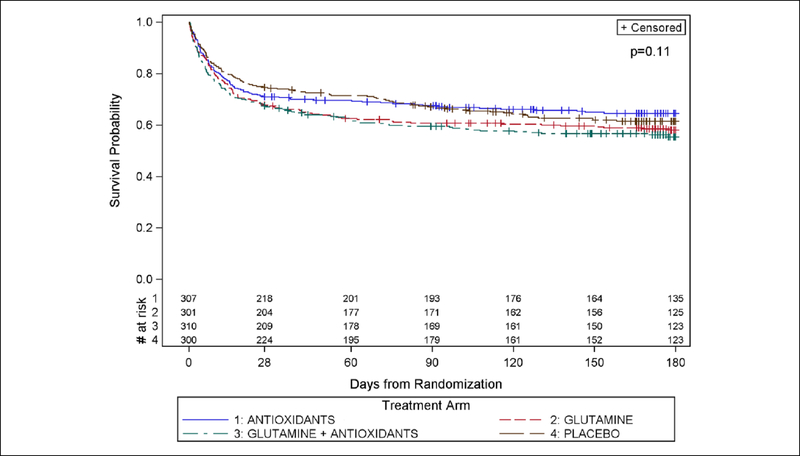
The 28-day mortality rates in the placebo, glutamine, antioxidant, and combination arms were 25%, 32%, 29%, and 33%, respectively. After adjusting for prespecified baseline covariates, the adjusted odds ratio of 28-day mortality vs placebo was 1.5 (95% confidence interval, 1.0-2.1, P = .05), 1.2 (0.8-1.8, P = .40), and 1.4 (0.9-2.0, P = .09) for glutamine, antioxidant, and glutamine plus antioxidant arms, respectively. In the post hoc subgroup analysis, both glutamine and antioxidants appeared most harmful in patients with baseline renal dysfunction. No subgroups suggested reduced mortality with supplements.
After adjustment for baseline covariates, early provision of high-dose glutamine administered separately from artificial nutrition was not beneficial and may be associated with increased mortality in critically ill patients with multiorgan failure. For both glutamine and antioxidants, the greatest potential for harm was observed in patients with multiorgan failure that included renal dysfunction upon study enrollment.
近期关于补充谷氨酰胺和抗氧化剂的大型随机对照试验表明,高剂量谷氨酰胺与多器官功能衰竭的重症患者死亡率增加有关。本分析的目的是在控制基线协变量后重新评估补充剂的效果,并确定潜在的重要亚组效应。
本研究是对在北美和欧洲40个重症监护病房进行的一项前瞻性析因2×2随机试验的事后分析。总共1223例机械通气的多器官功能衰竭成年患者被随机分为接受谷氨酰胺、抗氧化剂、谷氨酰胺和抗氧化剂联合治疗或与人工营养分开给予的安慰剂治疗。我们比较了3个活性治疗组(单独使用谷氨酰胺、单独使用抗氧化剂、谷氨酰胺+抗氧化剂)与安慰剂组的28天死亡率。事后分析中,在根据基线患者特征定义的亚组内检查治疗效果。使用逻辑回归估计在调整基线协变量后亚组内的治疗效果,并确定治疗与亚组的相互作用(效应修正)。
安慰剂组、谷氨酰胺组、抗氧化剂组和联合治疗组的28天死亡率分别为25%、32%、29%和33%。在调整预先设定的基线协变量后,谷氨酰胺组、抗氧化剂组和谷氨酰胺加抗氧化剂组与安慰剂相比,28天死亡率调整后的优势比分别为1.5(95%置信区间,1.0 - 2.1,P = 0.05)、1.2(0.8 - 1.8,P = 0.40)和1.4(0.9 - 2.0,P = 0.09)。在事后亚组分析中,谷氨酰胺和抗氧化剂在基线肾功能不全的患者中似乎危害最大。没有亚组表明补充剂可降低死亡率。
在调整基线协变量后,与人工营养分开给予的早期高剂量谷氨酰胺对多器官功能衰竭的重症患者无益,且可能与死亡率增加有关。对于谷氨酰胺和抗氧化剂,在研究入组时多器官功能衰竭且包括肾功能不全的患者中观察到最大的潜在危害。