Department of Biochemistry, Institute of Post-Graduate Medical Education & Research, 244B, Acharya J. C. Bose Road, Kolkata 700020, India ; Department of Neuroscience, Burke-Cornell Medical Research Institute, 785 Mamaroneck Avenue, White Plains, NY 10605, USA.
Department of Biochemistry, Institute of Post-Graduate Medical Education & Research, 244B, Acharya J. C. Bose Road, Kolkata 700020, India ; Department of Neuroscience, Rosalind Franklin University of Medicine and Science, 3333 Green Bay Road, North Chicago, IL 60064, USA.
Parkinsons Dis. 2014;2014:878935. doi: 10.1155/2014/878935. Epub 2014 Apr 2.
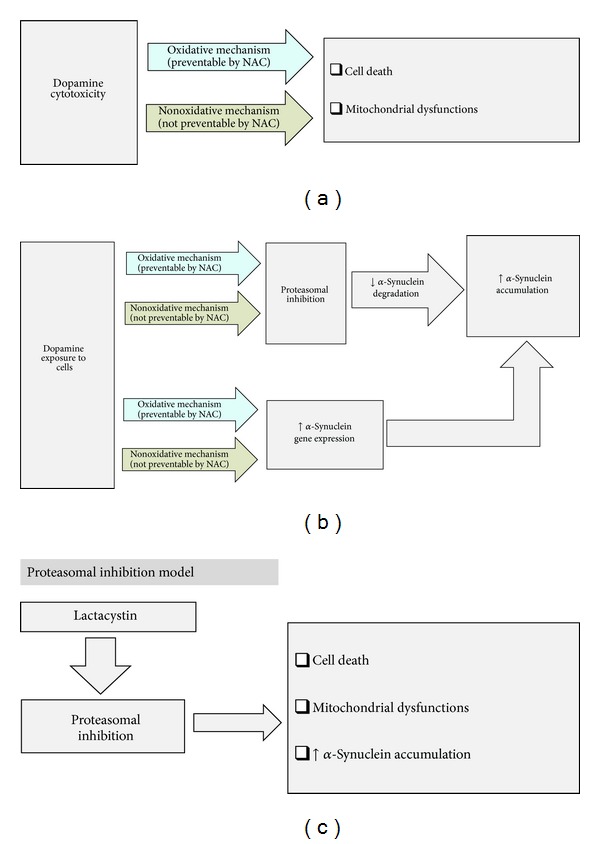
Background. The cytotoxic effects of dopamine (DA) on several catecholaminergic cell lines involve DA oxidation products like reactive oxygen species (ROS) and toxic quinones and have implications in the pathogenesis of sporadic Parkinson's disease (PD). However, many molecular details are yet to be elucidated, and the possible nonoxidative mechanism of dopamine cytotoxicity has not been studied in great detail. Results. Cultured SH-SY5Y cells treated with DA (up to 400 μM) or lactacystin (5 μM) or DA (400 μM) plus N-acetylcysteine (NAC, 2.5 mM) for 24 h are processed accordingly to observe the cell viability, mitochondrial dysfunctions, oxidative stress parameters, proteasomal activity, expression of alpha-synuclein gene, and intracellular accumulation of the protein. DA causes mitochondrial dysfunction and extensive loss of cell viability partially inhibited by NAC, potent inhibition of proteasomal activity marginally prevented by NAC, and overexpression with accumulation of intracellular alpha-synuclein partially preventable by NAC. Under similar conditions of incubation, NAC completely prevents enhanced production of ROS and increased formation of quinoprotein adducts in DA-treated SH-SY5Y cells. Separately, proteasomal inhibitor lactacystin causes accumulation of alpha-synuclein as well as mitochondrial dysfunction and cell death. Conclusions. DA cytotoxicity includes both oxidative and nonoxidative modes and may involve overexpression and accumulation of alpha-synuclein as well as proteasomal inhibition.
多巴胺(DA)对几种儿茶酚胺能细胞系的细胞毒性作用涉及 DA 氧化产物,如活性氧(ROS)和毒性醌,并与散发性帕金森病(PD)的发病机制有关。然而,许多分子细节仍有待阐明,并且多巴胺细胞毒性的可能非氧化机制尚未进行详细研究。
用 DA(高达 400μM)或乳清酸(5μM)或 DA(400μM)加 N-乙酰半胱氨酸(NAC,2.5mM)处理 24 小时的培养 SH-SY5Y 细胞,进行相应的处理以观察细胞活力、线粒体功能障碍、氧化应激参数、蛋白酶体活性、α-突触核蛋白基因的表达和细胞内蛋白的积累。DA 导致线粒体功能障碍和细胞活力的广泛丧失,部分被 NAC 抑制,NAC 轻微抑制蛋白酶体活性,NAC 部分阻止细胞内α-突触核蛋白的过度表达和积累。在相同的孵育条件下,NAC 完全防止 DA 处理的 SH-SY5Y 细胞中 ROS 产生增加和醌蛋白加合物形成增加。另外,蛋白酶体抑制剂乳清酸也会导致α-突触核蛋白的积累以及线粒体功能障碍和细胞死亡。
DA 细胞毒性包括氧化和非氧化模式,可能涉及α-突触核蛋白的过度表达和积累以及蛋白酶体抑制。