Liu Yidan, Li Jianming
Department of Molecular, Cellular, and Developmental Biology, University of Michigan Ann Arbor, MI, USA.
Front Plant Sci. 2014 Apr 30;5:162. doi: 10.3389/fpls.2014.00162. eCollection 2014.
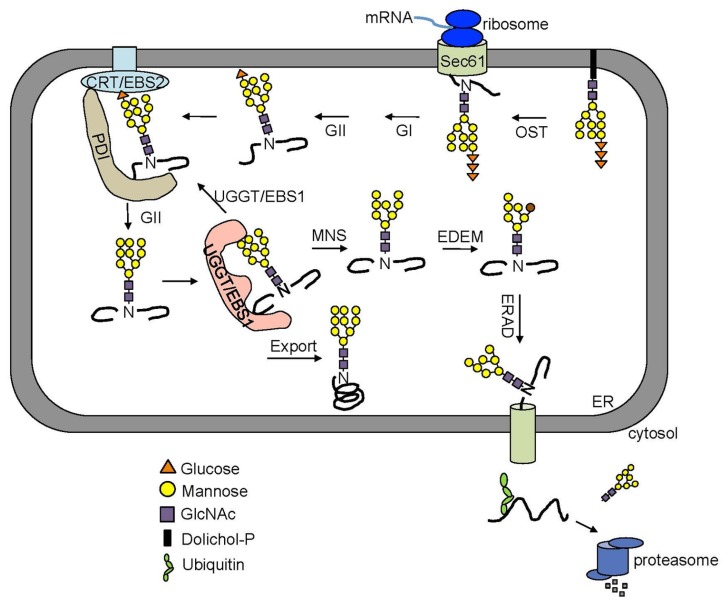
A correct three-dimensional structure is crucial for the physiological functions of a protein, yet the folding of proteins to acquire native conformation is a fundamentally error-prone process. Eukaryotic organisms have evolved a highly conserved endoplasmic reticulum-mediated protein quality control (ERQC) mechanism to monitor folding processes of secretory and membrane proteins, allowing export of only correctly folded proteins to their physiological destinations, retaining incompletely/mis-folded ones in the ER for additional folding attempts, marking and removing terminally misfolded ones via a unique multiple-step degradation process known as ER-associated degradation (ERAD). Most of our current knowledge on ERQC and ERAD came from genetic and biochemical investigations in yeast and mammalian cells. Recent studies in the reference plant Arabidopsis thaliana uncovered homologous components and similar mechanisms in plants for monitoring protein folding and for retaining, repairing, and removing misfolded proteins. These studies also revealed critical roles of the plant ERQC/ERAD systems in regulating important biochemical/physiological processes, such as abiotic stress tolerance and plant defense. In this review, we discuss our current understanding about the molecular components and biochemical mechanisms of the plant ERQC/ERAD system in comparison to yeast and mammalian systems.
正确的三维结构对于蛋白质的生理功能至关重要,然而蛋白质折叠以获得天然构象是一个从根本上就容易出错的过程。真核生物进化出了一种高度保守的内质网介导的蛋白质质量控制(ERQC)机制,以监测分泌蛋白和膜蛋白的折叠过程,仅允许正确折叠的蛋白质输出到其生理目的地,将不完全/错误折叠的蛋白质保留在内质网中进行额外的折叠尝试,通过一种称为内质网相关降解(ERAD)的独特多步降解过程标记并去除最终错误折叠的蛋白质。我们目前关于ERQC和ERAD的大部分知识来自酵母和哺乳动物细胞中的遗传学和生物化学研究。最近在模式植物拟南芥中的研究发现了植物中用于监测蛋白质折叠以及保留、修复和去除错误折叠蛋白质的同源成分和类似机制。这些研究还揭示了植物ERQC/ERAD系统在调节重要生化/生理过程(如非生物胁迫耐受性和植物防御)中的关键作用。在这篇综述中,我们将比较植物与酵母和哺乳动物系统,讨论我们目前对植物ERQC/ERAD系统的分子成分和生化机制的理解。