Wu Lun, Zhi Ye, Sui Zhengwei, Liu Yu
Institute of Remote Sensing and Geographical Information Systems, Peking University, Beijing, China.
China Center for Resources Satellite Data and Application, Beijing, China.
PLoS One. 2014 May 13;9(5):e97010. doi: 10.1371/journal.pone.0097010. eCollection 2014.
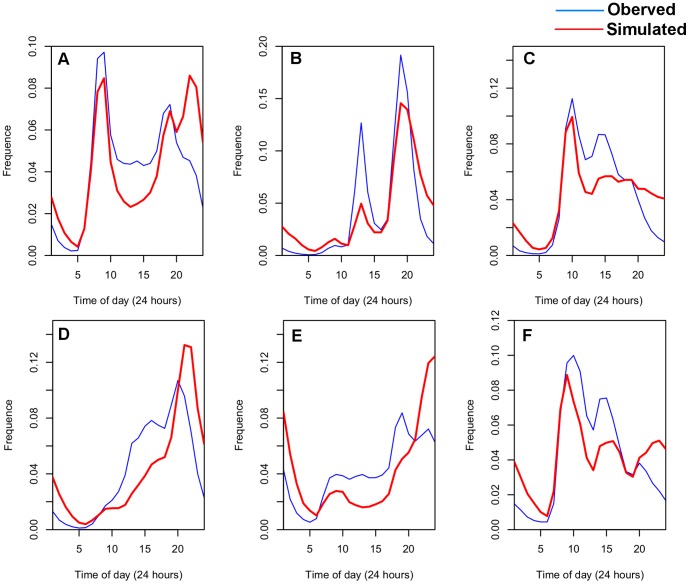
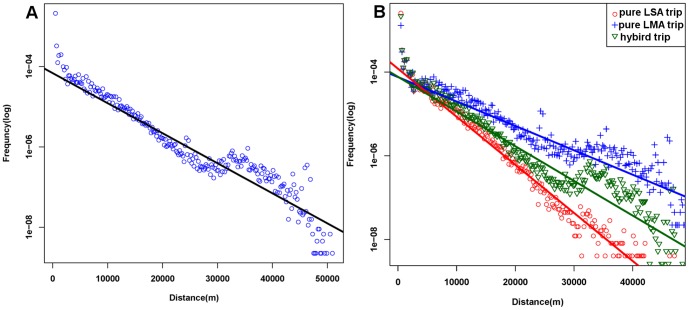
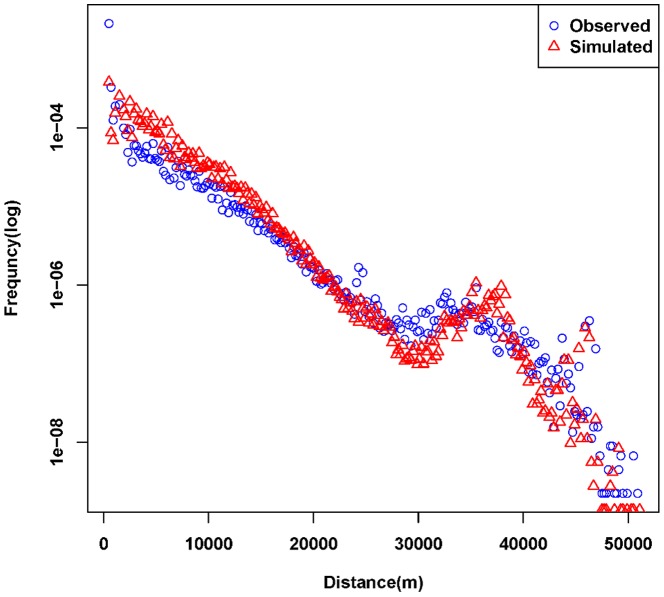
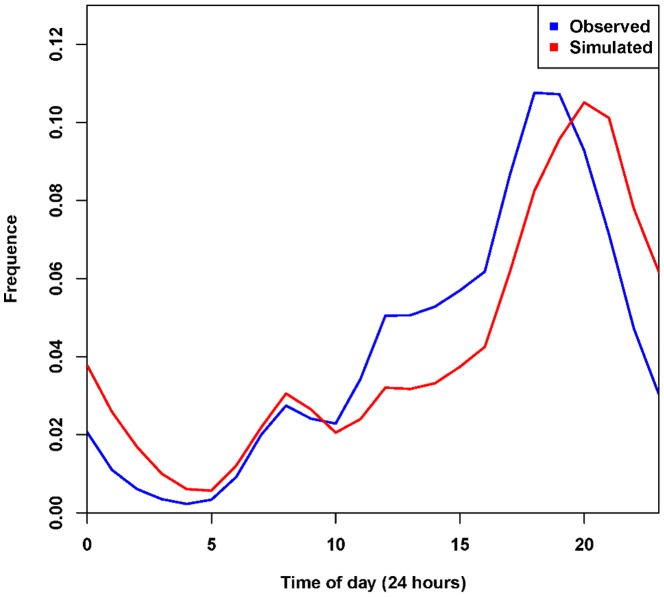
Most existing human mobility literature focuses on exterior characteristics of movements but neglects activities, the driving force that underlies human movements. In this research, we combine activity-based analysis with a movement-based approach to model the intra-urban human mobility observed from about 15 million check-in records during a yearlong period in Shanghai, China. The proposed model is activity-based and includes two parts: the transition of travel demands during a specific time period and the movement between locations. For the first part, we find the transition probability between activities varies over time, and then we construct a temporal transition probability matrix to represent the transition probability of travel demands during a time interval. For the second part, we suggest that the travel demands can be divided into two classes, locationally mandatory activity (LMA) and locationally stochastic activity (LSA), according to whether the demand is associated with fixed location or not. By judging the combination of predecessor activity type and successor activity type we determine three trip patterns, each associated with a different decay parameter. To validate the model, we adopt the mechanism of an agent-based model and compare the simulated results with the observed pattern from the displacement distance distribution, the spatio-temporal distribution of activities, and the temporal distribution of travel demand transitions. The results show that the simulated patterns fit the observed data well, indicating that these findings open new directions for combining activity-based analysis with a movement-based approach using social media check-in data.
大多数现有的人类移动性文献关注移动的外部特征,却忽略了活动,而活动是人类移动的潜在驱动力。在本研究中,我们将基于活动的分析与基于移动的方法相结合,以对在中国上海为期一年的时间里从约1500万条签到记录中观察到的城市内部人类移动性进行建模。所提出的模型是基于活动的,包括两个部分:特定时间段内出行需求的转移以及地点之间的移动。对于第一部分,我们发现活动之间的转移概率随时间变化,然后构建一个时间转移概率矩阵来表示一个时间间隔内出行需求的转移概率。对于第二部分,我们建议根据需求是否与固定地点相关,将出行需求分为两类,即地点强制性活动(LMA)和地点随机性活动(LSA)。通过判断前驱活动类型和后继活动类型的组合,我们确定了三种出行模式,每种模式都与一个不同的衰减参数相关。为了验证该模型,我们采用基于智能体模型的机制,并将模拟结果与从位移距离分布、活动的时空分布以及出行需求转移的时间分布中观察到的模式进行比较。结果表明,模拟模式与观测数据拟合良好,这表明这些发现为使用社交媒体签到数据将基于活动的分析与基于移动的方法相结合开辟了新的方向。