Al Mheid Ibhar, Corrigan Frank, Shirazi Farheen, Veledar Emir, Li Qunna, Alexander Wayne R, Taylor W Robert, Waller Edmund K, Quyyumi Arshed A
Emory University School of Medicine, Atlanta, GA (I.A.M., F.C., F.S., E.V., Q.L., W.R.A., R.T., E.K.W., A.A.Q.).
J Am Heart Assoc. 2014 May 15;3(3):e000845. doi: 10.1161/JAHA.114.000845.
Progenitor cells (PCs) are mobilized in response to vascular injury to effect regeneration and repair. Recruitment of PCs requires intact nitric oxide (NO) synthesis by endothelial cells, and their number and activity correlate with cardiovascular disease risk burden and future outcomes. Whereas cardiovascular vulnerability exhibits a robust circadian rhythm, the 24-hour variation of PCs and their inter-relation with vascular function remain unknown. We investigated the circadian variation of PCs and vascular function with the hypothesis that this will parallel the pattern observed for cardiovascular events (CVEs).
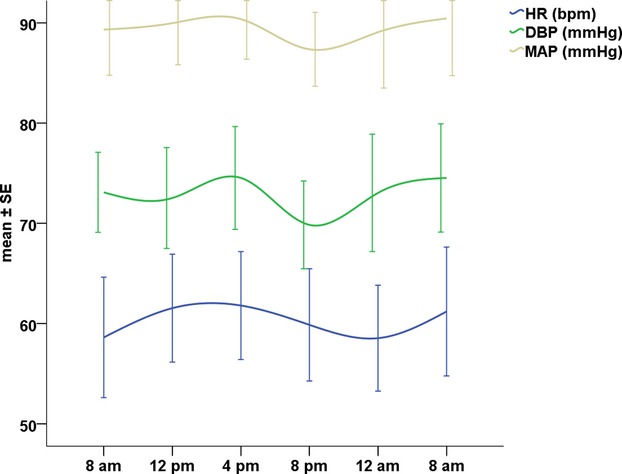
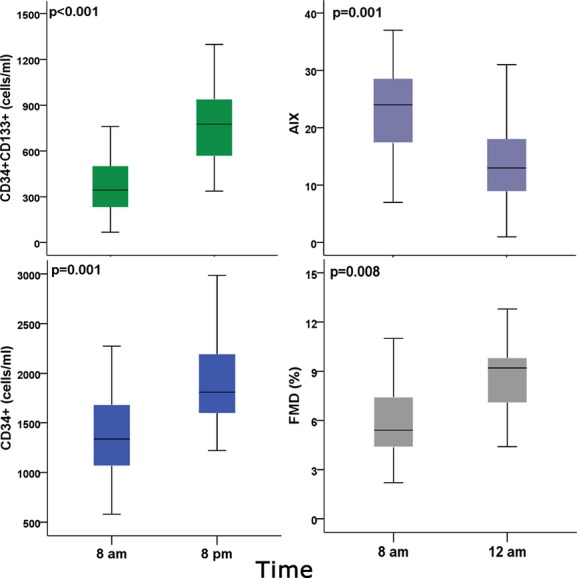
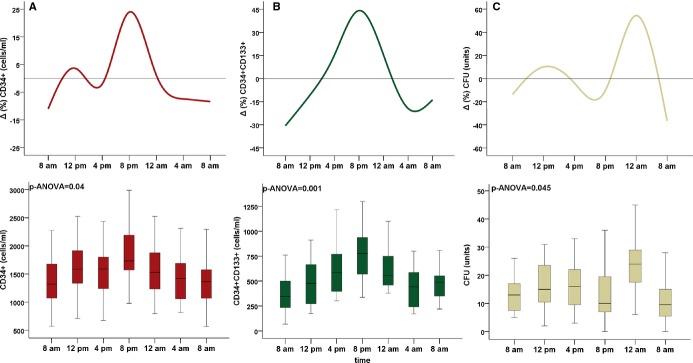
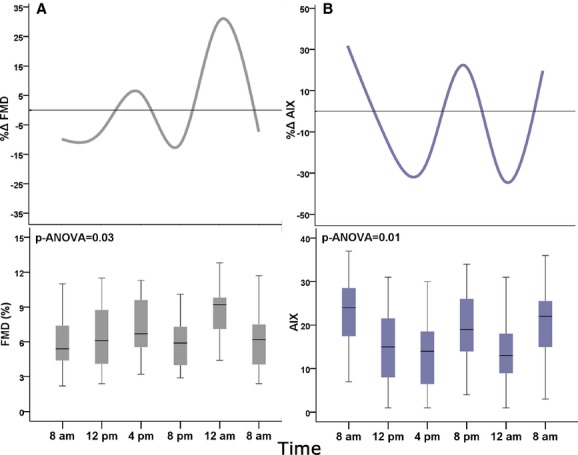
In 15 healthy subjects (9 men, 37±16 years), circulating PCs and vascular function were measured at 8 am, noon, 4 pm, 8 pm, midnight, 4 am (only PCs counts), and 8 am the following day. Circulating PCs were enumerated as mononuclear cells (MNCs; CD45(med)) that express CD34 as well as CD133, and their activity was assessed as the number of colonies formed by culturing MNCs. Vascular function was evaluated by measurement of endothelium-dependent, flow-mediated vasodilation (FMD) of the brachial artery and tonometry-derived indices of arterial stiffness. Higher CD34(+) and CD34(+)/CD133(+) cell counts were observed at 8 pm than any other time of the day (P-ANOVA=0.038 and <0.001; respectively) and were lowest at 8 am. PC colony formation was highest at midnight (P-ANOVA=0.045) and lowest in the morning hours. FMD was highest at midnight and lowest at 8 am and 8 pm, and systemic arterial stiffness was greatest at 8 am and lowest at 4 pm and midnight (P-ANOVA=0.03 and 0.01; respectively).
A robust circadian variation in PC counts and vascular function occurs in healthy humans and both exhibit an unfavorable profile in the morning hours that parallels the preponderance of CVEs at these times. Whether these changes are precipitated by awakening and time-dependent physical activity or governed by the endogenous circadian clock needs to be further investigated.
祖细胞(PCs)会因血管损伤而被动员起来,以实现再生和修复。祖细胞的募集需要内皮细胞完整地合成一氧化氮(NO),并且它们的数量和活性与心血管疾病风险负担及未来预后相关。虽然心血管易损性呈现出强烈的昼夜节律,但祖细胞的24小时变化及其与血管功能的相互关系仍不清楚。我们研究了祖细胞和血管功能的昼夜变化,假设其与心血管事件(CVEs)的模式相似。
在15名健康受试者(9名男性,37±16岁)中,于上午8点、中午、下午4点、晚上8点、午夜、凌晨4点(仅计数祖细胞)及次日上午8点测量循环祖细胞和血管功能。循环祖细胞被计为表达CD34以及CD133的单核细胞(MNCs;CD45(med)),其活性通过培养MNCs形成的集落数量来评估。通过测量肱动脉的内皮依赖性血流介导的血管舒张(FMD)和基于眼压测量得出的动脉僵硬度指标来评估血管功能。晚上8点时观察到的CD34(+)和CD34(+)/CD133(+)细胞计数高于一天中的其他任何时间(方差分析P值分别为0.038和<0.001),且在上午8点时最低。祖细胞集落形成在午夜时最高(方差分析P值=0.045),在上午时段最低。FMD在午夜时最高,在上午8点和晚上8点时最低,全身动脉僵硬度在上午8点时最大,在下午4点和午夜时最低(方差分析P值分别为0.03和0.01)。
健康人群中祖细胞计数和血管功能存在强烈的昼夜变化,且两者在上午时段均呈现出不利特征,这与此时心血管事件的高发情况相似。这些变化是由觉醒和时间依赖性体力活动引发,还是受内源性昼夜节律调控,有待进一步研究。