Kim Youngmee, van Ryn Michelle, Jensen Roxanne E, Griffin Joan M, Potosky Arnold, Rowland Julia
University of Miami, Coral Gables, FL, USA.
Psychooncology. 2015 Jan;24(1):95-105. doi: 10.1002/pon.3580. Epub 2014 May 16.
Cancer patients and their family caregivers often report elevated levels of depressive symptoms, along with poorer mental and physical health (quality of life: QOL). Although the mutuality in distress between patients and their caregivers is relatively well known, unknown are the degree to which caregivers' depressive symptoms independently predict their patient's QOL and vice versa, and whether the relations vary by cancer type or gender.
Colorectal or lung cancer patients and their caregivers (398 dyads) provided complete data for study variables (212 colorectal cancer patient dyads, 186 lung cancer patient dyads; 257 male patient dyads, 141 female patient dyads). Patients' depressive symptoms and QOL were measured approximately 4 and 12 months post-diagnosis; caregivers' depressive symptoms and QOL were measured approximately 5 months post-diagnosis.
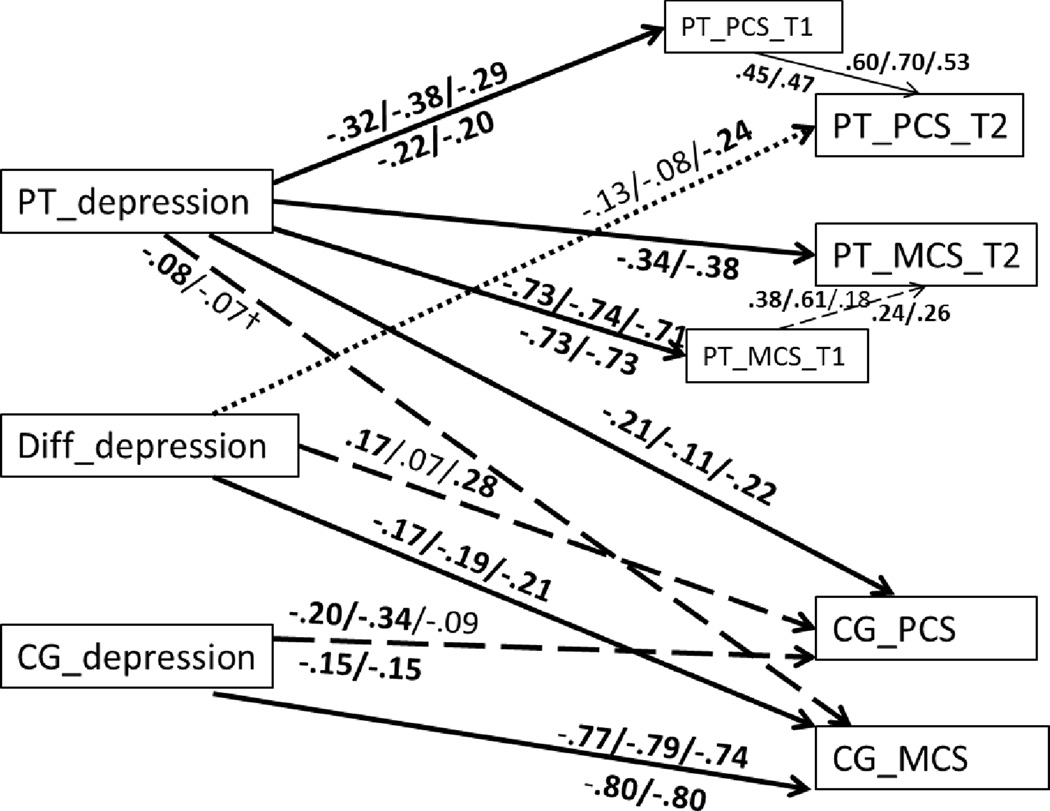
The actor-partner interdependence model confirmed that each person's depressive symptom level was uniquely associated with his/her own concurrent QOL. Female patients' depressive symptoms were also related to their caregivers' poorer physical and better mental health, particularly when the pair's depressive symptoms were at similarly elevated level. On the other hand, male patients' elevated depressive symptoms were related to their caregivers' poorer mental health.
Findings suggest that QOL among patients and their family caregivers is interdependent. In light of this interdependency, psychosocial interventions for managing depressive symptoms should target both patients and their family caregivers, from which both may benefit by not only alleviating depressive symptoms but also improving QOL.
癌症患者及其家庭照顾者常常报告抑郁症状水平升高,同时伴有较差的身心健康(生活质量:QOL)。尽管患者及其照顾者之间的痛苦相互关系已为人熟知,但尚不清楚照顾者的抑郁症状在多大程度上能独立预测其患者的生活质量,反之亦然,以及这种关系是否因癌症类型或性别而异。
结直肠癌或肺癌患者及其照顾者(398对)提供了研究变量的完整数据(212对结直肠癌患者,186对肺癌患者;257对男性患者,141对女性患者)。在诊断后约4个月和12个月测量患者的抑郁症状和生活质量;在诊断后约5个月测量照顾者的抑郁症状和生活质量。
行为者-伙伴相互依赖模型证实,每个人的抑郁症状水平都与他/她自己同时期的生活质量有独特关联。女性患者的抑郁症状也与她们照顾者较差的身体健康和较好的心理健康有关,特别是当两人的抑郁症状处于相似的升高水平时。另一方面,男性患者抑郁症状的升高与他们照顾者较差的心理健康有关。
研究结果表明,患者及其家庭照顾者的生活质量是相互依赖的。鉴于这种相互依赖性,管理抑郁症状的心理社会干预应针对患者及其家庭照顾者,两者都可能从中受益,不仅能缓解抑郁症状,还能提高生活质量。