Department of Drug Evaluation and Informatics, Graduate School of Pharmaceutical Sciences, University of Shizuoka, Shizuoka, Japan.
Department of Pharmacy, Kikugawa General Hospital, Shizuoka, Japan.
PLoS One. 2014 May 16;9(5):e96373. doi: 10.1371/journal.pone.0096373. eCollection 2014.
The anti-influenza virus activity of green tea catechins has been demonstrated in experimental studies, but clinical evidence has been inconclusive. School-aged children play an important role in the infection and spread of influenza in the form of school-based outbreaks. Preventing influenza infection among students is essential for reducing the frequency of epidemics and pandemics. As a non-pharmaceutical intervention against infection, gargling is also commonly performed in Asian countries but has not yet been extensively studied.
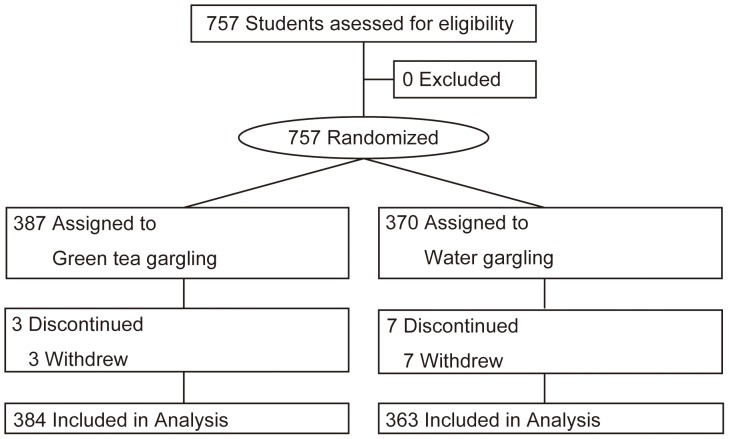
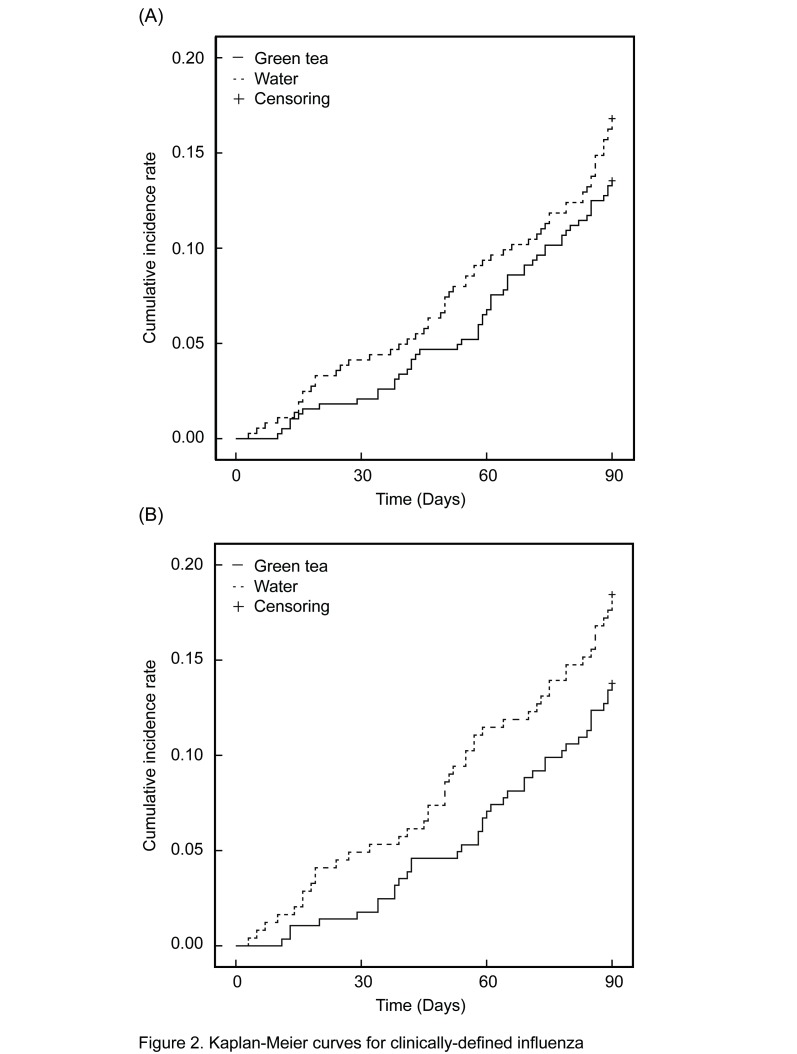
A randomized, open label, 2-group parallel study of 757 high school students (15 to 17 years of age) was conducted for 90 days during the influenza epidemic season from December 1st, 2011 to February 28th, 2012, in 6 high schools in Shizuoka Prefecture, Japan. The green tea gargling group gargled 3 times a day with bottled green tea, and the water gargling group did the same with tap water. The water group was restricted from gargling with green tea. The primary outcome measure was the incidence of laboratory-confirmed influenza using immunochromatographic assay for antigen detection. 757 participants were enrolled and 747 participants completed the study (384 in the green tea group and 363 in the water group). Multivariate logistic regression indicated no significant difference in the incidence of laboratory-confirmed influenza between the green tea group (19 participants; 4.9%) and the water group (25 participants; 6.9%) (adjusted OR, 0.69; 95%CI, 0.37 to 1.28; P = 0.24). The main limitation of the study is the adherence rate among high school students was lower than expected.
Among high school students, gargling with green tea three times a day was not significantly more efficacious than gargling with water for the prevention of influenza infection. In order to adequately assess the effectiveness of such gargling, additional large-scale randomized studies are needed.
ClinicalTrials.gov NCT01225770.
绿茶儿茶素的抗流感病毒活性已在实验研究中得到证实,但临床证据尚无定论。学龄儿童以学校为基础爆发的形式在流感感染和传播中发挥着重要作用。预防学生感染流感对于减少流感爆发和大流行的频率至关重要。作为一种非药物感染预防措施,漱口在亚洲国家也很常见,但尚未得到广泛研究。
在日本静冈县的 6 所高中,于 2011 年 12 月 1 日至 2012 年 2 月 28 日流感流行季节进行了一项为期 90 天的随机、开放标签、2 组平行研究,共纳入 757 名 15 至 17 岁的高中生。绿茶漱口组每天用瓶装绿茶漱口 3 次,水漱口组用自来水漱口。水漱口组被限制用绿茶漱口。主要结局指标为采用免疫层析法检测抗原的实验室确诊流感的发生率。共纳入 757 名参与者,747 名参与者完成了研究(绿茶组 384 名,水组 363 名)。多变量 logistic 回归分析表明,绿茶组(19 例;4.9%)与水组(25 例;6.9%)实验室确诊流感的发生率无显著差异(调整后的 OR,0.69;95%CI,0.37 至 1.28;P=0.24)。该研究的主要局限性是高中生的依从率低于预期。
在高中生中,每天用绿茶漱口 3 次在预防流感感染方面并不明显优于用水漱口。为了充分评估这种漱口的效果,还需要开展更多的大型随机研究。
ClinicalTrials.gov NCT01225770。