Department of Clinical Epidemiology and Biostatistics, Faculty of Health Sciences, McMaster University, Hamilton, L8N 3Z5 Ontario, Canada.
BMC Infect Dis. 2011 May 19;11:134. doi: 10.1186/1471-2334-11-134.
Antivirals play a critical role in the prevention and the management of influenza. One class of antivirals, neuraminidase inhibitors (NAIs), is effective against all human influenza viruses. Currently there are two NAI drugs which are licensed worldwide: oseltamivir (Tamiflu®) and zanamivir (Relenza®); and two drugs which have received recent approval in Japan: peramivir and laninamivir. Until recently, the prevalence of antiviral resistance has been relatively low. However, almost all seasonal H1N1 strains that circulated in 2008-09 were resistant to oseltamivir whereas about 1% of tested 2009 pandemic H1N1 viruses were found to be resistant to oseltamivir. To date, no studies have demonstrated widespread resistance to zanamivir. It seems likely that the literature on antiviral resistance associated with oseltamivir as well as zanamivir is now sufficiently comprehensive to warrant a systematic review.The primary objectives were to systematically review the literature to determine the incidence of resistance to oseltamivir, zanamivir, and peramivir in different population groups as well as assess the clinical consequences of antiviral resistance.
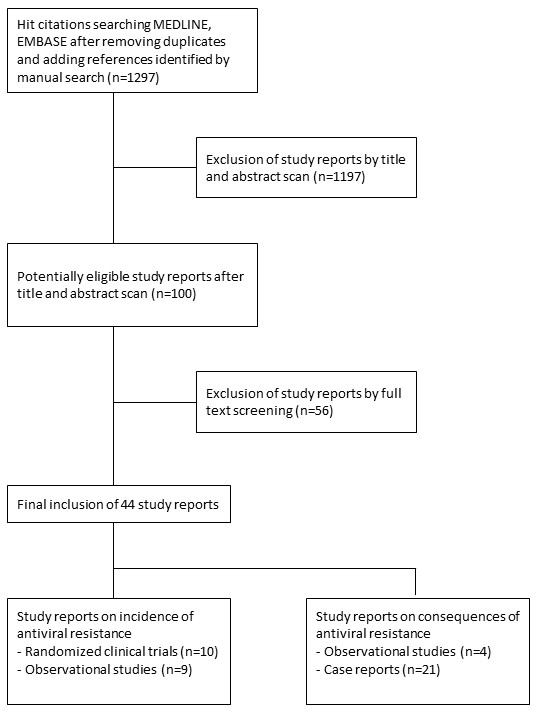
We searched MEDLINE and EMBASE without language restrictions in September 2010 to identify studies reporting incidence of resistance to oseltamivir, zanamivir, and peramivir. We used forest plots and meta-analysis of incidence of antiviral resistance associated with the three NAIs. Subgroup analyses were done across a number of population groups. Meta-analysis was also performed to evaluate associations between antiviral resistance and clinical complications and symptoms.
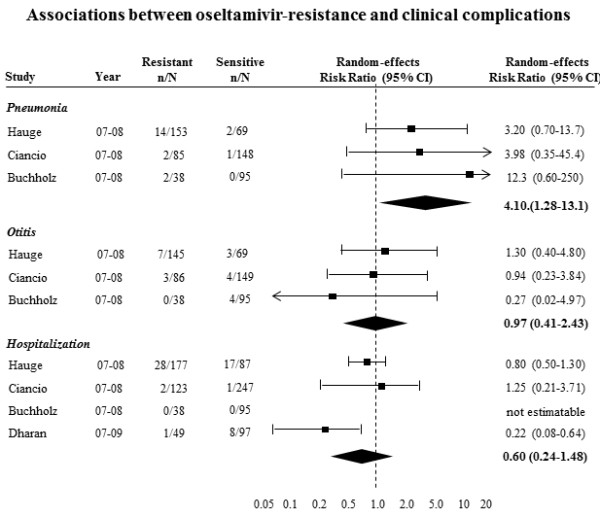
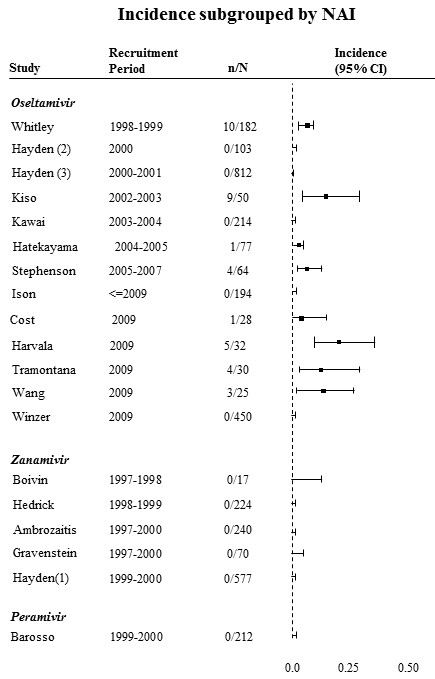
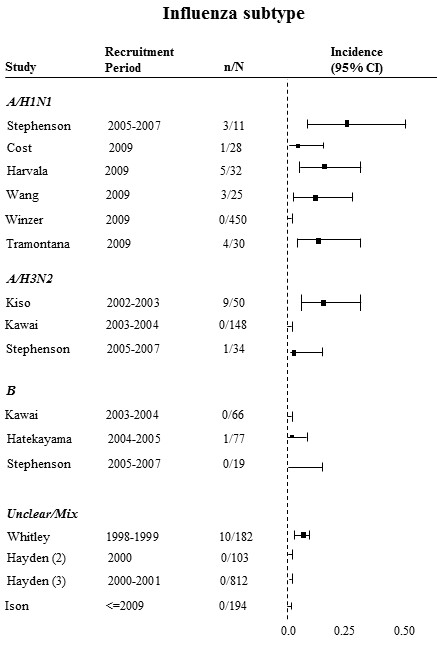
We identified 19 studies reporting incidence of antiviral resistance. Meta-analysis of 15 studies yielded a pooled incidence rate for oseltamivir resistance of 2.6% (95%CI 0.7% to 5.5%). The incidence rate for all zanamivir resistance studies was 0%. Only one study measured incidence of antiviral resistance among subjects given peramivir and was reported to be 0%. Subgroup analyses detected higher incidence rates among influenza A patients, especially for H1N1 subtype influenza. Considerable heterogeneity between studies precluded definite inferences about subgroup results for immunocompromised patients, in-patients, and children. A meta-analysis of 4 studies reporting association between oseltamivir-resistance and pneumonia yielded a statistically significant risk ratio of 4.2 (95% CI 1.3 to 13.1, p = 0.02). Oseltamivir-resistance was not statistically significantly associated with other clinical complications and symptoms.
Our results demonstrate that that a substantial number of patients may become oseltamivir-resistant as a result of oseltamivir use, and that oseltamivir resistance may be significantly associated with pneumonia. In contrast, zanamivir resistance has been rarely reported to date.
抗病毒药物在流感的预防和治疗中起着关键作用。神经氨酸酶抑制剂(NAI)是一类有效的抗病毒药物,可对抗所有人类流感病毒。目前,全球有两种 NAI 药物获得许可:奥司他韦(达菲)和扎那米韦(瑞乐沙);还有两种在日本最近获得批准的药物:帕拉米韦和拉尼米韦。直到最近,抗病毒药物的耐药性仍然相对较低。然而,2008-09 年流行的几乎所有季节性 H1N1 株均对奥司他韦耐药,而约 1%的测试 2009 年大流行 H1N1 病毒对奥司他韦耐药。迄今为止,尚无研究表明对扎那米韦存在广泛耐药性。目前看来,与奥司他韦和扎那米韦相关的抗病毒耐药性文献已经足够全面,可以进行系统评价。主要目的是系统地回顾文献,以确定不同人群中奥司他韦、扎那米韦和帕拉米韦耐药的发生率,并评估抗病毒耐药的临床后果。
我们于 2010 年 9 月在 MEDLINE 和 EMBASE 上进行了无语言限制的检索,以确定报告奥司他韦、扎那米韦和帕拉米韦耐药发生率的研究。我们使用森林图和荟萃分析来评估三种 NAI 相关的抗病毒耐药发生率。在多个人群组中进行了亚组分析。还进行了荟萃分析,以评估抗病毒耐药与临床并发症和症状之间的关系。
我们确定了 19 项报告抗病毒耐药发生率的研究。对 15 项研究进行荟萃分析,得出奥司他韦耐药的总发生率为 2.6%(95%CI 0.7%至 5.5%)。所有扎那米韦耐药研究的发生率均为 0%。只有一项研究测量了给予帕拉米韦的受试者的抗病毒耐药发生率,报告为 0%。亚组分析发现,流感 A 患者,尤其是 H1N1 亚型流感患者的耐药发生率较高。由于研究之间存在很大的异质性,因此无法对免疫功能低下患者、住院患者和儿童的亚组结果做出明确推断。对 4 项报告奥司他韦耐药与肺炎之间关系的研究进行荟萃分析,得出肺炎的风险比为 4.2(95%CI 1.3 至 13.1,p=0.02),具有统计学意义。奥司他韦耐药与其他临床并发症和症状无统计学显著相关性。
我们的研究结果表明,由于奥司他韦的使用,相当多的患者可能会产生奥司他韦耐药性,并且奥司他韦耐药性可能与肺炎显著相关。相比之下,目前扎那米韦耐药性的报道很少。