Department of Psychiatry, Seoul St. Mary's Hospital, The Catholic University of Korea College of Medicine, Seoul, Republic of Korea.
Psychiatry Investig. 2014 Apr;11(2):173-8. doi: 10.4306/pi.2014.11.2.173. Epub 2014 Apr 11.
Cigarette smoking is associated with a variety of health problems including cardiovascular, pulmonary, neoplasms, endocrinopathies including diabetes, the metabolic syndrome, and chronic inflammation. Adiponectin is an adipocyte-derived plasma protein that is closely associated with insulin sensitivity and the metabolic syndrome. The aim of this study was to evaluate the changes of plasma adiponectin levels after smoking cessation.
Thirty seven smokers that wanted to stop smoking without any nicotine replacement therapy or medication were recruited for this study. Fifteen smokers succeeded in stopping smoking (validated by urine cotinine levels ≤50 ng/mL) and 22 smokers failed. Therefore, only the 15 that succeeded were included in the analysis. The plasma adiponectin levels were determined using a commercially available enzyme-linked immunosorbent assay.
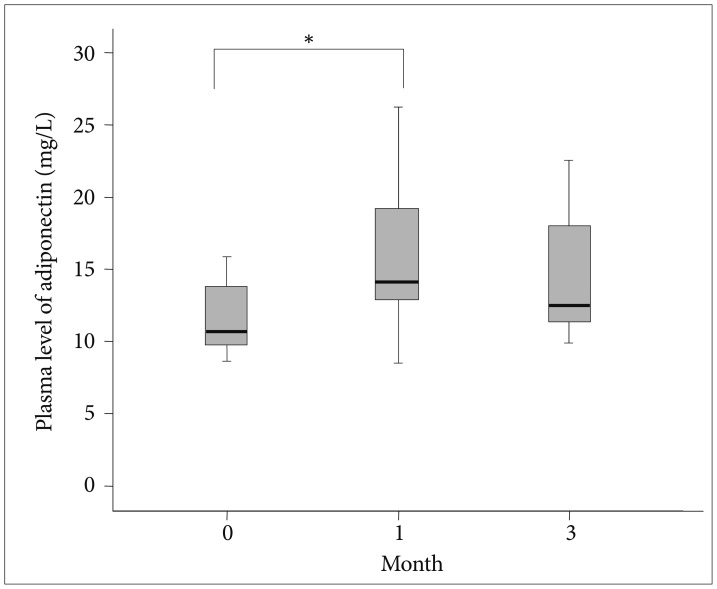
The mean age of the successful 15 was 35±9.3 years old. They were all males. The daily smoking habit was a mean of 13.5±5.4 cigarettes per day. The mean Nicotine Dependence Syndrome Scale (NDSS) and Fagerstrom Test for Nicotine Dependence (FTND) scores were 55.6±9.6 and 2.9±1.9. During the study period of three months, the mean body mass index (BMI), body fat mass (BFM), waist-hip ratio (WHR) and body weight increased by 1.1 kg/m(2), 3.0%, 0.02%, and 2.9 kg, respectively. The baseline mean adiponectin level in the subjects was 11.9±5.2 mg/L. The mean adiponectin levels measured at one and three months were 16.0±5.1 mg/L and 14.7±4.5 mg/L respectively. The mean plasma adiponectin levels of the successful group was significantly increased after four weeks when compared to the baseline (z=-2.401, p=0.016). However, the decrease in plasma adiponectin levels at one and three months was not statistically significant.
Even though the decrease over the next two months was not significant, these findings, the increase of plasma level of adiponectin after smoking cessation, provide preliminary data for future research on the possible mechanisms associated with smoking cessation and changes in body metabolism.
吸烟与多种健康问题有关,包括心血管、肺部、肿瘤、内分泌疾病,包括糖尿病、代谢综合征和慢性炎症。脂联素是一种脂肪细胞衍生的血浆蛋白,与胰岛素敏感性和代谢综合征密切相关。本研究的目的是评估戒烟后血浆脂联素水平的变化。
招募了 37 名希望不使用任何尼古丁替代疗法或药物戒烟的吸烟者进行这项研究。15 名吸烟者成功戒烟(尿可替宁水平≤50ng/ml 证实),22 名吸烟者失败。因此,只有成功的 15 人被纳入分析。使用商业可得的酶联免疫吸附测定法测定血浆脂联素水平。
成功的 15 人的平均年龄为 35±9.3 岁。他们都是男性。每日吸烟习惯为 13.5±5.4 支/天。平均尼古丁依赖综合征量表(NDSS)和尼古丁依赖 Fagerstrom 测试(FTND)评分分别为 55.6±9.6 和 2.9±1.9。在三个月的研究期间,平均体重指数(BMI)、体脂肪量(BFM)、腰围-臀围比(WHR)和体重分别增加了 1.1kg/m2、3.0%、0.02%和 2.9kg。研究对象的基础平均脂联素水平为 11.9±5.2mg/L。在一个月和三个月时测量的平均脂联素水平分别为 16.0±5.1mg/L 和 14.7±4.5mg/L。与基线相比,成功组的平均血浆脂联素水平在四周后显著升高(z=-2.401,p=0.016)。然而,一个月和三个月时的血浆脂联素水平下降没有统计学意义。
尽管在接下来的两个月里下降并不显著,但这些发现,即戒烟后血浆脂联素水平的升高,为戒烟与身体代谢变化相关的可能机制的进一步研究提供了初步数据。