Kryfti Maria, Dimakou Katerina, Toumbis Michail, Daniil Zoe, Hatzoglou Chryssi, Gourgoulianis Konstantinos I
6th Respiratory Medicine Department, Sotiria General Hospital for Thoracic Diseases, Mesogeion 152, 11527 Athens, Greece.
Respiratory Medicine Department, University of Thessaly School of Medicine, University Hospital of Larissa, Larissa, 41110 Greece.
Tob Induc Dis. 2015 Sep 3;13:30. doi: 10.1186/s12971-015-0054-7. eCollection 2015.
Evidence on the association of leptin and adiponectin and smoking is limited and discordant. Leptin and adiponectin represent the most abundant adipokines in human plasma that play crucial roles in the pathophysiology of metabolic syndrome, atherosclerosis and insulin resistance. Leptin up-regulates the expression of several pro-inflammatory cytokines and is increased upon weight gain. Adiponectin has been shown to possess insulin sensitizing, anti -inflammatory and anti-atherogenic properties and is increased upon weight reduction. Our aim was to assess the effects of smoking cessation on serum leptin and adiponectin levels.
We assessed the changes in serum leptin and adiponectin levels, serum CRP levels and BMI in apparently healthy smokers after 3 and 6 months of abstinence from smoking. Successful cessation was confirmed by an exhaled carbon monoxide measurement. 26 healthy non-smokers were recruited as controls.
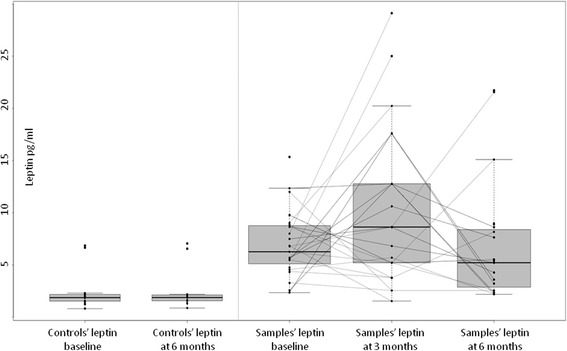
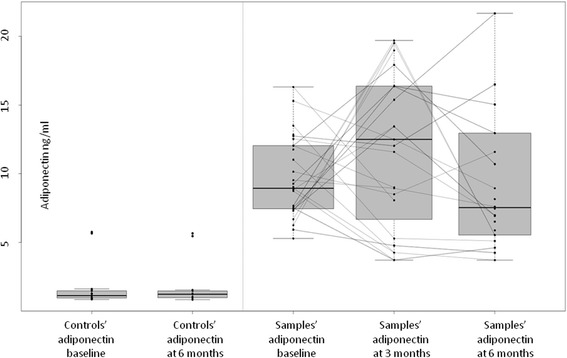
Among the sample group, 32 subjects had quitted smoking at 3 months and 29 subjects at 6 months. Samples' leptin increased significantly from baseline to three months (mean change 3.76 ng/ml [95 % CI 0.89, 6.64], p =0.012) and then decreased significantly from three to six months of smoking cessation (mean change -4,29 ng/ml [95 % CI -7.34, -6.64], p = 0.008). Samples' adiponectin increased significantly from baseline to three months of abstinence from smoking (mean change 2.34 [95 % CI -0.05, 4.73], p -0.05). BMI was significantly increased (mean change 2.03 kg/m(2) [95 % CI 1.60, 2.46], p <0.05), while CRP decreased significantly from baseline to 6 months of smoking cessation (mean change -0.68 mg/dl [95 % CI -1.06, -0.30], p = 0.001).
Smoking quitters' leptin levels appear to increase 3 months after smoking cessation and then decrease from 3 to 6 months of abstinence from smoking. Adiponectin levels increase during the first trimester of smoking cessation. The decrease in CRP levels indicates that the low grade inflammation observed in smokers is gradually restored. The alterations of serum leptin and adiponectin after 6 months of smoking cessation suggest the same but do not reach statistically significant levels. Weight gain and changes in fat distribution may attenuate the beneficial effects of smoking cessation.
关于瘦素、脂联素与吸烟之间关联的证据有限且不一致。瘦素和脂联素是人类血浆中含量最为丰富的脂肪因子,在代谢综合征、动脉粥样硬化和胰岛素抵抗的病理生理学过程中发挥着关键作用。瘦素可上调多种促炎细胞因子的表达,且在体重增加时升高。脂联素已被证明具有胰岛素增敏、抗炎和抗动脉粥样硬化特性,且在体重减轻时升高。我们的目的是评估戒烟对血清瘦素和脂联素水平的影响。
我们对明显健康的吸烟者在戒烟3个月和6个月后,评估其血清瘦素和脂联素水平、血清CRP水平及BMI的变化。通过呼出一氧化碳测量来确认成功戒烟。招募26名健康非吸烟者作为对照。
在样本组中,32名受试者在3个月时戒烟,29名受试者在6个月时戒烟。样本的瘦素水平从基线到3个月时显著升高(平均变化3.76 ng/ml [95%CI 0.89, 6.64],p = 0.012),然后在戒烟3至6个月时显著下降(平均变化 -4.29 ng/ml [95%CI -7.34, -6.64],p = 0.008)。样本的脂联素水平在戒烟3个月时从基线开始显著升高(平均变化2.34 [95%CI -0.05, 4.73],p = 0.05)。BMI显著增加(平均变化2.03 kg/m² [95%CI 1.60, 2.46],p < 0.05),而CRP从基线到戒烟6个月时显著下降(平均变化 -0.68 mg/dl [95%CI -1.06, -0.30],p = 0.001)。
戒烟者的瘦素水平在戒烟3个月后似乎升高,然后在戒烟3至6个月时下降。脂联素水平在戒烟的前三个月升高。CRP水平的下降表明吸烟者中观察到的低度炎症正在逐渐恢复。戒烟六个月后血清瘦素和脂联素的变化表明情况相同,但未达到统计学显著水平。体重增加和脂肪分布的变化可能会减弱戒烟的有益效果。