Tatara Alexander M, Lipner Justin H, Das Rosalina, Kim H Mike, Patel Nikunj, Ntouvali Eleni, Silva Matthew J, Thomopoulos Stavros
Department of Orthopaedic Surgery, Washington University, St. Louis, Missouri, United States of America.
PLoS One. 2014 May 21;9(5):e97375. doi: 10.1371/journal.pone.0097375. eCollection 2014.
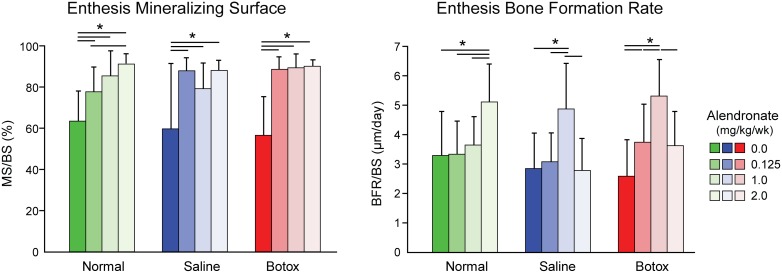
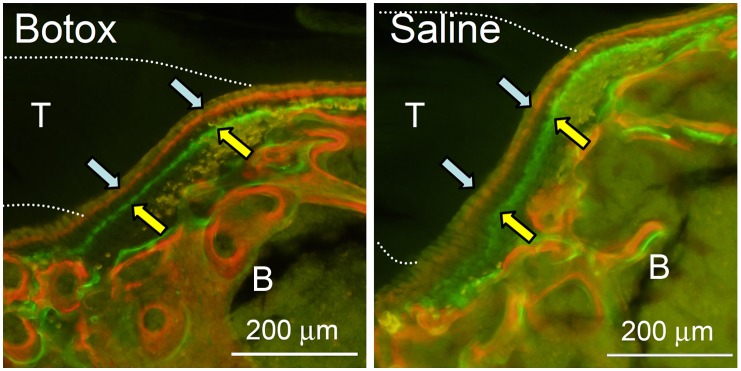
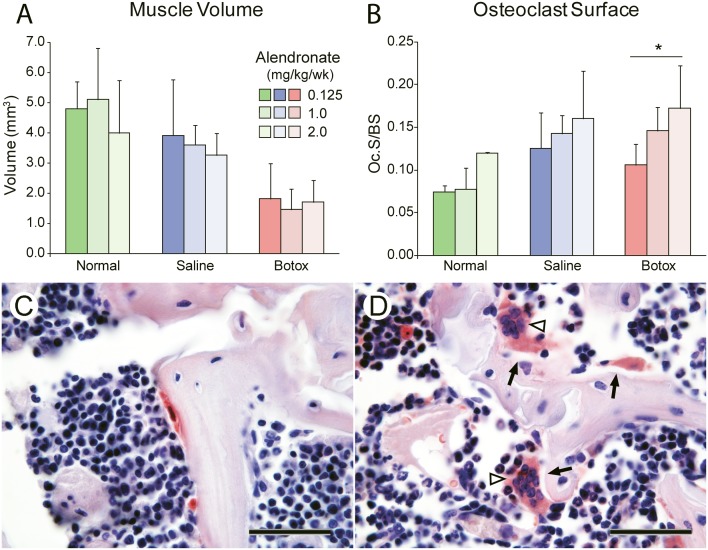
Muscle forces are necessary for the development and maintenance of a mineralized skeleton. Removal of loads leads to malformed bones and impaired musculoskeletal function due to changes in bone (re)modeling. In the current study, the development of a mineralized junction at the interface between muscle and bone was examined under normal and impaired loading conditions. Unilateral mouse rotator cuff muscles were paralyzed using botulinum toxin A at birth. Control groups consisted of contralateral shoulders injected with saline and a separate group of normal mice. It was hypothesized that muscle unloading would suppress bone formation and enhance bone resorption at the enthesis, and that the unloading-induced bony defects could be rescued by suppressing osteoclast activity. In order to modulate osteoclast activity, mice were injected with the bisphosphonate alendronate. Bone formation was measured at the tendon enthesis using alizarin and calcein fluorescent labeling of bone surfaces followed by quantitative histomorphometry of histologic sections. Bone volume and architecture was measured using micro computed tomography. Osteoclast surface was determined via quantitative histomorphometry of tartrate resistant acid phosphatase stained histologic sections. Muscle unloading resulted in delayed initiation of endochondral ossification at the enthesis, but did not impair bone formation rate. Unloading led to severe defects in bone volume and trabecular bone architecture. These defects were partially rescued by suppression of osteoclast activity through alendronate treatment, and the effect of alendronate was dose dependent. Similarly, bone formation rate was increased with increasing alendronate dose across loading groups. The bony defects caused by unloading were therefore likely due to maintained high osteoclast activity, which normally decreases from neonatal through mature timepoints. These results have important implications for the treatment of muscle unloading conditions such as neonatal brachial plexus palsy, which results in shoulder paralysis at birth and subsequent defects in the rotator cuff enthesis and humeral head.
肌肉力量对于矿化骨骼的发育和维持是必需的。去除负荷会导致骨骼畸形和肌肉骨骼功能受损,这是由于骨(再)建模的变化所致。在当前研究中,研究了在正常和受损负荷条件下肌肉与骨骼界面处矿化连接的发育情况。出生时使用肉毒杆菌毒素A使单侧小鼠肩袖肌肉麻痹。对照组包括注射生理盐水的对侧肩部以及另一组正常小鼠。研究假设是,肌肉卸载会抑制骨附着点处的骨形成并增强骨吸收,并且通过抑制破骨细胞活性可以挽救卸载诱导的骨缺陷。为了调节破骨细胞活性,给小鼠注射双膦酸盐阿仑膦酸钠。使用茜素和钙黄绿素对骨表面进行荧光标记,然后对组织学切片进行定量组织形态计量学分析,以测量肌腱附着点处的骨形成。使用微型计算机断层扫描测量骨体积和结构。通过对耐酒石酸酸性磷酸酶染色的组织学切片进行定量组织形态计量学分析来确定破骨细胞表面。肌肉卸载导致骨附着点处软骨内骨化的起始延迟,但并未损害骨形成速率。卸载导致骨体积和小梁骨结构出现严重缺陷。通过阿仑膦酸钠治疗抑制破骨细胞活性可部分挽救这些缺陷,并且阿仑膦酸钠的作用具有剂量依赖性。同样,在不同负荷组中,随着阿仑膦酸钠剂量的增加,骨形成速率也增加。因此,卸载引起的骨缺陷可能是由于破骨细胞活性持续保持在较高水平,而正常情况下从新生儿期到成熟阶段破骨细胞活性会降低。这些结果对于治疗肌肉卸载状况(如新生儿臂丛神经麻痹)具有重要意义,新生儿臂丛神经麻痹会导致出生时肩部麻痹以及随后肩袖附着点和肱骨头出现缺陷。