Department of Nursing, Samsung Medical Center, Seoul, Korea.
Department of Nursing Science, Woo Suk University, Wanju, Korea.
Diabetes Metab J. 2014 Apr;38(2):120-33. doi: 10.4093/dmj.2014.38.2.120. Epub 2014 Apr 18.
Longer needle and complicated insulin injection technique such as injecting at a 45-degree angle and making skinfolds may decrease patient compliance to insulin injection therapy. In this light, shorter insulin needles have been recently developed. However, it is necessary to ascertain that such shorter needles are appropriate for Korean patients with diabetes as well.
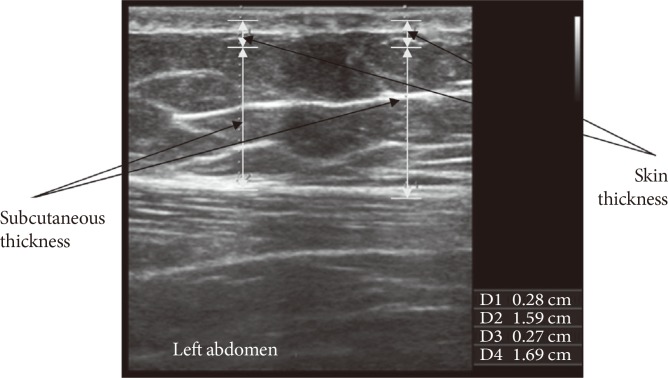
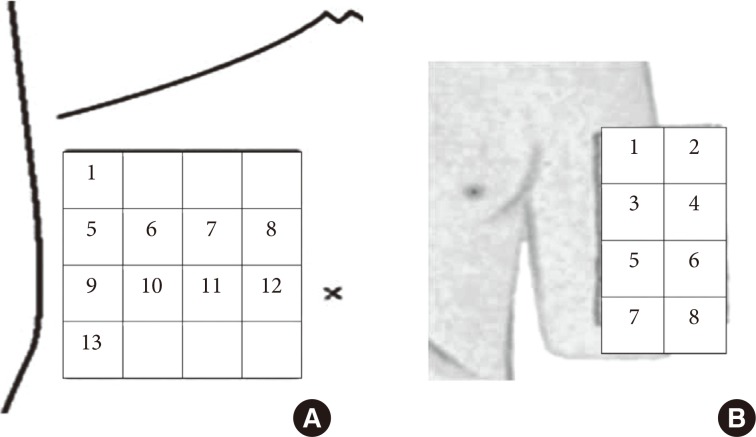
First, the diverse demographic and diabetic features of 156 Korean adults with diabetes were collected by a questionnaire and a device unit of body fat measurement. The skin and subcutaneous fat thicknesses of each subject were measured by Ultrasound device with a 7- to 12-MHz probe. Data were analyzed using analysis of variance and multiple linear regression.
The mean skin thickness was 2.29±0.37 mm in the abdomen and 2.00±0.34 mm in the upper arms, and the mean subcutaneous fat thickness was to 10.15±6.54 mm in the abdomen and 5.50±2.68 mm in the upper arms. Our analysis showed that the factors affecting the skin thickness of the abdomen and upper arms were gender and body mass index (BMI), whereas the factors influencing the subcutaneous fat thickness in the abdomen were gender and BMI, and the factors influencing the subcutaneous fat thickness in the upper arms were gender, BMI, and age. Insulin fluids may not appear to be intradermally injected into the abdomen and upper arms at any needle lengths. The risk of intramuscular injection is likely to increase with longer insulin needles and lower BMI.
It is recommended to fully inform the patients about the lengths of needles for insulin injections. As for the recommended needle length, the findings of this study indicate that needles as short as 4 mm are sufficient to deliver insulin for Korean patients with diabetes.
较长的针和复杂的胰岛素注射技术,如以 45 度角注射和皮肤褶皱,可能会降低患者对胰岛素注射治疗的依从性。有鉴于此,最近开发了更短的胰岛素针。然而,有必要确定这种更短的针对于韩国糖尿病患者也是合适的。
首先,通过问卷调查和身体脂肪测量装置收集了 156 名韩国成年糖尿病患者的各种人口统计学和糖尿病特征。使用带有 7-12MHz 探头的超声设备测量每位受试者的皮肤和皮下脂肪厚度。使用方差分析和多元线性回归进行数据分析。
腹部皮肤厚度平均值为 2.29±0.37mm,上臂皮肤厚度平均值为 2.00±0.34mm,腹部皮下脂肪厚度平均值为 10.15±6.54mm,上臂皮下脂肪厚度平均值为 5.50±2.68mm。我们的分析表明,影响腹部和上臂皮肤厚度的因素是性别和体重指数(BMI),而影响腹部皮下脂肪厚度的因素是性别和 BMI,影响上臂皮下脂肪厚度的因素是性别、BMI 和年龄。在任何长度的针下,胰岛素液似乎都不会被注入腹部和上臂的真皮内。随着胰岛素针更长和 BMI 更低,肌肉内注射的风险可能会增加。
建议向患者充分告知胰岛素注射用针的长度。至于推荐的针长,本研究的结果表明,对于韩国糖尿病患者,4mm 短的针足以输送胰岛素。