Stankevicius Aistis, Huys Quentin J M, Kalra Aditi, Seriès Peggy
Institute for Adaptive and Neural Computation, University of Edinburgh, Edinburgh, United Kingdom.
Translational Neuromodeling Unit, Institute for Biomedical Engineering, University of Zürich and ETH Zürich, Zürich, Switzerland; Department of Psychiatry, Psychotherapy and Psychosomatics, University Hospital of Psychiatry Zurich, Zürich, Switzerland; Gatsby Computational Neuroscience Unit and Wellcome Trust Neuroimaging Centre, UCL, London, United Kingdom.
PLoS Comput Biol. 2014 May 22;10(5):e1003605. doi: 10.1371/journal.pcbi.1003605. eCollection 2014 May.
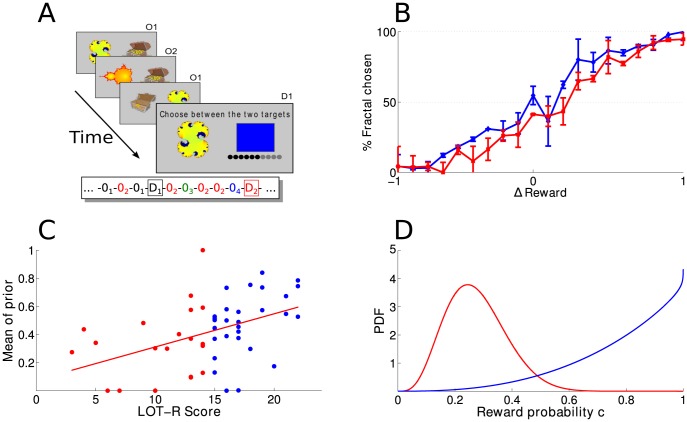
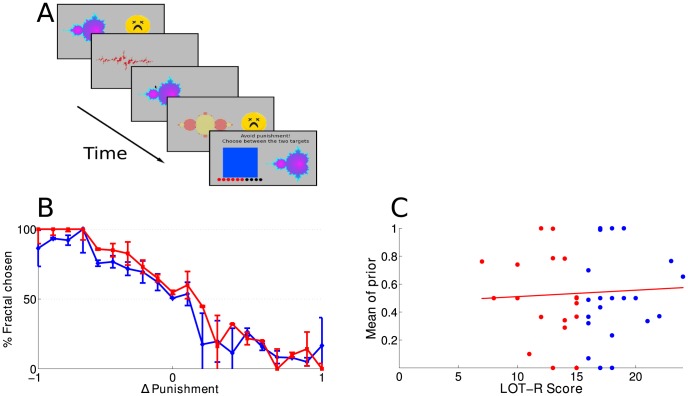
Optimists hold positive a priori beliefs about the future. In Bayesian statistical theory, a priori beliefs can be overcome by experience. However, optimistic beliefs can at times appear surprisingly resistant to evidence, suggesting that optimism might also influence how new information is selected and learned. Here, we use a novel Pavlovian conditioning task, embedded in a normative framework, to directly assess how trait optimism, as classically measured using self-report questionnaires, influences choices between visual targets, by learning about their association with reward progresses. We find that trait optimism relates to an a priori belief about the likelihood of rewards, but not losses, in our task. Critically, this positive belief behaves like a probabilistic prior, i.e. its influence reduces with increasing experience. Contrary to findings in the literature related to unrealistic optimism and self-beliefs, it does not appear to influence the iterative learning process directly.
乐观主义者对未来持有积极的先验信念。在贝叶斯统计理论中,先验信念可以被经验克服。然而,乐观信念有时似乎对证据具有惊人的抵抗力,这表明乐观主义也可能影响新信息的选择和学习方式。在这里,我们使用一种嵌入规范框架的新颖巴甫洛夫条件任务,通过了解视觉目标与奖励进展之间的关联,直接评估经典使用自我报告问卷测量的特质乐观主义如何影响视觉目标之间的选择。我们发现,特质乐观主义与我们任务中关于奖励可能性而非损失可能性的先验信念相关。至关重要的是,这种积极信念的行为类似于概率先验,即随着经验的增加,其影响会减弱。与文献中关于不切实际的乐观主义和自我信念的研究结果相反,它似乎不会直接影响迭代学习过程。