Jeso Valer, Aquino Claudio, Cheng Xiayun, Mizoguchi Haruki, Nakashige Mika, Micalizio Glenn C
Department of Chemistry, Burke Laboratory, Dartmouth College , Hanover, New Hampshire 03755, United States.
J Am Chem Soc. 2014 Jun 11;136(23):8209-12. doi: 10.1021/ja504374j. Epub 2014 May 29.
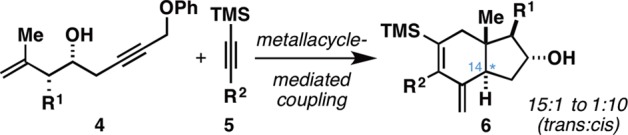
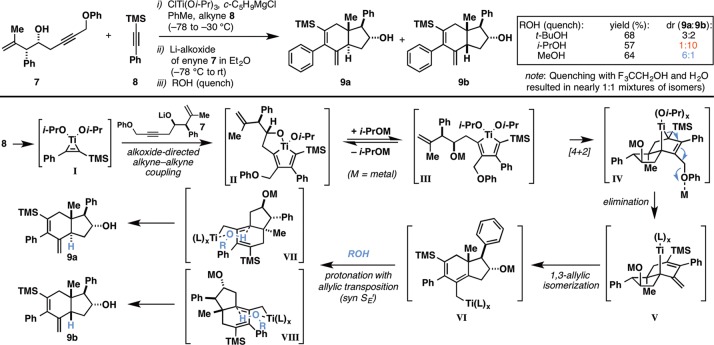
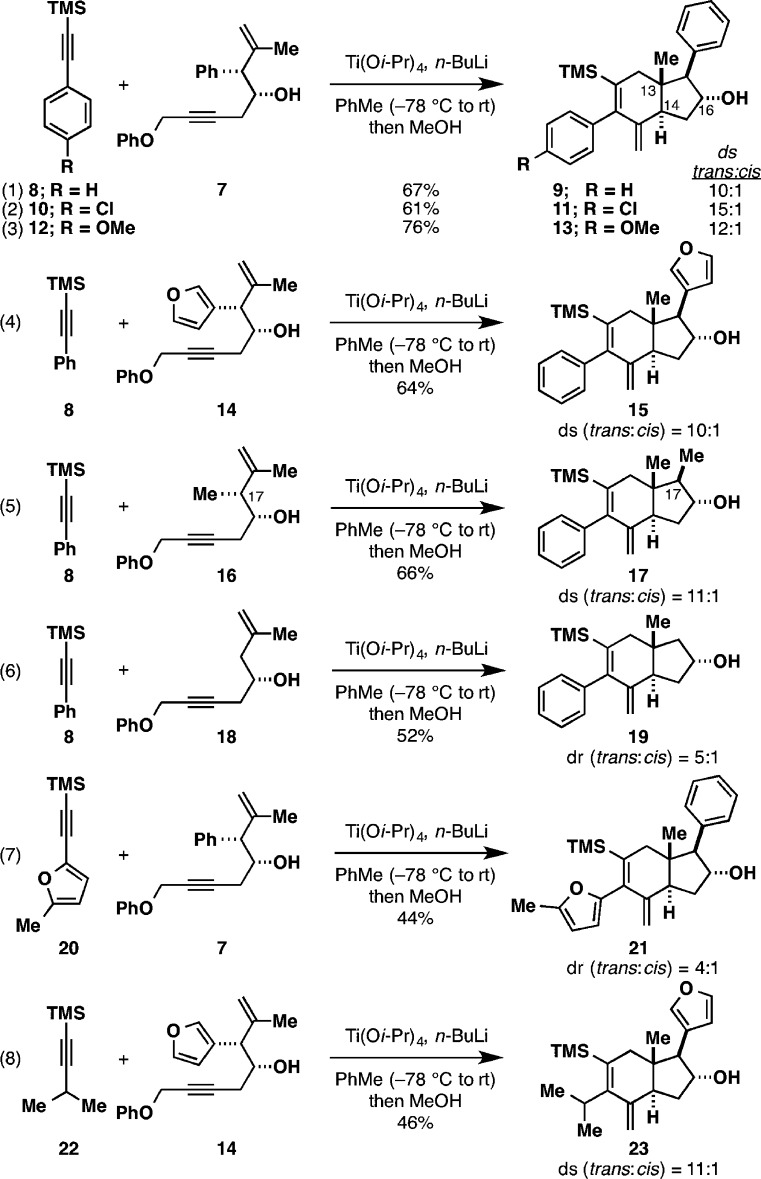
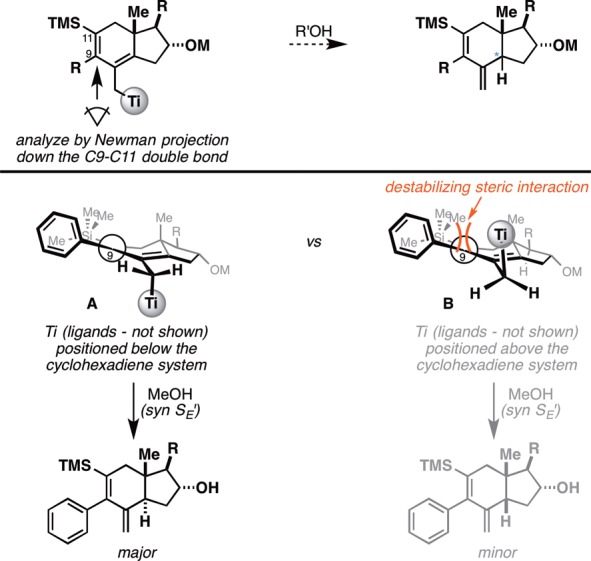
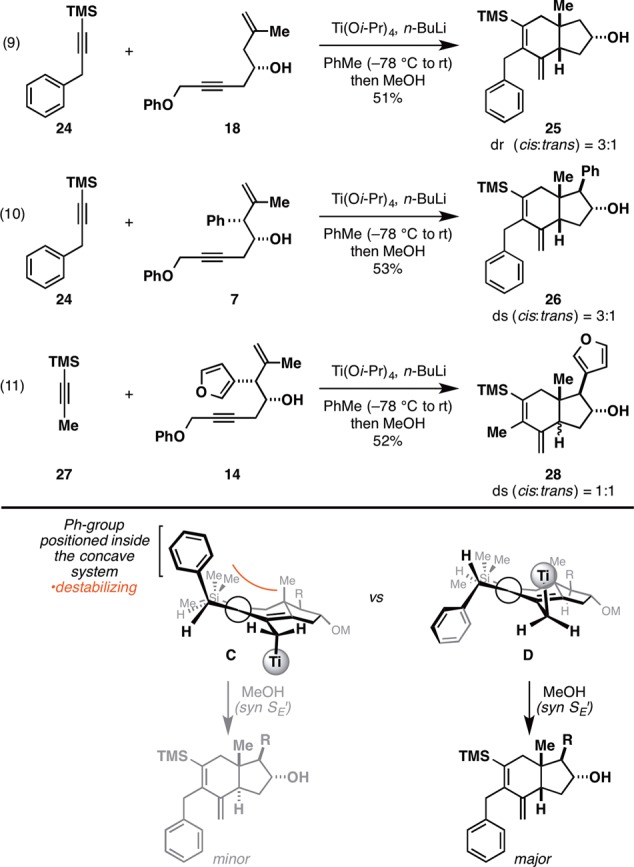
Angularly substituted trans-fused hydroindanes are now accessible by the direct and convergent union of trimethylsilyl (TMS)-alkynes with 4-hydroxy-1,6-enynes by a process that forges three C-C bonds, one C-H bond, and two new stereocenters. The annulation is proposed to proceed by initial formation of a Ti-alkyne complex (with a TMS-alkyne) followed by regioselective alkoxide-directed coupling with the enyne, stereoselective intramolecular cycloaddition, elimination of phenoxide, 1,3-metallotropic shift, and stereoselective protonation of the penultimate allylic organometallic intermediate. Several examples are given to demonstrate the compatibility of this reaction with substrates bearing aromatic and aliphatic substituents, and an empirical model is presented to accompany the stereochemical observations.
通过三甲基硅基(TMS)-炔烃与4-羟基-1,6-烯炔的直接和汇聚式结合,现在可以合成角取代的反式稠合氢化茚,该过程能形成三个C-C键、一个C-H键和两个新的立体中心。据推测,环化反应首先通过形成钛-炔烃络合物(与TMS-炔烃)进行,随后是区域选择性的醇盐导向的与烯炔的偶联、立体选择性的分子内环加成、酚盐的消除、1,3-金属迁移以及倒数第二个烯丙基有机金属中间体的立体选择性质子化。给出了几个例子来说明该反应与带有芳香族和脂肪族取代基的底物的兼容性,并提出了一个经验模型来配合立体化学观察结果。