Bacikova Veronika, Pasulka Josef, Kubicek Karel, Stefl Richard
CEITEC-Central European Institute of Technology, Masaryk University, Brno 62500, Czech Republic National Centre for Biomolecular Research, Faculty of Science, Masaryk University, Brno 62500, Czech Republic.
CEITEC-Central European Institute of Technology, Masaryk University, Brno 62500, Czech Republic National Centre for Biomolecular Research, Faculty of Science, Masaryk University, Brno 62500, Czech Republic
Nucleic Acids Res. 2014 Jul;42(12):8024-38. doi: 10.1093/nar/gku446. Epub 2014 May 23.
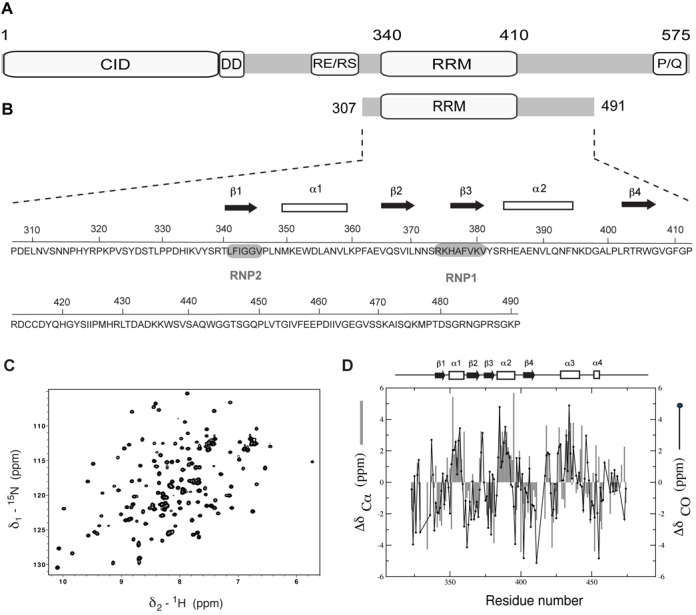
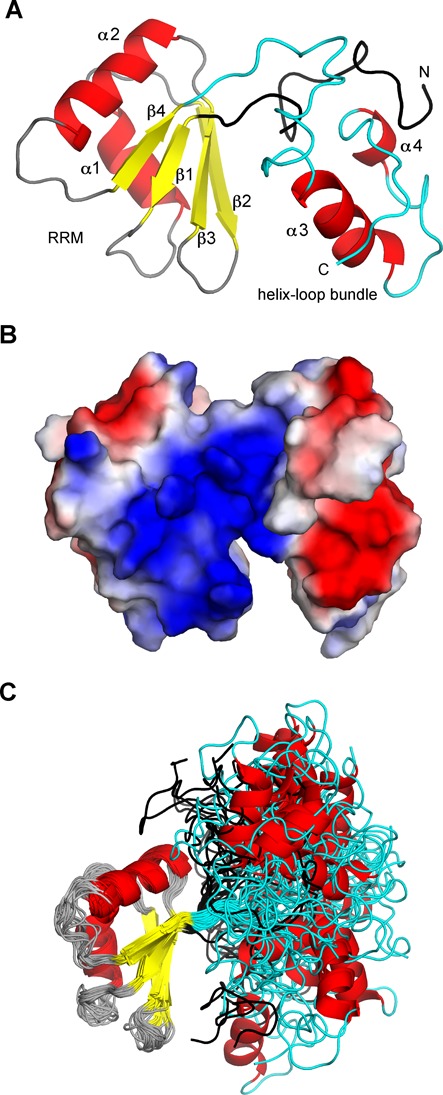
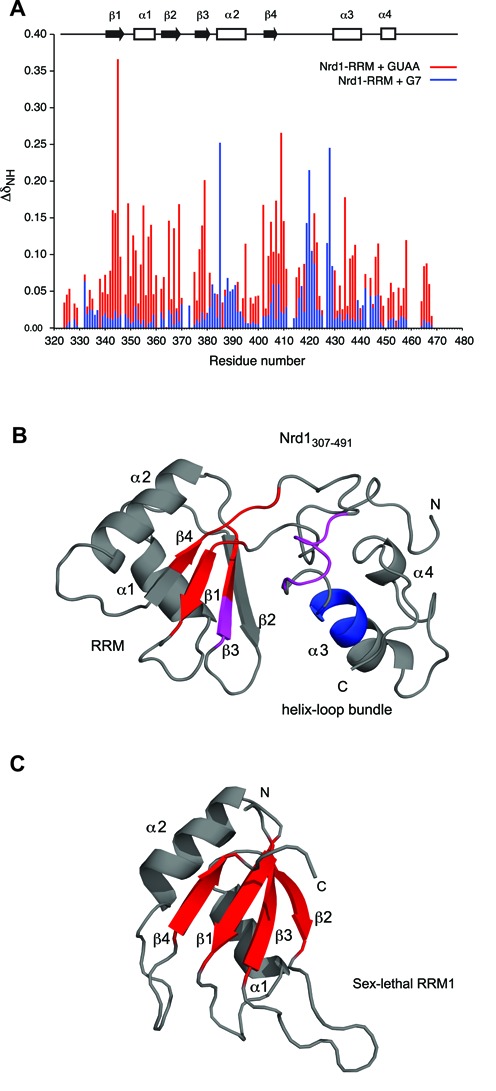
In Saccharomyces cerevisiae, the Nrd1-dependent termination and processing pathways play an important role in surveillance and processing of non-coding ribonucleic acids (RNAs). The termination and subsequent processing is dependent on the Nrd1 complex consisting of two RNA-binding proteins Nrd1 and Nab3 and Sen1 helicase. It is established that Nrd1 and Nab3 cooperatively recognize specific termination elements within nascent RNA, GUA[A/G] and UCUU[G], respectively. Interestingly, some transcripts do not require GUA[A/G] motif for transcription termination in vivo and binding in vitro, suggesting the existence of alternative Nrd1-binding motifs. Here we studied the structure and RNA-binding properties of Nrd1 using nuclear magnetic resonance (NMR), fluorescence anisotropy and phenotypic analyses in vivo. We determined the solution structure of a two-domain RNA-binding fragment of Nrd1, formed by an RNA-recognition motif and helix-loop bundle. NMR and fluorescence data show that not only GUA[A/G] but also several other G-rich and AU-rich motifs are able to bind Nrd1 with affinity in a low micromolar range. The broad substrate specificity is achieved by adaptable interaction surfaces of the RNA-recognition motif and helix-loop bundle domains that sandwich the RNA substrates. Our findings have implication for the role of Nrd1 in termination and processing of many non-coding RNAs arising from bidirectional pervasive transcription.
在酿酒酵母中,Nrd1 依赖性的终止和加工途径在非编码核糖核酸(RNA)的监测和加工中发挥着重要作用。终止及后续加工依赖于由两种 RNA 结合蛋白 Nrd1 和 Nab3 以及 Sen1 解旋酶组成的 Nrd1 复合物。已证实,Nrd1 和 Nab3 分别协同识别新生 RNA 中的特定终止元件 GUA[A/G]和 UCUU[G]。有趣的是,一些转录本在体内转录终止和体外结合时并不需要 GUA[A/G]基序,这表明存在其他 Nrd1 结合基序。在这里,我们利用核磁共振(NMR)、荧光偏振和体内表型分析研究了 Nrd1 的结构和 RNA 结合特性。我们确定了由 RNA 识别基序和螺旋-环束形成的 Nrd1 的两结构域 RNA 结合片段的溶液结构。NMR 和荧光数据表明,不仅 GUA[A/G],而且其他几个富含 G 和富含 AU 的基序也能够以低微摩尔范围的亲和力与 Nrd1 结合。广泛的底物特异性是通过夹着 RNA 底物的 RNA 识别基序和螺旋-环束结构域的适应性相互作用表面实现的。我们的研究结果对 Nrd1 在双向普遍转录产生的许多非编码 RNA 的终止和加工中的作用具有启示意义。