
网络对称和双眼竞争实验。
Network symmetry and binocular rivalry experiments.
机构信息
Department of Mathematical Sciences, New Jersey Institute of Technology, Newark, NJ, 07102, USA.
Mathematical Biosciences Institute, The Ohio State University, Columbus, OH, 43210, USA.
出版信息
J Math Neurosci. 2014 May 7;4:12. doi: 10.1186/2190-8567-4-12. eCollection 2014.
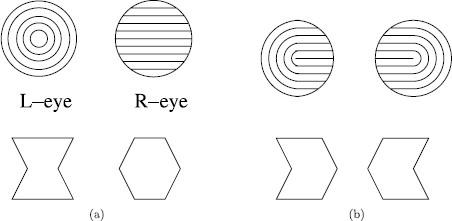
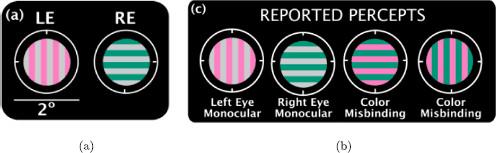
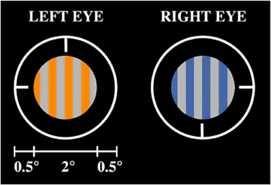
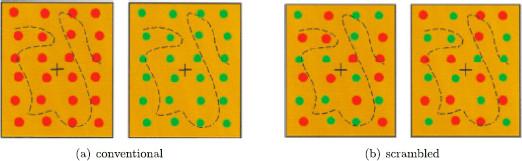
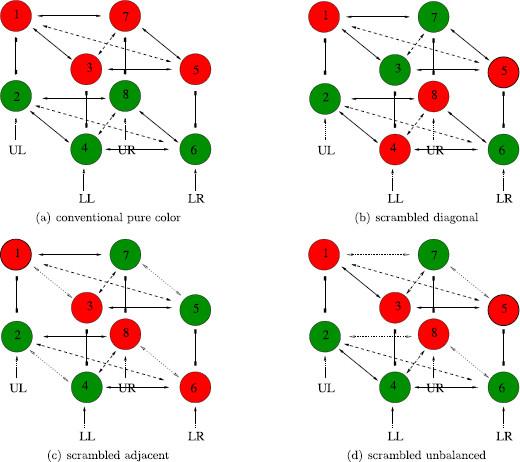
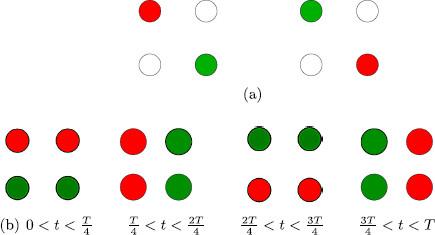
Hugh Wilson has proposed a class of models that treat higher-level decision making as a competition between patterns coded as levels of a set of attributes in an appropriately defined network (Cortical Mechanisms of Vision, pp. 399-417, 2009; The Constitution of Visual Consciousness: Lessons from Binocular Rivalry, pp. 281-304, 2013). In this paper, we propose that symmetry-breaking Hopf bifurcation from fusion states in suitably modified Wilson networks, which we call rivalry networks, can be used in an algorithmic way to explain the surprising percepts that have been observed in a number of binocular rivalry experiments. These rivalry networks modify and extend Wilson networks by permitting different kinds of attributes and different types of coupling. We apply this algorithm to psychophysics experiments discussed by Kovács et al. (Proc. Natl. Acad. Sci. USA 93:15508-15511, 1996), Shevell and Hong (Vis. Neurosci. 23:561-566, 2006; Vis. Neurosci. 25:355-360, 2008), and Suzuki and Grabowecky (Neuron 36:143-157, 2002). We also analyze an experiment with four colored dots (a simplified version of a 24-dot experiment performed by Kovács), and a three-dot analog of the four-dot experiment. Our algorithm predicts surprising differences between the three- and four-dot experiments.
休·威尔逊(Hugh Wilson)提出了一类模型,将高级别决策视为在适当定义的网络中作为属性集的不同层次的模式之间的竞争(《皮质视觉机制》,第 399-417 页,2009 年;《视觉意识的构成:来自双眼竞争的教训》,第 281-304 页,2013 年)。在本文中,我们提出,在适当修改的威尔逊网络(我们称之为竞争网络)中,从融合状态的对称破缺 Hopf 分岔可以以算法方式用于解释在许多双眼竞争实验中观察到的惊人知觉。这些竞争网络通过允许不同类型的属性和不同类型的耦合来修改和扩展威尔逊网络。我们将此算法应用于 Kovács 等人讨论的心理物理学实验(Proc. Natl. Acad. Sci. USA 93:15508-15511, 1996),Shevell 和 Hong(Vis. Neurosci. 23:561-566, 2006;Vis. Neurosci. 25:355-360, 2008),以及 Suzuki 和 Grabowecky(Neuron 36:143-157, 2002)。我们还分析了一个由四个彩色点组成的实验(Kovács 进行的 24 点实验的简化版本)和三个点的四个点实验的类似实验。我们的算法预测了三个点和四个点实验之间的惊人差异。










 Zotero 插件