Laboratory for Cell and Molecular Biology, Division of Hematology and Oncology, Beth Israel Deaconess Medical Center, Harvard Medical School, Boston, MA 02215, USA; Department of Biochemistry and Cancer Research Institute, Kosin University College of Medicine, Busan 602-703, Korea.
Department of Surgery, Beth Israel Deaconess Medical Center, Harvard Medical School, Boston, MA 02215, USA.
BMB Rep. 2014 Jul;47(7):411-6. doi: 10.5483/bmbrep.2014.47.7.104.
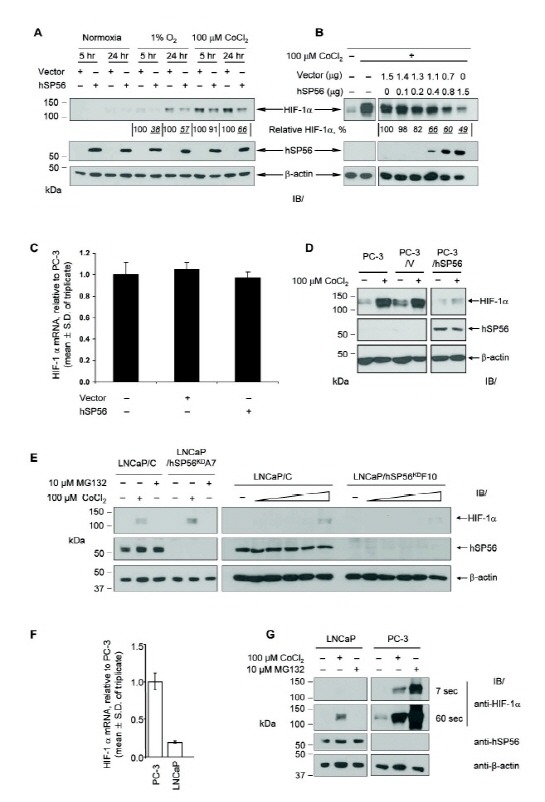
In the present study, we demonstrate that ectopic expression of 56-kDa human selenium binding protein-1 (hSP56) in PC-3 cells that do not normally express hSP56 results in a marked inhibition of cell growth in vitro and in vivo. Down-regulation of hSP56 in LNCaP cells that normally express hSP56 results in enhanced anchorage-independent growth. PC-3 cells expressing hSP56 exhibit a significant reduction of hypoxia inducible protein (HIF)-1α protein levels under hypoxic conditions without altering HIF-1α mRNA (HIF1A) levels. Taken together, our findings strongly suggest that hSP56 plays a critical role in prostate cells by mechanisms including negative regulation of HIF-1α, thus identifying hSP56 as a candidate anti-oncogene product.
在本研究中,我们证明了在通常不表达 hSP56 的 PC-3 细胞中外源性表达 56kDa 人硒结合蛋白-1(hSP56)可显著抑制体外和体内的细胞生长。下调通常表达 hSP56 的 LNCaP 细胞中的 hSP56 会导致锚定非依赖性生长增强。在缺氧条件下,表达 hSP56 的 PC-3 细胞表现出缺氧诱导蛋白(HIF)-1α蛋白水平的显著降低,而不改变 HIF-1αmRNA(HIF1A)水平。总之,我们的研究结果强烈表明,hSP56 通过包括负调控 HIF-1α在内的机制,在前列腺细胞中发挥关键作用,从而将 hSP56 鉴定为候选抑癌基因产物。