Allergy and Clinical Immunology Research Centre, The First Affiliated Hospital of Liaoning Medical University, No. 2, Section 5, Renmin Street, Guta District, Jinzhou, Liaoning 121001, China ; Department of Pathophysiology, Liaoning Medical University, Jinzhou, Liaoning 121001, China.
Department of Respiratory Medicine, The First Affiliated Hospital of Nanjing Medical University, Nanjing 210029, China.
Mediators Inflamm. 2014;2014:829068. doi: 10.1155/2014/829068. Epub 2014 Apr 30.
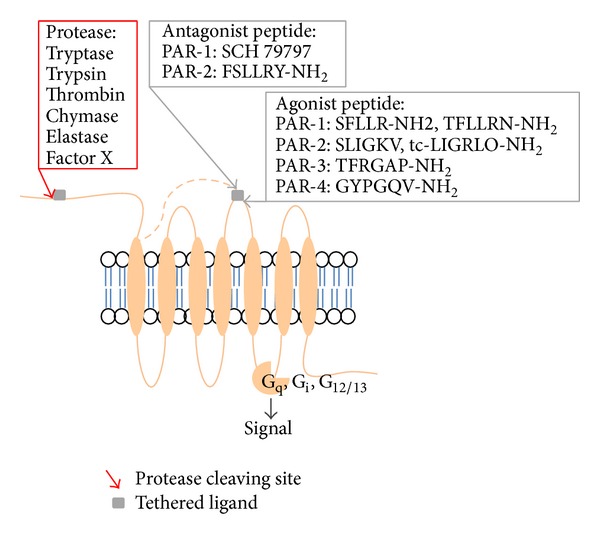
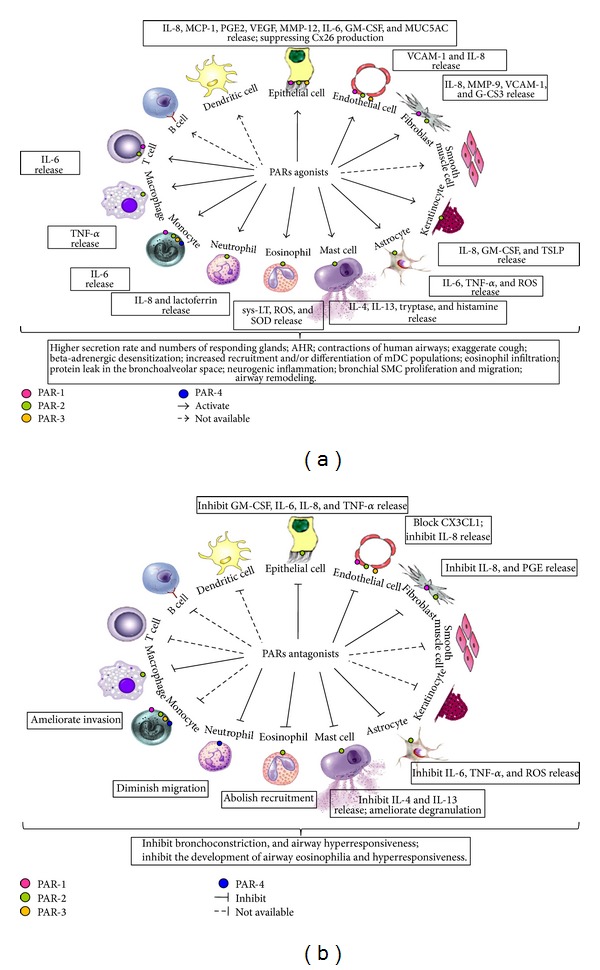
Protease activated receptors (PARs) have been recognized as a distinctive four-member family of seven transmembrane G protein-coupled receptors (GPCRs) that can be cleaved by certain serine proteases. In recent years, there has been considerable interest in the role of PARs in allergic inflammation, the fundamental pathologic changes of allergy, but the potential roles of PARs in allergy remain obscure. Since many of these proteases are produced and actively involved in the pathologic process of inflammation including exudation of plasma components, inflammatory cell infiltration, and tissue damage and repair, PARs appear to make important contribution to allergy. The aim of the present review is to summarize the expression of PARs in inflammatory and structural cells, the influence of agonists or antagonists of PARs on cell behavior, and the involvement of PARs in allergic disorders, which will help us to better understand the roles of serine proteases and PARs in allergy.
蛋白酶激活受体(PARs)已被确认为一种独特的四成员家族的七跨膜 G 蛋白偶联受体(GPCRs),可被某些丝氨酸蛋白酶切割。近年来,PARs 在过敏炎症中的作用引起了相当大的兴趣,过敏是过敏的基本病理变化,但 PARs 在过敏中的潜在作用仍然不清楚。由于许多这些蛋白酶被产生和积极参与炎症的病理过程,包括血浆成分的渗出、炎症细胞浸润以及组织损伤和修复,PARs 似乎对过敏有重要贡献。本综述的目的是总结 PARs 在炎症和结构细胞中的表达,PARs 的激动剂或拮抗剂对细胞行为的影响,以及 PARs 在过敏疾病中的参与,这将有助于我们更好地理解丝氨酸蛋白酶和 PARs 在过敏中的作用。