Suh Hyeon-Sook, Lo Yungtai, Choi Namjong, Letendre Scott, Lee Sunhee C
Department of Pathology, Albert Einstein College of Medicine, Bronx, New York, United States of America.
Department of Epidemiology and Population Health, Albert Einstein College of Medicine, Bronx, New York, United States of America.
PLoS One. 2014 May 30;9(5):e98184. doi: 10.1371/journal.pone.0098184. eCollection 2014.
Compelling data exist that show that normal levels of progranulin (PGRN) are required for successful CNS aging. PGRN production is also modulated by inflammation and infection, but no data are available on the production and role of PGRN during CNS HIV infection.
To determine the relationships between PGRN and HIV disease, neurocognition, and inflammation, we analyzed 107 matched CSF and plasma samples from CHARTER, a well-characterized HIV cohort. Levels of PGRN were determined by ELISA and compared to levels of several inflammatory mediators (IFNγ, IL-6, IL-10, IP-10, MCP-1, TNFα, IL-1β, IL-4 and IL-13), as well as clinical, virologic and demographic parameters. The relationship between HIV infection and PGRN was also examined in HIV-infected primary human microglial cultures.
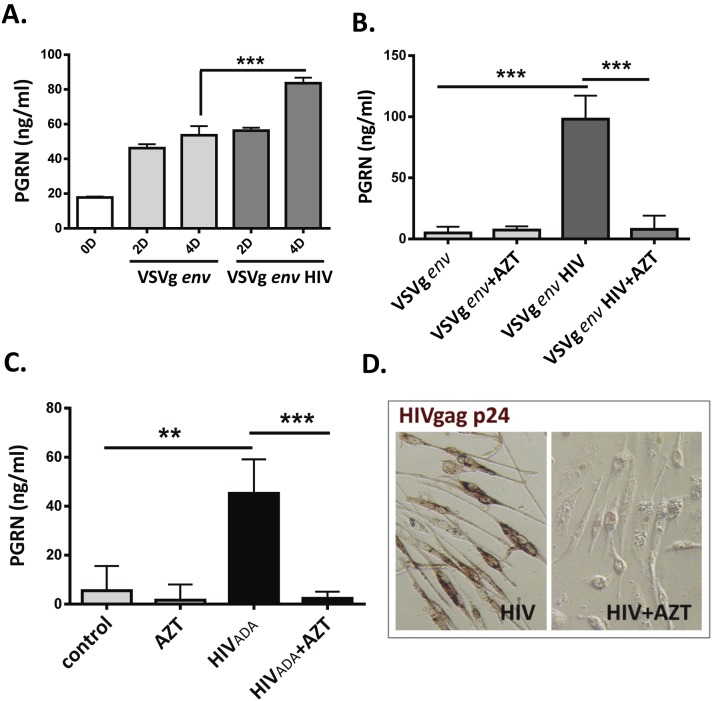
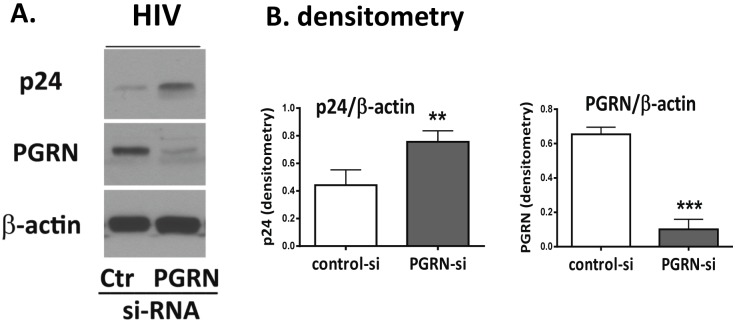
In plasma, PGRN levels correlated with the viral load (VL, p<0.001). In the CSF of subjects with undetectable VL, lower PGRN was associated with neurocognitive impairment (p = 0.046). CSF PGRN correlated with CSF IP-10, TNFα and IL-10, and plasma PGRN correlated with plasma IP-10. In vitro, microglial HIV infection increased PGRN production and PGRN knockdown increased HIV replication, demonstrating that PGRN is an innate antiviral protein.
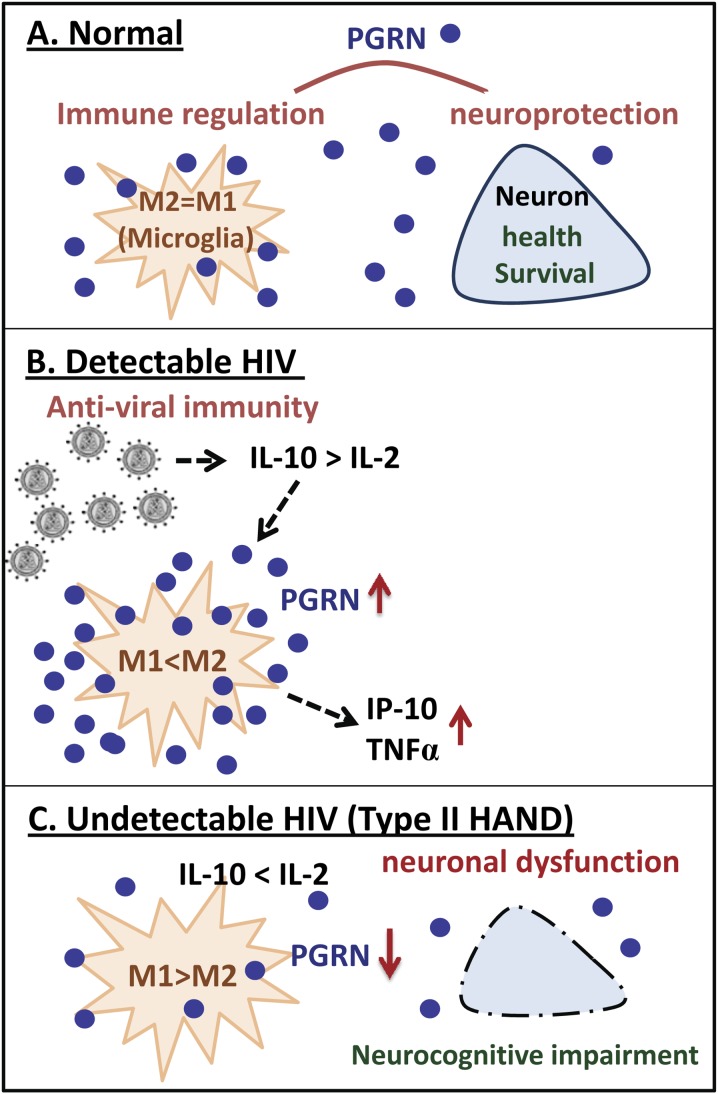
We propose that PGRN plays dual roles in people living with HIV disease. With active HIV replication, PGRN is induced in infected macrophages and microglia and functions as an antiviral protein. In individuals without active viral replication, decreased PGRN production contributes to neurocognitive dysfunction, probably through a diminution of its neurotrophic functions. Our results have implications for the pathogenesis, biomarker studies and therapy for HIV diseases including HIV-associated neurocognitive dysfunction (HAND).
有确凿数据表明,正常水平的颗粒蛋白前体(PGRN)是中枢神经系统(CNS)成功老化所必需的。PGRN的产生也受炎症和感染的调节,但关于CNS感染HIV期间PGRN的产生及作用尚无相关数据。
为确定PGRN与HIV疾病、神经认知及炎症之间的关系,我们分析了来自CHARTER(一个特征明确的HIV队列)的107对匹配的脑脊液和血浆样本。通过酶联免疫吸附测定(ELISA)确定PGRN水平,并与几种炎症介质(干扰素γ、白细胞介素-6、白细胞介素-10、干扰素诱导蛋白10、单核细胞趋化蛋白-1、肿瘤坏死因子α、白细胞介素-1β、白细胞介素-4和白细胞介素-13)的水平以及临床、病毒学和人口统计学参数进行比较。还在HIV感染的原代人小胶质细胞培养物中研究了HIV感染与PGRN之间的关系。
在血浆中,PGRN水平与病毒载量相关(VL,p<0.001)。在病毒载量不可检测的受试者的脑脊液中,较低的PGRN与神经认知障碍相关(p = 0.046)。脑脊液PGRN与脑脊液干扰素诱导蛋白10、肿瘤坏死因子α和白细胞介素-10相关,血浆PGRN与血浆干扰素诱导蛋白10相关。在体外,小胶质细胞HIV感染增加了PGRN的产生,而PGRN敲低增加了HIV复制,表明PGRN是一种先天性抗病毒蛋白。
我们提出,PGRN在HIV感染者中发挥双重作用。在HIV活跃复制时,PGRN在受感染的巨噬细胞和小胶质细胞中被诱导,并作为一种抗病毒蛋白发挥作用。在没有活跃病毒复制的个体中,PGRN产生减少可能通过其神经营养功能的减弱导致神经认知功能障碍。我们的结果对包括HIV相关神经认知障碍(HAND)在内的HIV疾病的发病机制、生物标志物研究和治疗具有启示意义。