Caton Samantha J, Blundell Pam, Ahern Sara M, Nekitsing Chandani, Olsen Annemarie, Møller Per, Hausner Helene, Remy Eloïse, Nicklaus Sophie, Chabanet Claire, Issanchou Sylvie, Hetherington Marion M
Institute of Psychological Sciences, University of Leeds, Leeds, United Kingdom; School of Health and Related Research, University of Sheffield, United Kingdom.
Institute of Psychological Sciences, University of Leeds, Leeds, United Kingdom.
PLoS One. 2014 May 30;9(5):e97609. doi: 10.1371/journal.pone.0097609. eCollection 2014.
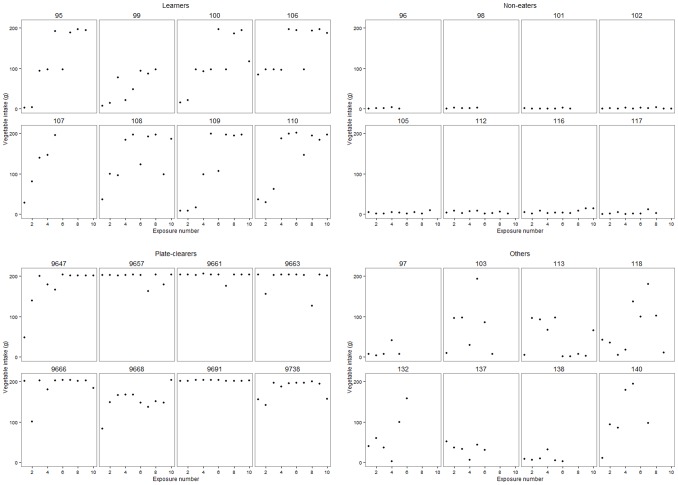
Vegetable intake is generally low among children, who appear to be especially fussy during the pre-school years. Repeated exposure is known to enhance intake of a novel vegetable in early life but individual differences in response to familiarisation have emerged from recent studies. In order to understand the factors which predict different responses to repeated exposure, data from the same experiment conducted in three groups of children from three countries (n = 332) aged 4-38 m (18.9±9.9 m) were combined and modelled. During the intervention period each child was given between 5 and 10 exposures to a novel vegetable (artichoke puree) in one of three versions (basic, sweet or added energy). Intake of basic artichoke puree was measured both before and after the exposure period. Overall, younger children consumed more artichoke than older children. Four distinct patterns of eating behaviour during the exposure period were defined. Most children were "learners" (40%) who increased intake over time. 21% consumed more than 75% of what was offered each time and were labelled "plate-clearers". 16% were considered "non-eaters" eating less than 10 g by the 5th exposure and the remainder were classified as "others" (23%) since their pattern was highly variable. Age was a significant predictor of eating pattern, with older pre-school children more likely to be non-eaters. Plate-clearers had higher enjoyment of food and lower satiety responsiveness than non-eaters who scored highest on food fussiness. Children in the added energy condition showed the smallest change in intake over time, compared to those in the basic or sweetened artichoke condition. Clearly whilst repeated exposure familiarises children with a novel food, alternative strategies that focus on encouraging initial tastes of the target food might be needed for the fussier and older pre-school children.
儿童的蔬菜摄入量普遍较低,而且在学龄前阶段,他们似乎特别挑食。已知反复接触某种新蔬菜能增加儿童在幼年时期对该蔬菜的摄入量,但最近的研究显示,儿童对熟悉过程的反应存在个体差异。为了了解哪些因素能够预测对反复接触的不同反应,我们将来自三个国家的三组4至38个月大(平均年龄18.9±9.9个月)儿童(n = 332)的同一实验数据进行合并并建模。在干预期间,每个儿童以三种形式(原味、甜味或添加能量型)之一,接触5至10次新蔬菜(洋蓟泥)。在接触期前后分别测量原味洋蓟泥的摄入量。总体而言,年龄较小的儿童比年龄较大的儿童食用了更多的洋蓟。我们定义了接触期内四种不同的饮食行为模式。大多数儿童是“学习者”(40%),他们的摄入量随时间增加。21%的儿童每次食用量超过提供量的75%,被标记为“光盘族”。16%的儿童被认为是“不吃者”,到第5次接触时食用量不足10克,其余的被归类为“其他”(23%),因为他们的模式变化很大。年龄是饮食模式的一个重要预测因素,年龄较大的学龄前儿童更有可能是不吃者。光盘族比在食物挑剔方面得分最高的不吃者对食物的喜爱程度更高,饱腹感反应更低。与原味或甜味洋蓟组相比,添加能量组的儿童摄入量随时间的变化最小。显然,虽然反复接触能让儿童熟悉新食物,但对于更挑食和年龄较大的学龄前儿童,可能需要采取其他策略来鼓励他们初次尝试目标食物。