King Ursula, Furgal Christopher
National Centre for Epidemiology and Population Health, College of Medicine, Biology and Environment, Australian National University, Canberra, ACT 0200, Australia.
Indigenous Environmental Studies Program, Trent University, Peterborough, ON K9J 7B8, Canada.
Int J Environ Res Public Health. 2014 May 28;11(6):5751-82. doi: 10.3390/ijerph110605751.
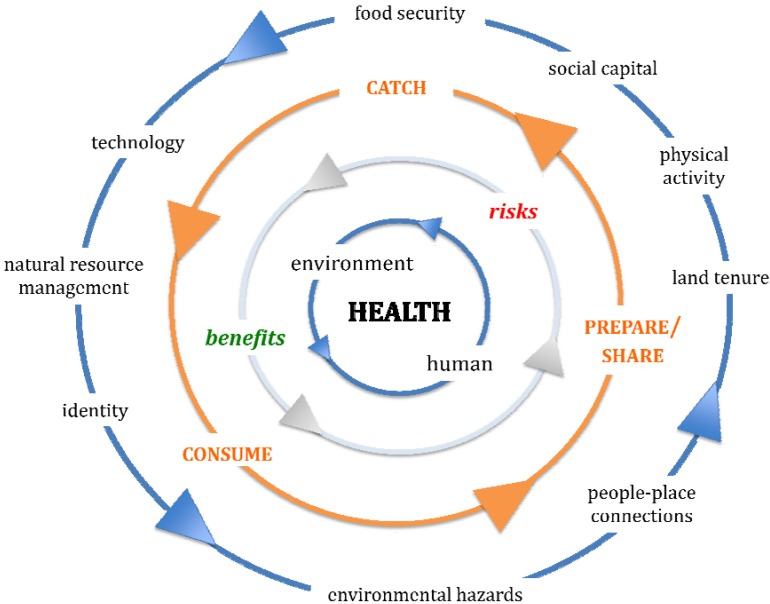
Indigenous participation in land-based practices such as hunting, fishing, ceremony, and land care has a long history. In recent years, researchers and policy makers have advocated the benefits of these practices for both Indigenous people and the places they live. However, there have also been documented risks associated with participation in these activities. Environmental change brought about by shifts in land use, climate changes, and the accumulation of contaminants in the food chain sit alongside equally rapid shifts in social, economic and cultural circumstances, preferences and practices. To date, the literature has not offered a wide-ranging review of the available cross-disciplinary or cross-ecozone evidence for these intersecting benefits and risks, for both human and environmental health and wellbeing. By utilising hunting as a case study, this paper seeks to fill part of that gap through a transdisciplinary meta-analysis of the international literature exploring the ways in which Indigenous participation in land-based practices and human-environmental health have been studied, where the current gaps are, and how these findings could be used to inform research and policy. The result is an intriguing summary of disparate research that highlights the patchwork of contradictory understandings, and uneven regional emphasis, that have been documented. A new model was subsequently developed that facilitates a more in-depth consideration of these complex issues within local-global scale considerations. These findings challenge the bounded disciplinary and geographic spaces in which much of this work has occurred to date, and opens a dialogue to consider the importance of approaching these issues holistically.
原住民参与狩猎、捕鱼、仪式和土地养护等基于土地的活动有着悠久的历史。近年来,研究人员和政策制定者倡导这些活动对原住民及其居住地区都有益处。然而,也有记录表明参与这些活动存在风险。土地利用变化、气候变化以及食物链中污染物的积累所带来的环境变化,与社会、经济和文化环境、偏好及实践同样迅速的转变并存。迄今为止,文献尚未对这些交叉的益处和风险,以及对人类和环境健康与福祉的现有跨学科或跨生态区证据进行广泛综述。本文以狩猎为案例研究,旨在通过对国际文献的跨学科元分析来填补部分空白,探讨原住民参与基于土地的活动与人类 - 环境健康的研究方式、当前存在的差距,以及这些研究结果如何用于为研究和政策提供信息。结果是对不同研究的有趣总结,突出了已记录的相互矛盾的理解拼凑以及不均衡的区域重点。随后开发了一个新模型,有助于在地方 - 全球尺度的考量内更深入地思考这些复杂问题。这些发现挑战了迄今为止许多此类工作所处的有限学科和地理空间,并开启了一场对话,以考虑全面处理这些问题的重要性。