Department of Earth, Atmospheric and Planetary Sciences, Massachusetts Institute of Technology, 77 Massachusetts Avenue, Cambridge, MA 02139, USA
Department of Earth, Atmospheric and Planetary Sciences, Massachusetts Institute of Technology, 77 Massachusetts Avenue, Cambridge, MA 02139, USA.
Philos Trans A Math Phys Eng Sci. 2014 Jul 13;372(2019):20130040. doi: 10.1098/rsta.2013.0040.
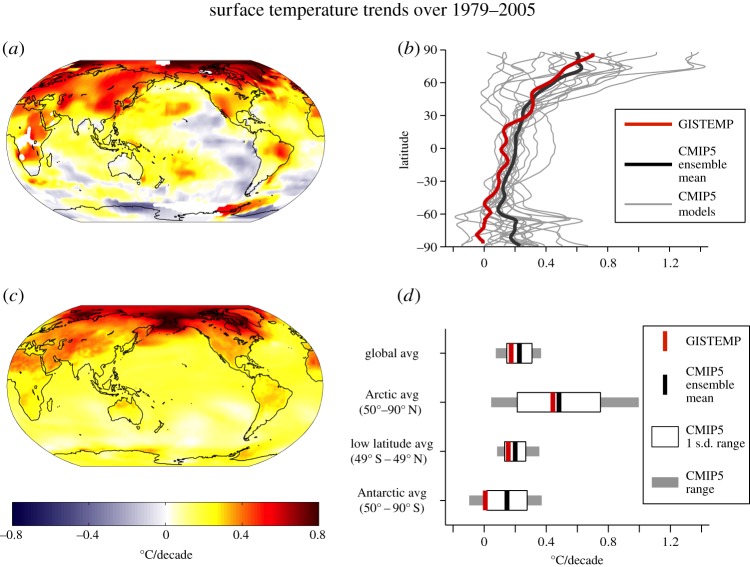
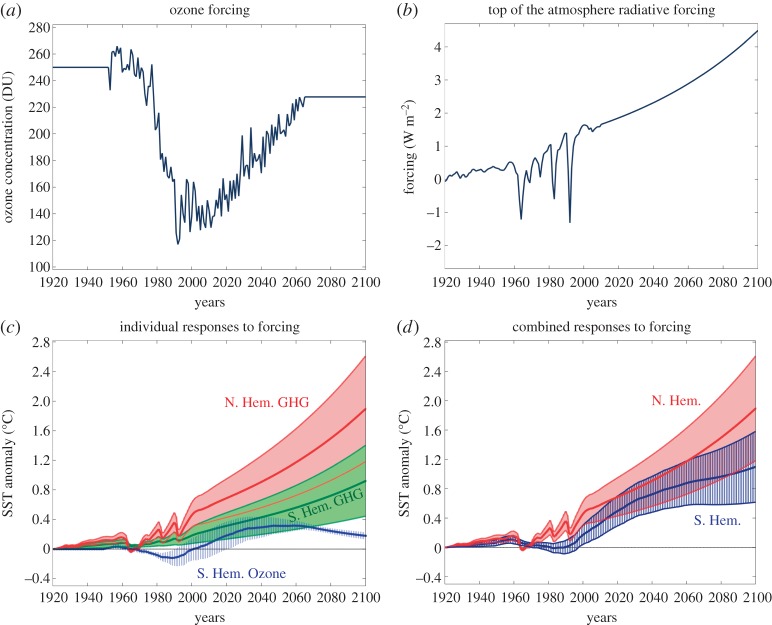
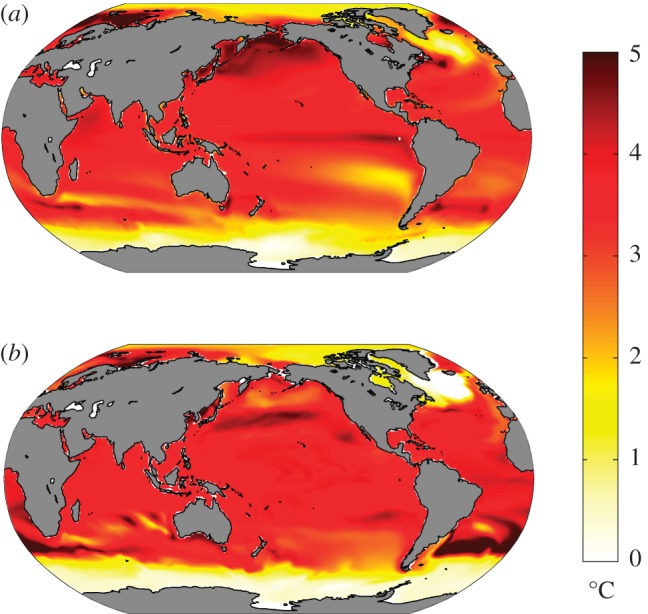
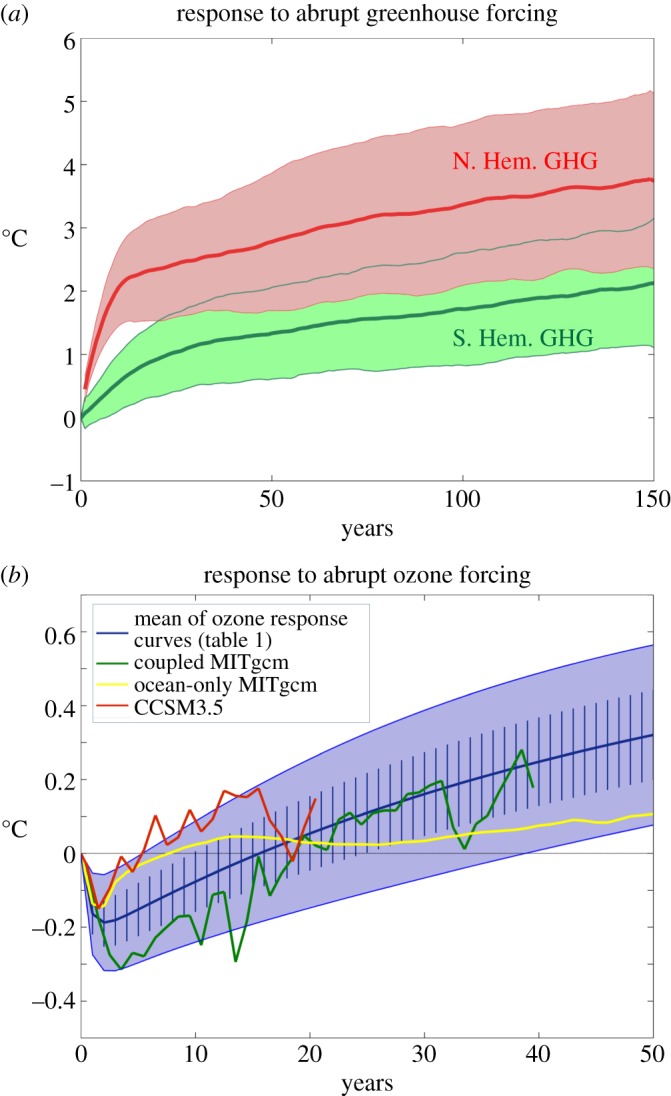
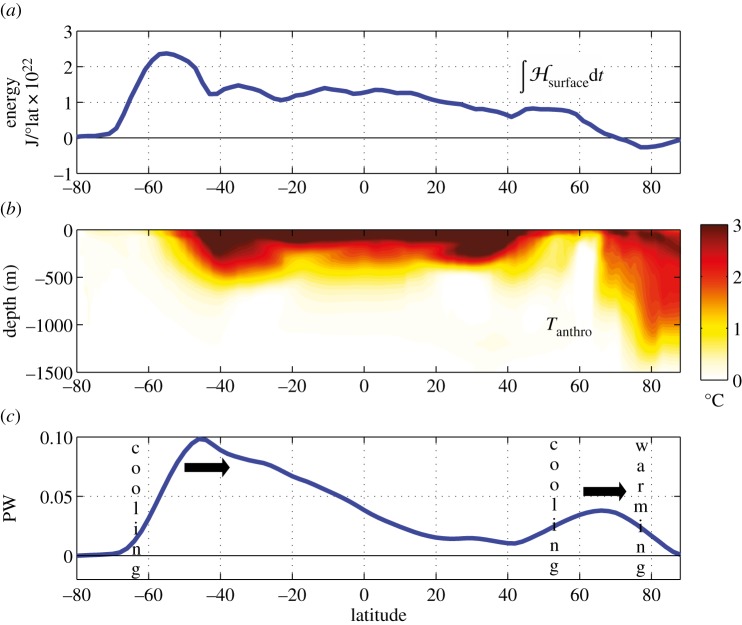
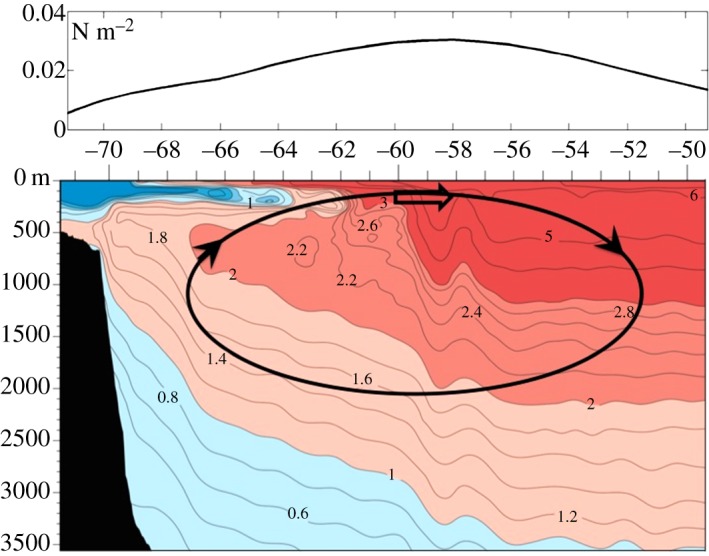
In recent decades, the Arctic has been warming and sea ice disappearing. By contrast, the Southern Ocean around Antarctica has been (mainly) cooling and sea-ice extent growing. We argue here that interhemispheric asymmetries in the mean ocean circulation, with sinking in the northern North Atlantic and upwelling around Antarctica, strongly influence the sea-surface temperature (SST) response to anthropogenic greenhouse gas (GHG) forcing, accelerating warming in the Arctic while delaying it in the Antarctic. Furthermore, while the amplitude of GHG forcing has been similar at the poles, significant ozone depletion only occurs over Antarctica. We suggest that the initial response of SST around Antarctica to ozone depletion is one of cooling and only later adds to the GHG-induced warming trend as upwelling of sub-surface warm water associated with stronger surface westerlies impacts surface properties. We organize our discussion around 'climate response functions' (CRFs), i.e. the response of the climate to 'step' changes in anthropogenic forcing in which GHG and/or ozone-hole forcing is abruptly turned on and the transient response of the climate revealed and studied. Convolutions of known or postulated GHG and ozone-hole forcing functions with their respective CRFs then yield the transient forced SST response (implied by linear response theory), providing a context for discussion of the differing warming/cooling trends in the Arctic and Antarctic. We speculate that the period through which we are now passing may be one in which the delayed warming of SST associated with GHG forcing around Antarctica is largely cancelled by the cooling effects associated with the ozone hole. By mid-century, however, ozone-hole effects may instead be adding to GHG warming around Antarctica but with diminished amplitude as the ozone hole heals. The Arctic, meanwhile, responding to GHG forcing but in a manner amplified by ocean heat transport, may continue to warm at an accelerating rate.
近几十年来,北极地区一直在变暖,海冰也在不断融化。相比之下,南极洲周围的南大洋一直在(主要)降温,海冰面积也在扩大。我们在这里认为,跨半球海洋环流的不对称性,即北大西洋北部的下沉和南极洲周围的上升流,强烈影响了海洋表面温度(SST)对人为温室气体(GHG)强迫的响应,加速了北极变暖,同时延缓了南极变暖。此外,虽然极地的 GHG 强迫幅度相似,但只有南极洲上空出现了大量臭氧消耗。我们认为,南极洲周围 SST 对臭氧消耗的初始响应是降温,只有当与更强的西风相关的表面温暖海水的上升流影响表面特性时,才会加入到 GHG 引起的变暖趋势中。我们围绕“气候响应函数”(CRF)组织讨论,即气候对人为强迫的“阶跃”变化的响应,其中 GHG 和/或臭氧空洞强迫突然开启,以及气候的瞬态响应被揭示和研究。已知或假设的 GHG 和臭氧空洞强迫函数与它们各自的 CRF 的卷积,然后产生瞬态强迫 SST 响应(由线性响应理论暗示),为讨论北极和南极的不同变暖/冷却趋势提供了背景。我们推测,我们现在所处的时期可能是一个南极地区 GHG 强迫引起的 SST 延迟变暖在很大程度上被与臭氧空洞相关的冷却效应抵消的时期。然而,到本世纪中叶,臭氧空洞效应可能会加剧南极地区的 GHG 变暖,但由于臭氧空洞的修复,其幅度会减小。与此同时,北极对 GHG 强迫的响应,但由于海洋热输送的放大,可能会继续以加速的速度变暖。