Department of Surgery, The University of Chicago, Chicago, Illinois, United States of America.
Department of Medicine, The University of Chicago, Chicago, Illinois, United States of America.
PLoS One. 2014 Jun 3;9(6):e98654. doi: 10.1371/journal.pone.0098654. eCollection 2014.
Frailty is a predictor of poor outcomes following many types of operations. We measured thoracic surgeons' accuracy in assessing patient frailty using videos of standardized patients demonstrating signs of physical frailty. We compared their performance to that of geriatrics specialists.
We developed an anchored scale for rating degree of frailty. Reference categories were assigned to 31 videos of standardized patients trained to exhibit five levels of activity ranging from "vigorous" to "frail." Following an explanation of frailty, thoracic surgeons and geriatrics specialists rated the videos. We evaluated inter-rater agreement and tested differences between ratings and reference categories. The influences of clinical specialty, clinical experience, and self-rated expertise were examined.
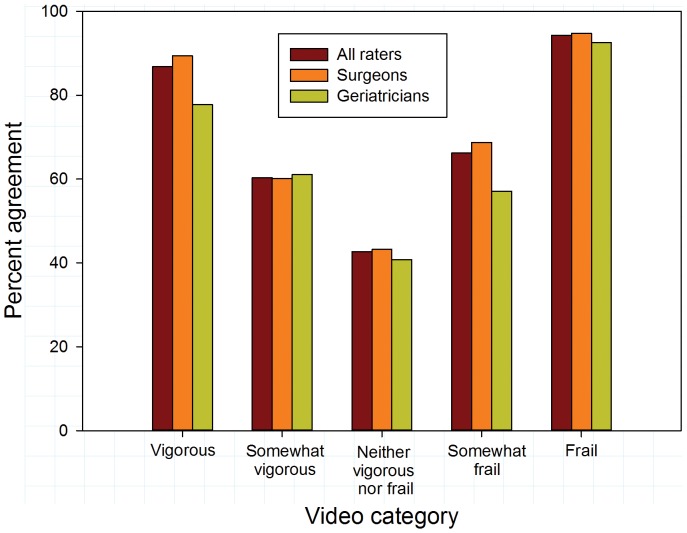
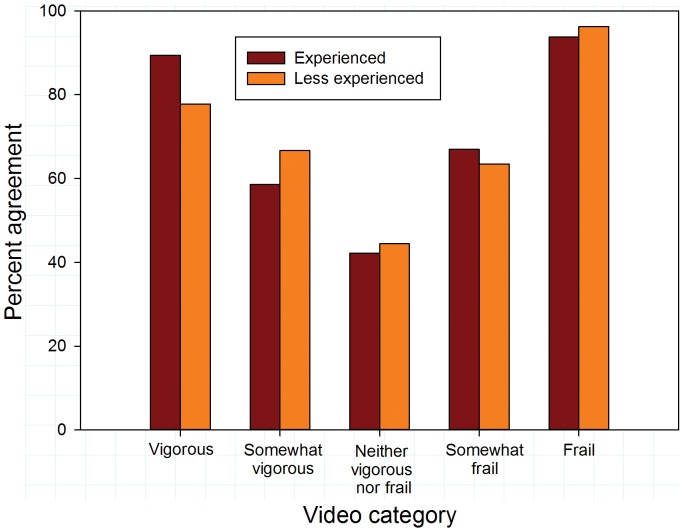
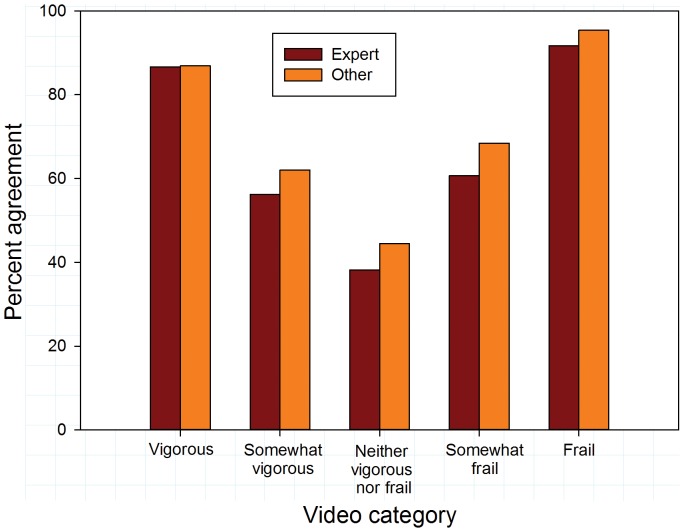
Inter-rater rank correlation among all participants was high (Kendall's W 0.85) whereas exact agreement (Fleiss' kappa) was only moderate (0.47). Better inter-rater agreement was demonstrated for videos exhibiting extremes of behavior. Exact agreement was better for thoracic surgeons (n = 32) than geriatrics specialists (n = 9; p = 0.045), whereas rank correlation was similar for both groups. More clinical years of experience and self-reported expertise were not associated with better inter-rater agreement.
Videos of standardized patients exhibiting varying degrees of frailty are rated with internal consistency by thoracic surgeons as accurately as geriatrics specialists when referenced to an anchored scale. Ratings were less consistent for moderate degrees of frailty, suggesting that physicians require training to recognize early frailty. Such videos may be useful in assessing and teaching frailty recognition.
虚弱是许多类型手术不良预后的预测因素。我们通过展示身体虚弱迹象的标准化患者视频来衡量胸外科医生评估患者虚弱程度的准确性。我们将他们的表现与老年病专家进行了比较。
我们开发了一种用于评估虚弱程度的有锚定标准的量表。参考类别被分配给 31 个经过训练的标准化患者视频,这些患者被训练展示从“精力充沛”到“虚弱”五个不同活动水平的迹象。在对虚弱进行解释后,胸外科医生和老年病专家对视频进行了评分。我们评估了评分者之间的一致性,并测试了评分与参考类别之间的差异。还检查了临床专业、临床经验和自我评估专业知识的影响。
所有参与者之间的评分者间等级相关度较高(Kendall 的 W 为 0.85),而完全一致性(Fleiss 的 kappa)仅为中等(0.47)。对于表现出极端行为的视频,评分者之间的一致性更好。胸外科医生(n = 32)的完全一致性优于老年病专家(n = 9;p = 0.045),而两组的等级相关性相似。更多的临床工作年限和自我报告的专业知识与更好的评分者间一致性无关。
当参考有锚定标准时,展示不同程度虚弱的标准化患者视频被胸外科医生和老年病专家一致准确地进行了评分。对于中度虚弱,评分的一致性较差,这表明医生需要接受识别早期虚弱的培训。此类视频可能有助于评估和教授虚弱识别。