Key Laboratory of Agricultural Water Resources, Center for Agricultural Resources Research, Institute of Genetics and Developmental Biology, Chinese Academy of Sciences, Shijiazhuang, Hebei, China.
Department of Soil Quality, Wageningen University, Alterra, Wageningen, The Netherlands.
PLoS One. 2014 Jun 3;9(6):e98445. doi: 10.1371/journal.pone.0098445. eCollection 2014.
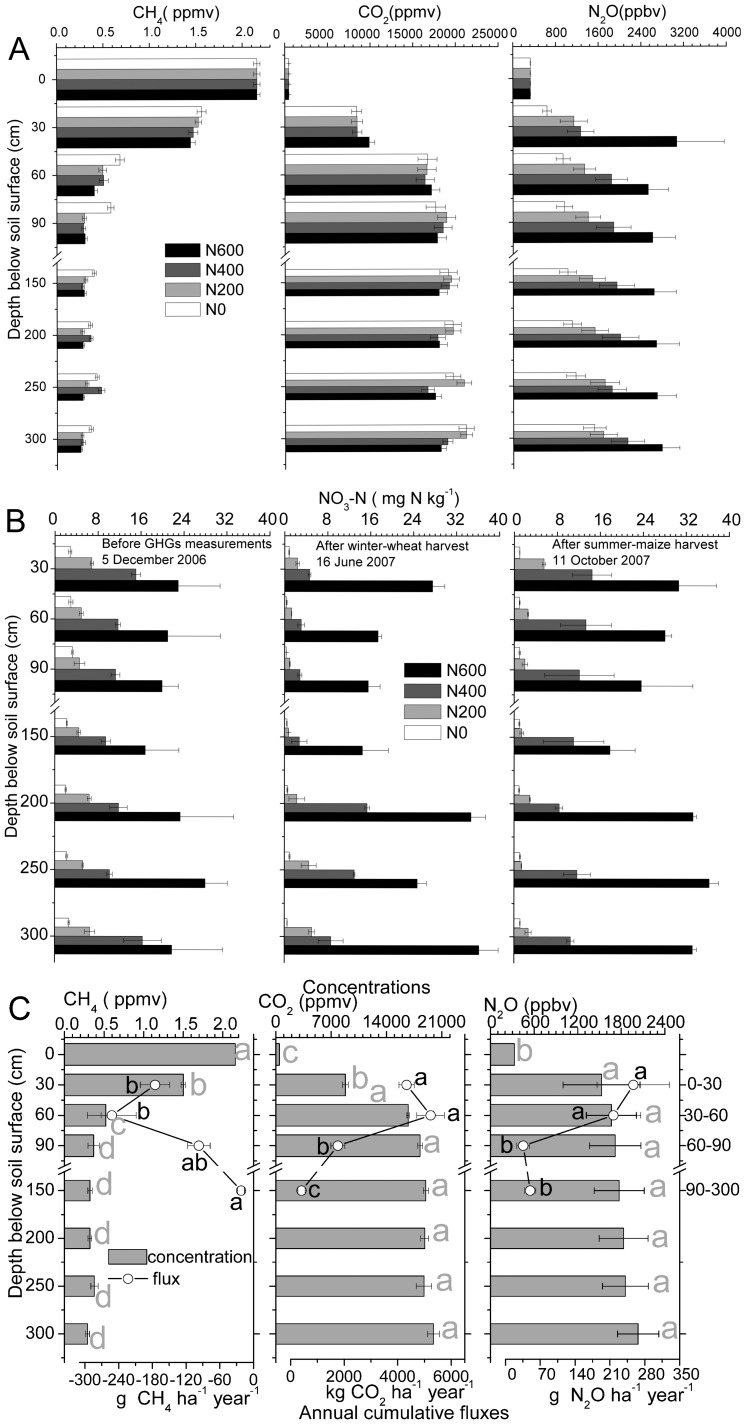
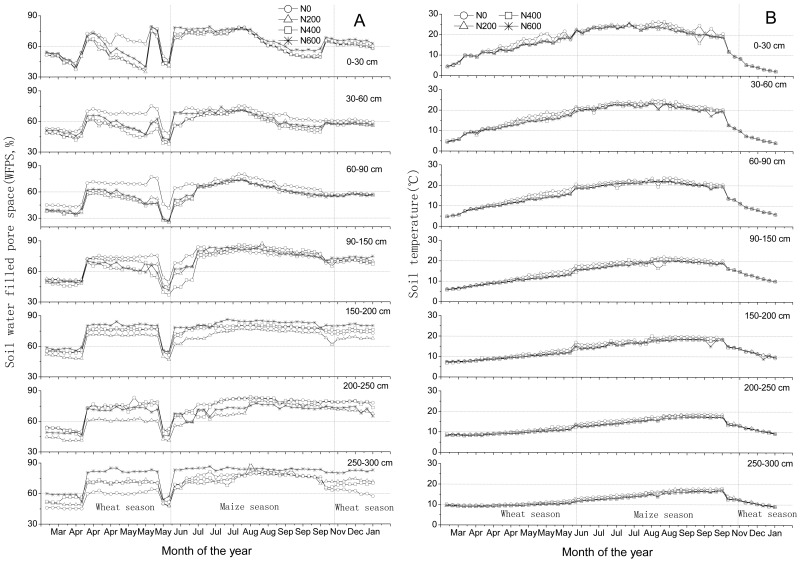
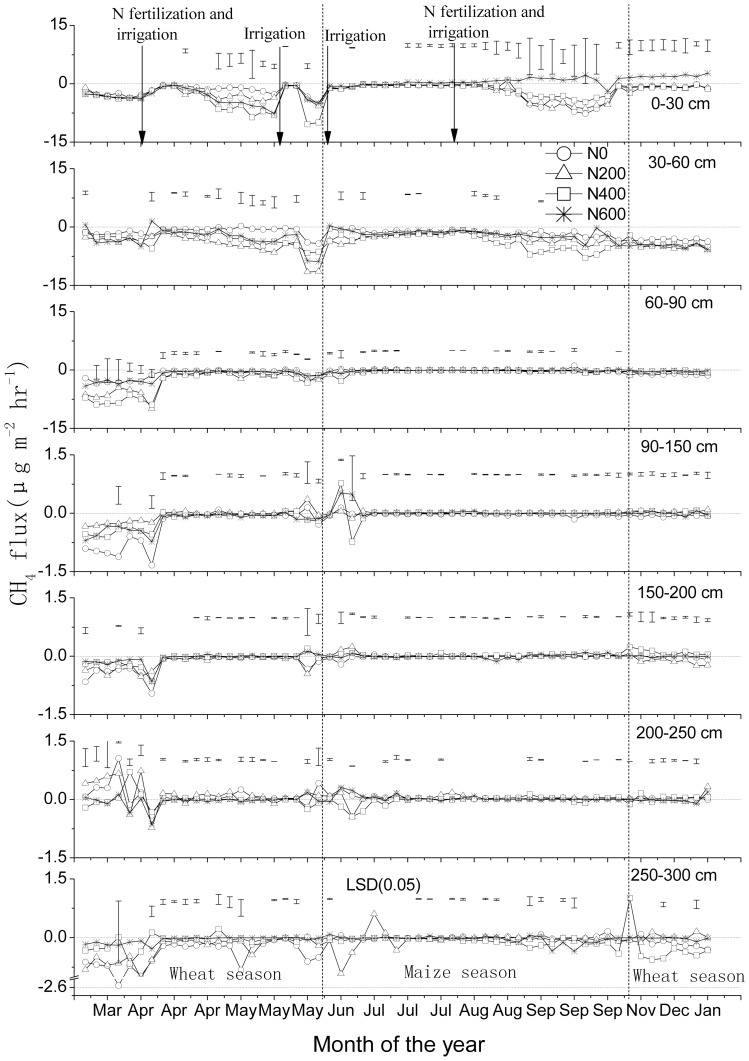
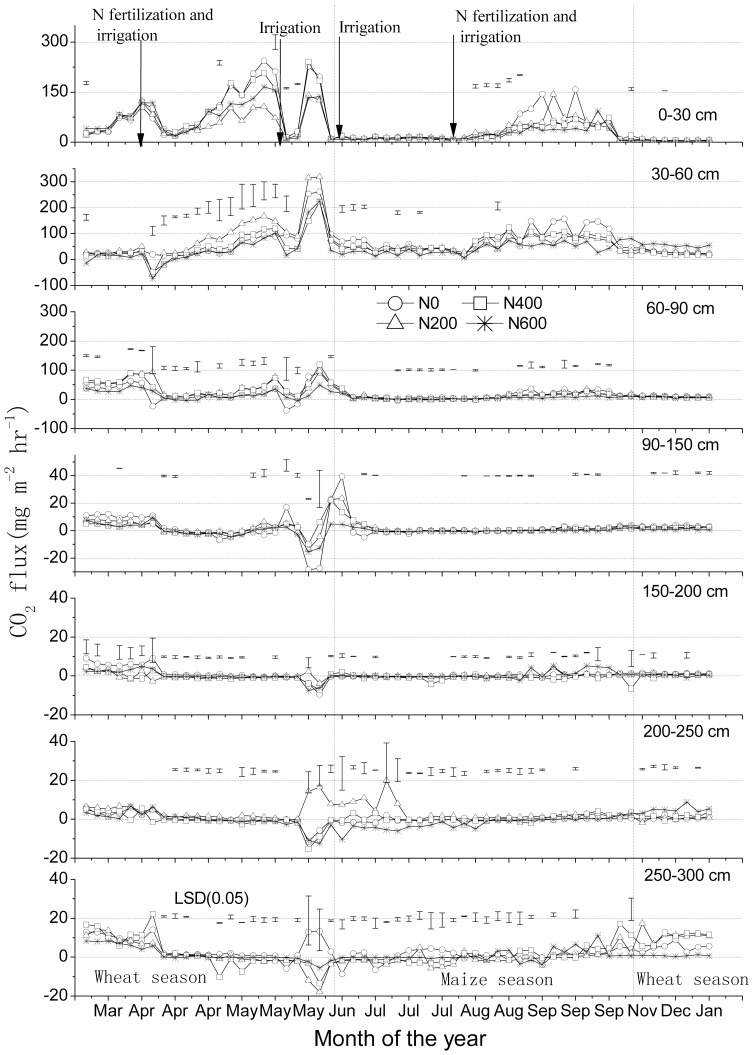
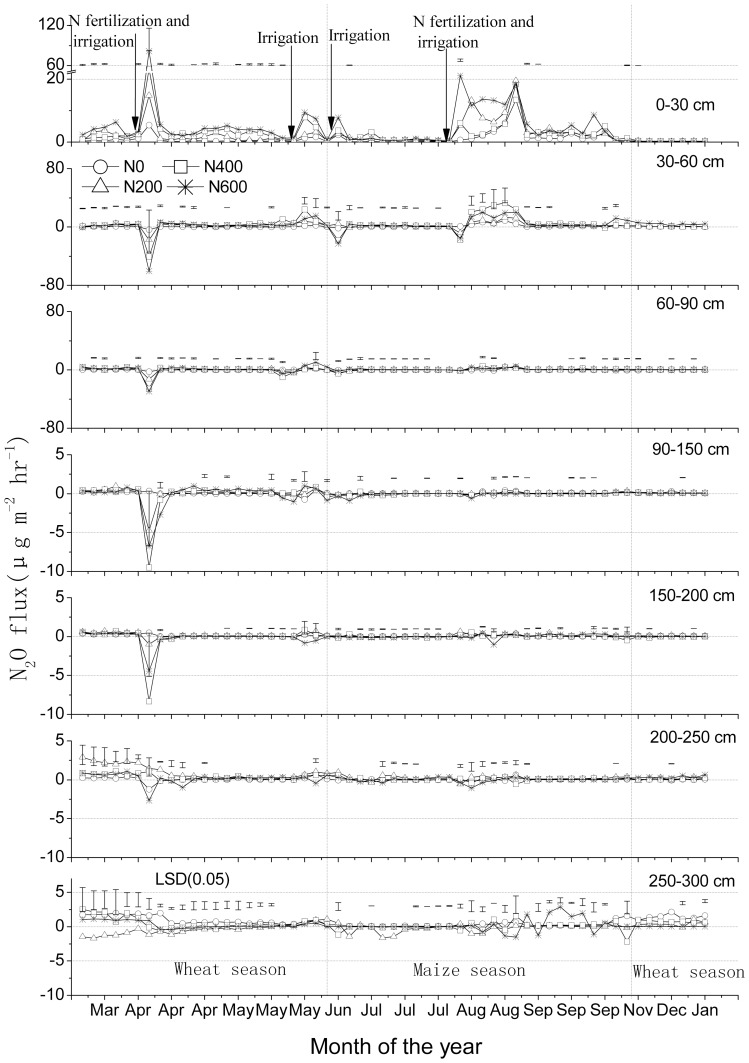
The production and consumption of the greenhouse gases (GHGs) methane (CH4), carbon dioxide (CO2) and nitrous oxide (N2O) in soil profile are poorly understood. This work sought to quantify the GHG production and consumption at seven depths (0-30, 30-60, 60-90, 90-150, 150-200, 200-250 and 250-300 cm) in a long-term field experiment with a winter wheat-summer maize rotation system, and four N application rates (0; 200; 400 and 600 kg N ha(-1) year(-1)) in the North China Plain. The gas samples were taken twice a week and analyzed by gas chromatography. GHG production and consumption in soil layers were inferred using Fick's law. Results showed nitrogen application significantly increased N2O fluxes in soil down to 90 cm but did not affect CH4 and CO2 fluxes. Soil moisture played an important role in soil profile GHG fluxes; both CH4 consumption and CO2 fluxes in and from soil tended to decrease with increasing soil water filled pore space (WFPS). The top 0-60 cm of soil was a sink of atmospheric CH4, and a source of both CO2 and N2O, more than 90% of the annual cumulative GHG fluxes originated at depths shallower than 90 cm; the subsoil (>90 cm) was not a major source or sink of GHG, rather it acted as a 'reservoir'. This study provides quantitative evidence for the production and consumption of CH4, CO2 and N2O in the soil profile.
土壤剖面中温室气体(GHG)甲烷(CH4)、二氧化碳(CO2)和氧化亚氮(N2O)的产生和消耗情况了解甚少。本研究旨在量化华北平原冬小麦-夏玉米轮作系统中 7 个深度(0-30、30-60、60-90、90-150、150-200、200-250 和 250-300 cm)和 4 个施氮量(0、200、400 和 600 kg N ha-1 year-1)下的 GHG 产生和消耗情况。每周采集两次气体样本并用气相色谱法进行分析。使用菲克定律推断土壤各层中的 GHG 产生和消耗情况。结果表明,氮素的施加显著增加了 90 cm 以下土壤中 N2O 的通量,但对 CH4 和 CO2 的通量没有影响。土壤水分在土壤剖面 GHG 通量中起着重要作用;土壤中 CH4 的消耗和 CO2 的通量均随土壤水填充孔隙空间(WFPS)的增加而减少。0-60 cm 的表层土壤是大气 CH4 的汇,也是 CO2 和 N2O 的源,超过 90%的年累积 GHG 通量来源于 90 cm 以下的土壤;底土(>90 cm)不是 GHG 的主要源或汇,而是一个“储库”。本研究为土壤剖面中 CH4、CO2 和 N2O 的产生和消耗提供了定量证据。