Serrano Samantha E, Braun Joseph, Trasande Leonardo, Dills Russell, Sathyanarayana Sheela
Center for Child Health, Behavior and Development, Seattle Children's Research Institute, 2001 8th Avenue, 98121 Seattle, WA, USA.
Environ Health. 2014 Jun 2;13(1):43. doi: 10.1186/1476-069X-13-43.
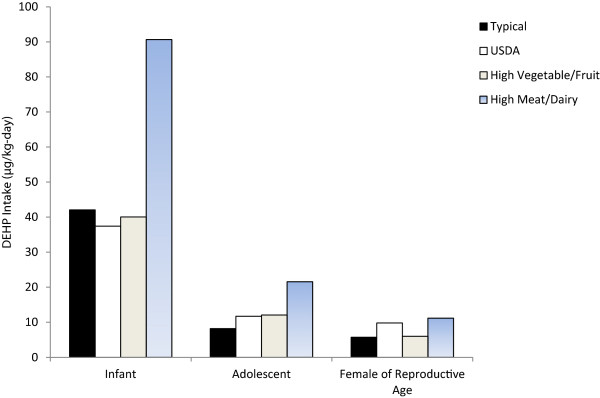
Phthalates are associated with a variety of health outcomes, but sources that may be targeted for exposure reduction messaging remain elusive. Diet is considered a significant exposure pathway for these compounds. Therefore, we sought to identify primary foods associated with increased exposure through a review of the food monitoring survey and epidemiological data. A search in PubMed and Google Scholar for keywords "phthalates" and "diet" "food" "food stuffs" "dietary intake" "food intake" and "food concentration" resulted in 17 studies measuring phthalate concentrations in United States (US) and international foods, three epidemiological association studies, and three interventions. We report on food groups with high (≥300 μg/kg) and low (<50 μg/kg) concentrations and compare these to foods associated with phthalate body burden. Based on these data, we estimated daily intakes of di-2-ethylhexyl phthalate (DEHP) of US women of reproductive age, adolescents and infants for typical consumption patterns as well as healthy and poor diets. We consistently observed high DEHP concentrations in poultry, cooking oils and cream-based dairy products (≥300 μg/kg) across food monitoring studies. Diethyl phthalate (DEP) levels were found at low concentrations across all food groups. In line with these data, epidemiological studies showed positive associations between consumption of meats, discretionary fat and dairy products and DEHP. In contrast to food monitoring data, DEP was found to be associated with intake of vegetables in two studies. DEHP exposure estimates based on typical diets were 5.7, 8.1, and 42.1 μg/kg-day for women of reproductive age, adolescents and infants, respectively, with dairy as the largest contributor to exposure. Diets high in meat and dairy consumption resulted in two-fold increases in exposure. Estimates for infants based on a typical diet exceeded the Environmental Protection Agency's reference dose of 20 μg/kg-day while diets high in dairy and meat consumed by adolescents also exceeded this threshold. The review of the literature demonstrated that DEHP in some meats, fats and dairy products is consistently found in high concentrations and can contribute to exposure. Guidance on future research in this area is provided that may help to identify methods to reduce dietary phthalate exposures.
邻苯二甲酸盐与多种健康结果相关,但可能成为减少接触信息目标的来源仍不明确。饮食被认为是这些化合物的一个重要接触途径。因此,我们试图通过回顾食品监测调查和流行病学数据来确定与接触增加相关的主要食物。在PubMed和谷歌学术中搜索关键词“邻苯二甲酸盐”以及“饮食”“食物”“食品”“膳食摄入量”“食物摄入量”和“食物浓度”,得到了17项测量美国和国际食物中邻苯二甲酸盐浓度的研究、3项流行病学关联研究以及3项干预研究。我们报告了高浓度(≥300μg/kg)和低浓度(<50μg/kg)的食物类别,并将其与与邻苯二甲酸酯身体负担相关的食物进行比较。基于这些数据,我们估算了美国育龄妇女、青少年和婴儿按照典型消费模式以及健康和不良饮食摄入邻苯二甲酸二(2-乙基己基)酯(DEHP)的每日摄入量。在各项食品监测研究中,我们一致观察到家禽、食用油和乳制奶油产品中DEHP浓度较高(≥300μg/kg)。在所有食物类别中,邻苯二甲酸二乙酯(DEP)水平均较低。与这些数据一致,流行病学研究表明肉类、 discretionary脂肪和乳制品的消费与DEHP之间存在正相关。与食品监测数据相反,在两项研究中发现DEP与蔬菜摄入量有关。基于典型饮食的DEHP接触估计值分别为育龄妇女5.7μg/kg-天、青少年8.1μg/kg-天和婴儿42.1μg/kg-天,其中乳制品是接触的最大贡献者。高肉类和乳制品消费的饮食导致接触量增加两倍。基于典型饮食的婴儿估计值超过了美国环境保护局20μg/kg-天的参考剂量,而青少年高乳制品和肉类消费的饮食也超过了这一阈值。文献综述表明,在一些肉类、脂肪和乳制品中始终发现高浓度的DEHP,并且可能导致接触。提供了该领域未来研究的指导意见,这可能有助于确定减少膳食邻苯二甲酸盐接触的方法。