Smith Jeffrey Michael, Baawo Saye Dahn, Subah Marion, Sirtor-Gbassie Varwo, Howe Cuallau Jabbeh, Ishola Gbenga, Tehoungue Bentoe Z, Dwivedi Vikas
MCHIP, Jhpiego, 1776 Massachusetts Ave,, NW#300, Washington, DC 20036, USA.
BMC Pregnancy Childbirth. 2014 Jun 4;14:189. doi: 10.1186/1471-2393-14-189.
A postpartum hemorrhage prevention program to increase uterotonic coverage for home and facility births was introduced in two districts of Liberia. Advance distribution of misoprostol was offered during antenatal care (ANC) and home visits. Feasibility, acceptability, effectiveness of distribution mechanisms and uterotonic coverage were evaluated.
Eight facilities were strengthened to provide PPH prevention with oxytocin, PPH management and advance distribution of misoprostol during ANC. Trained traditional midwives (TTMs) as volunteer community health workers (CHWs) provided education to pregnant women, and district reproductive health supervisors (DRHSs) distributed misoprostol during home visits. Data were collected through facility and DRHS registers. Postpartum interviews were conducted with a sample of 550 women who received advance distribution of misoprostol on place of delivery, knowledge, misoprostol use, and satisfaction.
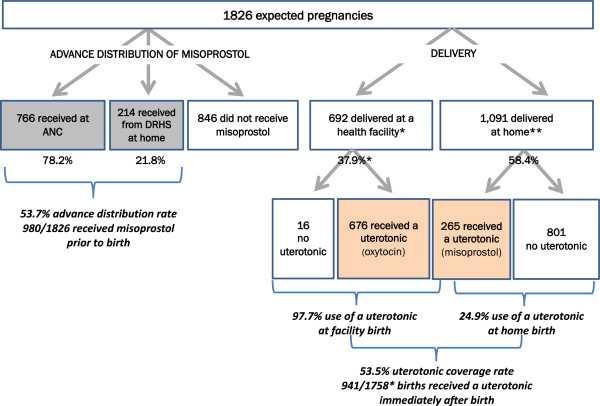
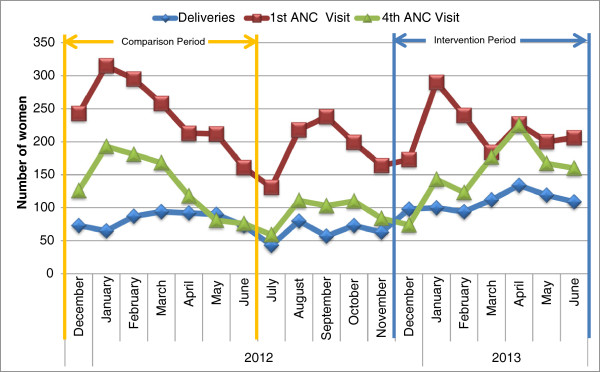
There were 1826 estimated deliveries during the seven-month implementation period. A total of 980 women (53.7%) were enrolled and provided misoprostol, primarily through ANC (78.2%). Uterotonic coverage rate of all deliveries was 53.5%, based on 97.7% oxytocin use at recorded facility vaginal births and 24.9% misoprostol use at home births. Among 550 women interviewed postpartum, 87.7% of those who received misoprostol and had a home birth took the drug. Sixty-three percent (63.0%) took it at the correct time, and 54.0% experienced at least one minor side effect. No serious adverse events reported among enrolled women. Facility-based deliveries appeared to increase during the program.
The program was moderately effective at achieving high uterotonic coverage of all births. Coverage of home births was low despite the use of two channels of advance distribution of misoprostol. Although ANC reached a greater proportion of women in late pregnancy than home visits, 46.3% of expected deliveries did not receive education or advance distribution of misoprostol. A revised community-based strategy is needed to increase advance distribution rates and misoprostol coverage rates for home births. Misoprostol for PPH prevention appears acceptable to women in Liberia. Correct timing of misoprostol self-administration needs improved emphasis during counseling and education.
在利比里亚的两个地区引入了一项产后出血预防计划,以提高在家分娩和医疗机构分娩时宫缩剂的覆盖率。在产前保健(ANC)和家访期间提供米索前列醇的预先分发。对分发机制的可行性、可接受性、有效性以及宫缩剂覆盖率进行了评估。
加强了八家医疗机构,以便在ANC期间提供催产素预防产后出血、管理产后出血并预先分发米索前列醇。经过培训的传统助产士(TTMs)作为志愿社区卫生工作者(CHWs)为孕妇提供教育,地区生殖健康监督员(DRHSs)在家访期间分发米索前列醇。通过医疗机构和DRHS的登记册收集数据。对550名预先收到米索前列醇分发的妇女进行了产后访谈,了解她们的分娩地点、知识、米索前列醇的使用情况和满意度。
在七个月的实施期间,估计有1826例分娩。共有980名妇女(53.7%)登记并获得了米索前列醇,主要是通过ANC(78.2%)。根据记录的医疗机构阴道分娩中催产素的使用率为97.7%以及在家分娩中米索前列醇的使用率为24.9%,所有分娩的宫缩剂覆盖率为53.5%。在550名产后接受访谈的妇女中,87.7%在家分娩且收到米索前列醇的妇女服用了该药物。63.0%的妇女在正确时间服用,54.0%的妇女经历了至少一种轻微副作用。登记的妇女中未报告严重不良事件。在该计划实施期间,医疗机构分娩似乎有所增加。
该计划在实现所有分娩的高宫缩剂覆盖率方面有一定成效。尽管采用了两种米索前列醇预先分发渠道,但在家分娩的覆盖率较低。尽管ANC在妊娠晚期覆盖的妇女比例高于家访,但46.3%的预期分娩妇女未接受教育或米索前列醇的预先分发。需要修订基于社区的策略,以提高在家分娩的预先分发率和米索前列醇覆盖率。在利比里亚,用于预防产后出血的米索前列醇似乎为妇女所接受。在咨询和教育过程中,需要更加强调米索前列醇自我给药的正确时间。