Rajbhandari Swaraj Pradhan, Aryal Kamal, Sheldon Wendy R, Ban Bharat, Upreti Senendra Raj, Regmi Kiran, Aryal Shilu, Winikoff Beverly
Gynuity Health Projects, 15 East 26th Street, Suite 801, New York, NY, 10010, USA.
New ERA (P) Ltd., Kathmandu, Nepal.
BMC Pregnancy Childbirth. 2017 Jun 5;17(1):169. doi: 10.1186/s12884-017-1347-z.
In 2009, the Nepal Ministry of Health and Population launched a national program for prevention of postpartum hemorrhage (PPH) during home births that features advance distribution of misoprostol to pregnant women. In the years since, the government has scaled-up the program throughout much of the country. This paper presents findings from the first large-scale assessment of the effectiveness of the advance distribution program.
Data collection was carried out in nine districts and all three ecological zones. To assess knowledge, receipt and use of misoprostol, household interviews were conducted with 2070 women who had given birth within the past 12 months. To assess supply and provision of misoprostol, interviews were conducted with 270 Female Community Health Volunteers (FCHVs) and staff at 99 health facilities.
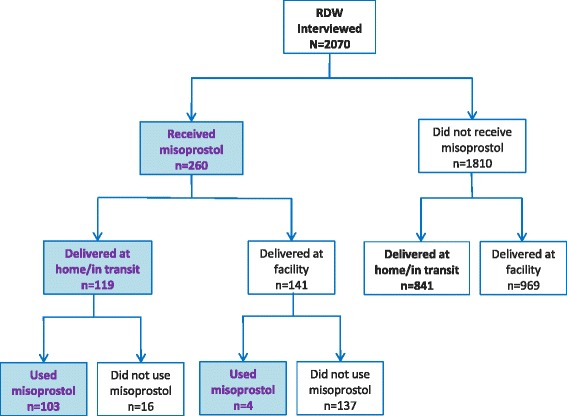
Among recently delivered women, only 15% received information about misoprostol and 13% received misoprostol tablets in advance of delivery. Yet 87% who received advance misoprostol and delivered at home used it for PPH prevention. Among FCHVs, 96% were providing advance misoprostol for PPH prevention; however 81% had experienced at least one misoprostol stock out within the past year. About one-half of FCHVs were providing incomplete information about the use of misoprostol; in addition, many did not discuss side effects, how to recognize PPH or where to go if PPH occurs. Among health facilities, just one-half had sufficient misoprostol stock, while 95% had sufficient oxytocin stock, at the time of this assessment.
In Nepal, women who receive advance misoprostol are both willing and able to use the medication for PPH prevention during home births. However the supply and personnel challenges identified raise questions about scalability and impact of the program over the long-term. Further assessment is needed.
2009年,尼泊尔卫生与人口部启动了一项针对在家分娩时预防产后出血(PPH)的全国性计划,该计划的特色是提前向孕妇分发米索前列醇。自那以后的几年里,政府已在该国大部分地区扩大了该计划。本文介绍了对提前分发计划有效性的首次大规模评估结果。
在九个地区和所有三个生态区进行了数据收集。为了评估米索前列醇的知识知晓情况、接收和使用情况,对过去12个月内分娩的2070名妇女进行了家庭访谈。为了评估米索前列醇的供应和发放情况,对270名女性社区卫生志愿者(FCHV)和99家卫生机构的工作人员进行了访谈。
在近期分娩的妇女中,只有15%的人收到了关于米索前列醇的信息,13%的人在分娩前收到了米索前列醇片。然而,87%提前收到米索前列醇并在家分娩的妇女将其用于预防产后出血。在女性社区卫生志愿者中,96%的人在为预防产后出血提前发放米索前列醇;然而,81%的人在过去一年中至少经历过一次米索前列醇缺货情况。约一半的女性社区卫生志愿者在米索前列醇使用方面提供的信息不完整;此外,许多人没有讨论副作用、如何识别产后出血或产后出血发生时应前往何处。在此次评估时,卫生机构中只有一半有足够的米索前列醇库存,而95%有足够的缩宫素库存。
在尼泊尔,提前收到米索前列醇的妇女愿意且能够在家分娩时使用该药物预防产后出血。然而,所发现的供应和人员方面的挑战引发了对该计划长期可扩展性和影响的质疑。需要进一步评估。