Simmons Glenn E, Pandey Somnath, Nedeljkovic-Kurepa Ana, Saxena Madhurima, Wang Allison, Pruitt Kevin
Department of Molecular and Cellular Physiology, LSU Health Sciences Center School of Medicine in Shreveport, Shreveport, Louisiana, United States of America.
Department of Molecular and Cellular Physiology, LSU Health Sciences Center School of Medicine in Shreveport, Shreveport, Louisiana, United States of America; The Feist-Weiller Cancer Center, LSU Health Sciences Center School of Medicine in Shreveport, Shreveport, Louisiana, United States of America.
PLoS One. 2014 Jun 4;9(6):e98861. doi: 10.1371/journal.pone.0098861. eCollection 2014.
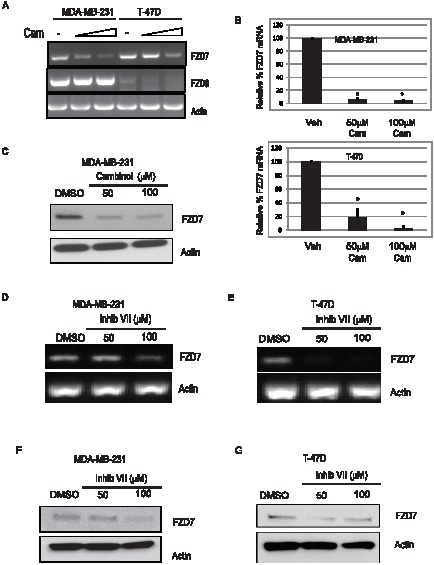
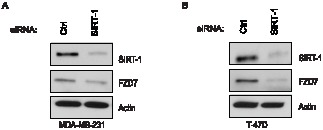
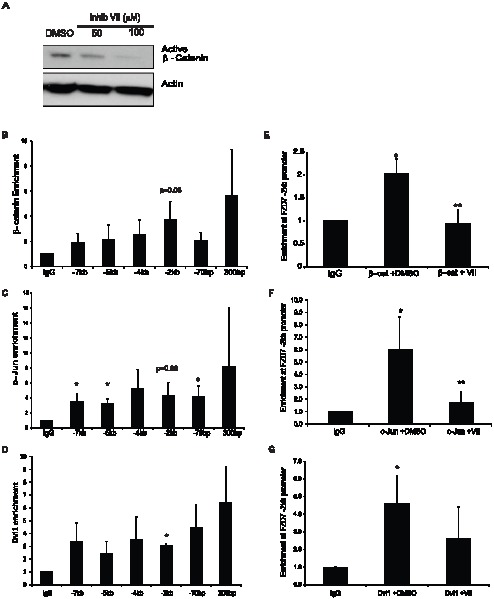
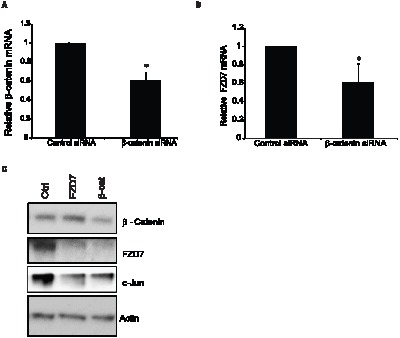
The Wnt signaling pathway is often chronically activated in diverse human tumors, and the Frizzled (FZD) family of receptors for Wnt ligands, are central to propagating oncogenic signals in a β-catenin-dependent and independent manner. SIRT1 is a class III histone deacetylase (HDAC) that deacetylates histone and non-histone proteins to regulate gene transcription and protein function. We previously demonstrated that SIRT1 loss of function led to a significant decrease in the levels of Dishevelled (Dvl) proteins. To further explore this connection between the sirtuins and components of the Wnt pathway, we analyzed sirtuin-mediated regulation of FZD proteins. Here we explore the contribution of sirtuin deacetylases in promoting constitutive Wnt pathway activation in breast cancer cells. We demonstrate that the use of small molecule inhibitors of SIRT1 and SIRT2, and siRNA specific to SIRT1, all reduce the levels of FZD7 mRNA. We further demonstrate that pharmacologic inhibition of SIRT1/2 causes a marked reduction in FZD7 protein levels. Additionally, we show that β-catenin and c-Jun occupy the 7 kb region upstream of the transcription start site of the FZD7 gene, and SIRT1 inhibition leads to a reduction in the occupancy of both β-catenin and c-Jun at points along this region. This work uncovers a new mechanism for the regulation of FZD7 and provides a critical new link between the sirtuins and FZD7, one of the earliest nodal points from which oncogenic Wnt signaling emanates. This study shows that inhibition of specific sirtuins may provide a unique strategy for inhibiting the constitutively active Wnt pathway at the level of the receptor.
Wnt信号通路在多种人类肿瘤中常常被慢性激活,而Wnt配体的卷曲蛋白(Frizzled,FZD)家族受体是以β-连环蛋白依赖性和非依赖性方式传播致癌信号的核心。沉默调节蛋白1(SIRT1)是一种III类组蛋白去乙酰化酶(HDAC),可使组蛋白和非组蛋白去乙酰化,从而调节基因转录和蛋白质功能。我们之前证明,SIRT1功能丧失导致散乱蛋白(Dishevelled,Dvl)水平显著降低。为了进一步探究沉默调节蛋白与Wnt通路组分之间的这种联系,我们分析了沉默调节蛋白对FZD蛋白的介导调控作用。在此,我们探讨了沉默调节蛋白去乙酰化酶在促进乳腺癌细胞中Wnt通路组成性激活方面的作用。我们证明,使用SIRT1和SIRT2的小分子抑制剂以及针对SIRT1的小干扰RNA(siRNA),均会降低FZD7 mRNA的水平。我们进一步证明,对SIRT1/2的药理学抑制会导致FZD7蛋白水平显著降低。此外,我们表明β-连环蛋白和c-Jun占据FZD7基因转录起始位点上游7 kb区域,而抑制SIRT1会导致β-连环蛋白和c-Jun在该区域各点的占据率降低。这项工作揭示了FZD7调控的一种新机制,并在沉默调节蛋白与FZD7之间提供了一个关键的新联系,FZD7是致癌Wnt信号最早发出的节点之一。这项研究表明,抑制特定的沉默调节蛋白可能为在受体水平抑制组成性激活的Wnt通路提供一种独特策略。