Departamento de Biotecnología, Instituto de Agroquímica y Tecnología de los Alimentos (CSIC), Burjassot, P,O, Box 73E-46100 Valencia, Spain.
BMC Genomics. 2014 Jun 4;15(1):432. doi: 10.1186/1471-2164-15-432.
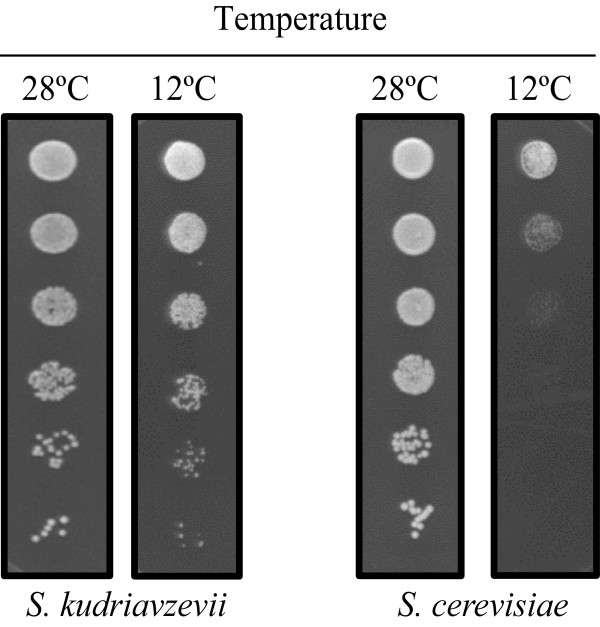
Comparative transcriptomics and functional studies of different Saccharomyces species have opened up the possibility of studying and understanding new yeast abilities. This is the case of yeast adaptation to stress, in particular the cold stress response, which is especially relevant for the food industry. Since the species Saccharomyces kudriavzevii is adapted to grow at low temperatures, it has been suggested that it contains physiological adaptations that allow it to rapidly and efficiently acclimatise after cold shock.
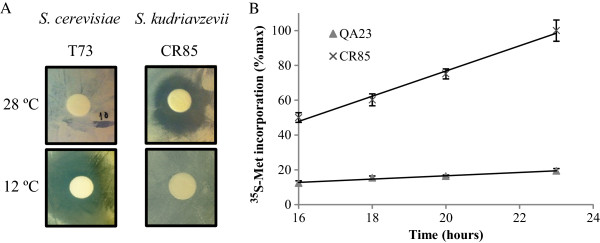
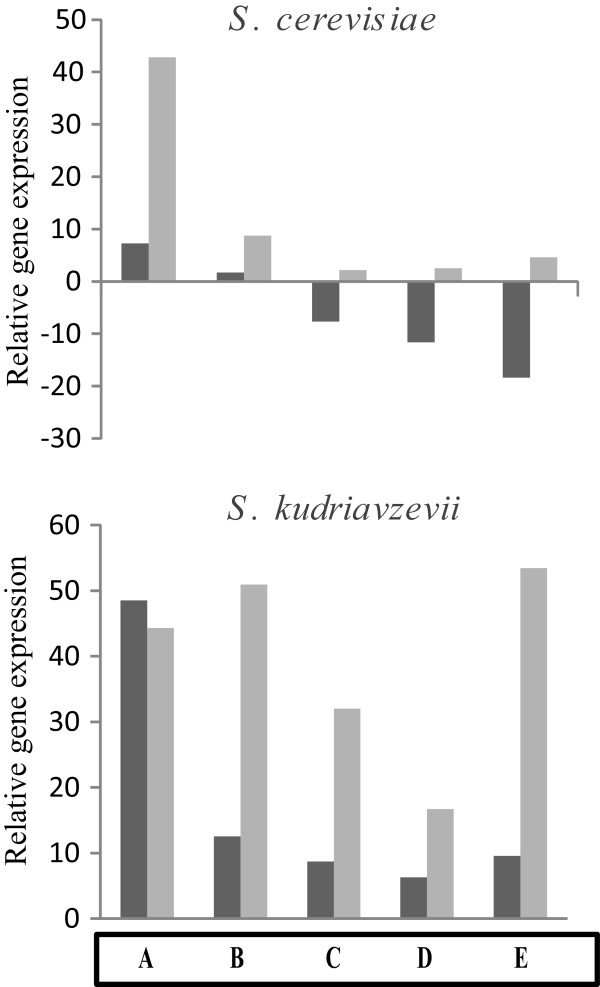
In this work, we aimed to provide new insights into the molecular basis determining this better cold adaptation of S. kudriavzevii strains. To this end, we have compared S. cerevisiae and S. kudriavzevii transcriptome after yeast adapted to cold shock. The results showed that both yeast mainly activated the genes related to translation machinery by comparing 12°C with 28°C, but the S. kudriavzevii response was stronger, showing an increased expression of dozens of genes involved in protein synthesis. This suggested enhanced translation efficiency at low temperatures, which was confirmed when we observed increased resistance to translation inhibitor paromomycin. Finally, 35S-methionine incorporation assays confirmed the increased S. kudriavzevii translation rate after cold shock.
This work confirms that S. kudriavzevii is able to grow at low temperatures, an interesting ability for different industrial applications. We propose that this adaptation is based on its enhanced ability to initiate a quick, efficient translation of crucial genes in cold adaptation among others, a mechanism that has been suggested for other microorganisms.
不同酿酒酵母物种的比较转录组学和功能研究为研究和理解新的酵母能力开辟了可能性。这就是酵母适应应激的情况,特别是冷应激反应,这对食品工业尤为重要。由于物种萨奇酵母(Saccharomyces kudriavzevii)适应在低温下生长,因此有人认为它包含了使它能够在冷冲击后快速有效地适应的生理适应。
在这项工作中,我们旨在为更好地了解决定 S. kudriavzevii 菌株冷适应能力的分子基础提供新的见解。为此,我们比较了适应冷冲击后的酿酒酵母(Saccharomyces cerevisiae)和 S. kudriavzevii 的转录组。结果表明,两种酵母主要通过将 12°C 与 28°C 进行比较,激活与翻译机制相关的基因,但 S. kudriavzevii 的反应更强,显示出数十个与蛋白质合成有关的基因表达增加。这表明在低温下翻译效率提高,当我们观察到翻译抑制剂巴龙霉素的抗性增加时得到了证实。最后,35S-甲硫氨酸掺入试验证实了冷冲击后 S. kudriavzevii 翻译率的增加。
这项工作证实了 S. kudriavzevii 能够在低温下生长,这是其在不同工业应用中的一个有趣能力。我们提出,这种适应是基于其在冷适应等其他关键基因快速、高效翻译的能力增强,这种机制已被提议用于其他微生物。