Zhang Liqun, Centa Thomas, Buck Matthias
Department of Physiology and Biophysics, Medical School of Case Western Reserve University , Cleveland, Ohio 44106, United States.
J Phys Chem B. 2014 Jul 3;118(26):7302-11. doi: 10.1021/jp503668k. Epub 2014 Jun 25.
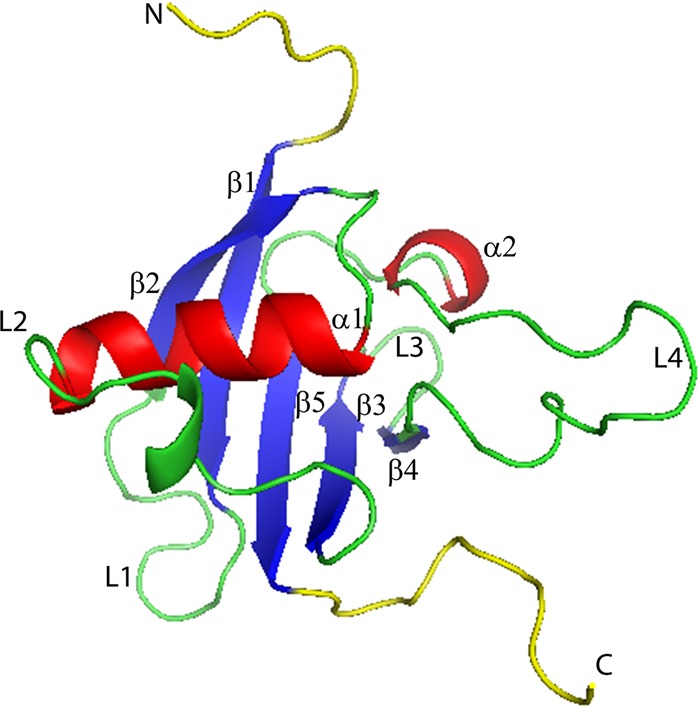
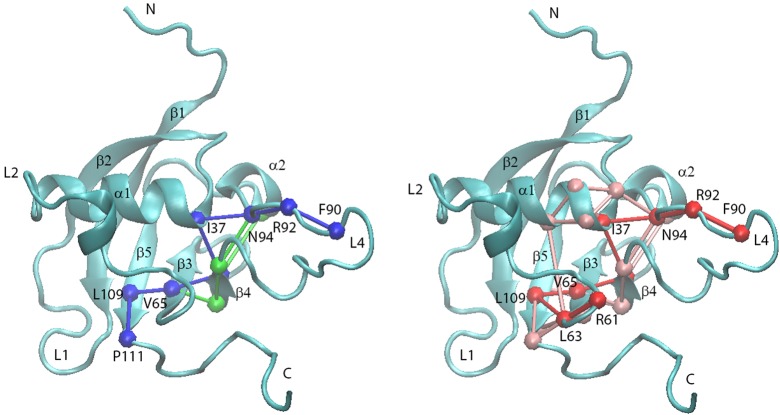
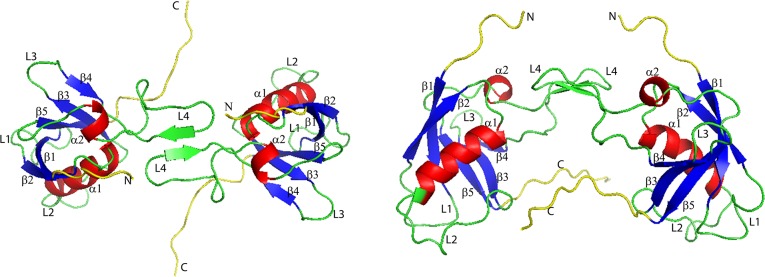
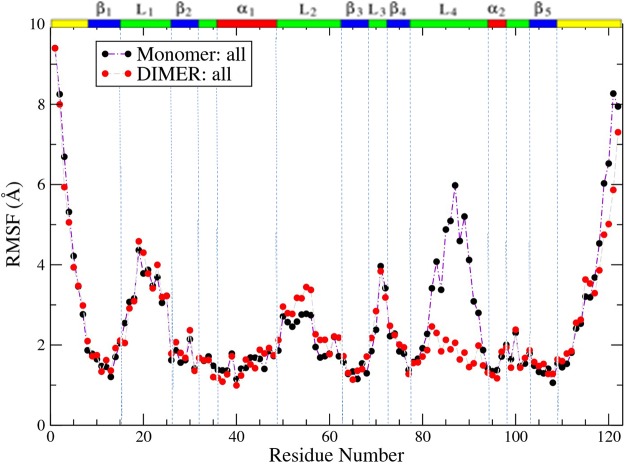
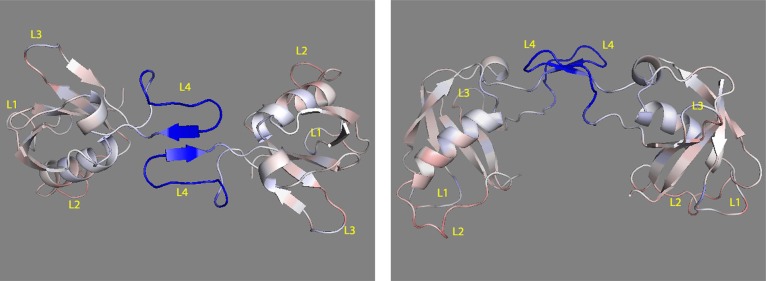
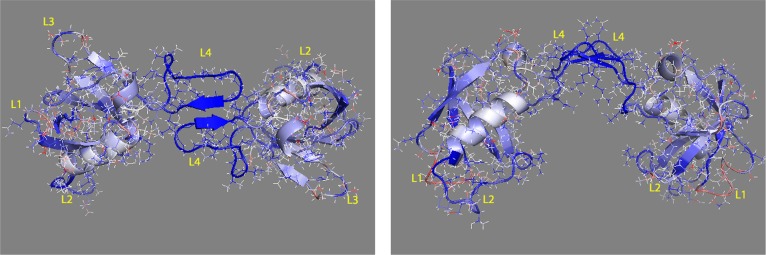
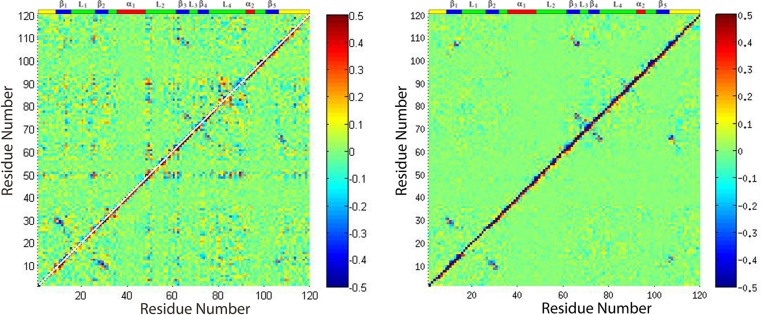
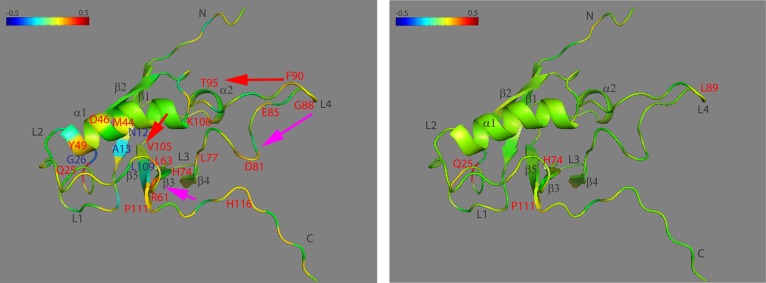
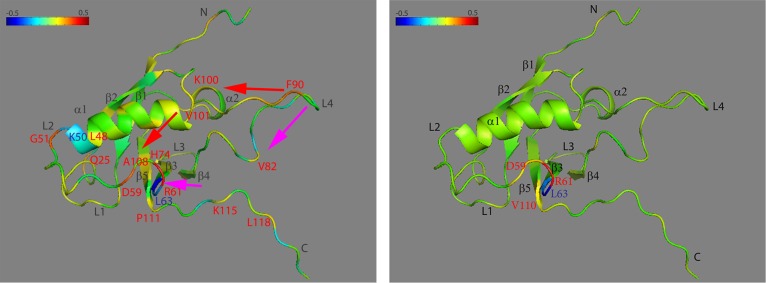
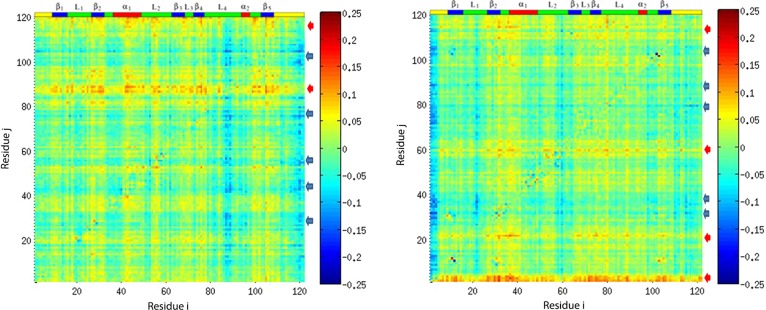
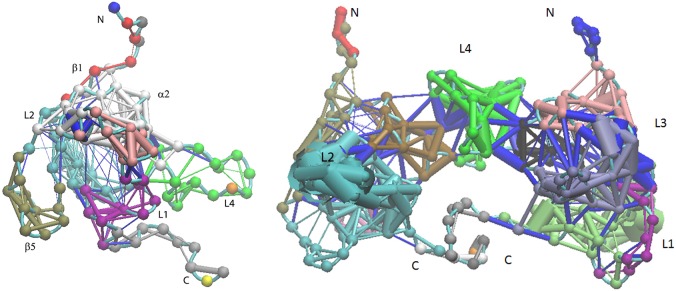
Plexin-B1 is a single-pass transmembrane receptor. Its Rho GTPase binding domain (RBD) can associate with small Rho GTPases and can also self-bind to form a dimer. In total, more than 400 ns of NAMD molecular dynamics simulations were performed on RBD monomer and dimer. Different analysis methods, such as root mean squared fluctuation (RMSF), order parameters (S(2)), dihedral angle correlation, transfer entropy, principal component analysis, and dynamical network analysis, were carried out to characterize the motions seen in the trajectories. RMSF results show that after binding, the L4 loop becomes more rigid, but the L2 loop and a number of residues in other regions become slightly more flexible. Calculating order parameters (S(2)) for CH, NH, and CO bonds on both backbone and side chain shows that the L4 loop becomes essentially rigid after binding, but part of the L1 loop becomes slightly more flexible. Backbone dihedral angle cross-correlation results show that loop regions such as the L1 loop including residues Q25 and G26, the L2 loop including residue R61, and the L4 loop including residues L89-R91, are highly correlated compared to other regions in the monomer form. Analysis of the correlated motions at these residues, such as Q25 and R61, indicate two signal pathways. Transfer entropy calculations on the RBD monomer and dimer forms suggest that the binding process should be driven by the L4 loop and C-terminal. However, after binding, the L4 loop functions as the motion responder. The signal pathways in RBD were predicted based on a dynamical network analysis method using the pathways predicted from the dihedral angle cross-correlation calculations as input. It is found that the shortest pathways predicted from both inputs can overlap, but signal pathway 2 (from F90 to R61) is more dominant and overlaps all of the routes of pathway 1 (from F90 to P111). This project confirms the allosteric mechanism in signal transmission inside the RBD network, which was in part proposed in the previous experimental study.
丛状蛋白-B1是一种单次跨膜受体。其Rho GTP酶结合结构域(RBD)可与小Rho GTP酶结合,也可自身结合形成二聚体。总共对RBD单体和二聚体进行了超过400纳秒的NAMD分子动力学模拟。采用了不同的分析方法,如均方根波动(RMSF)、序参量(S(2))、二面角相关性、转移熵、主成分分析和动力学网络分析,来表征轨迹中观察到的运动。RMSF结果表明,结合后,L4环变得更加刚性,但L2环和其他区域的一些残基变得稍微更灵活。计算主链和侧链上CH、NH和CO键的序参量(S(2))表明,结合后L4环基本变得刚性,但L1环的一部分变得稍微更灵活。主链二面角交叉相关性结果表明,与单体形式的其他区域相比,包括残基Q25和G26的L1环、包括残基R61的L2环以及包括残基L89-R91的L4环等环区域高度相关。对这些残基(如Q25和R61)的相关运动分析表明有两条信号通路。对RBD单体和二聚体形式的转移熵计算表明,结合过程应由L4环和C端驱动。然而,结合后,L4环作为运动响应者发挥作用。基于动力学网络分析方法,以二面角交叉相关性计算预测的通路为输入,预测了RBD中的信号通路。发现从两种输入预测的最短通路可以重叠,但信号通路2(从F90到R61)更占主导地位,并且与通路1(从F90到P111)的所有路线重叠。该项目证实了RBD网络内部信号传递中的变构机制,这在之前的实验研究中部分提出。