Anderson Ruth A, Toles Mark P, Corazzini Kirsten, McDaniel Reuben R, Colón-Emeric Cathleen
Duke University School of Nursing, DUMC 3322, Durham, NC 27710, USA.
BMC Health Serv Res. 2014 Jun 5;14:244. doi: 10.1186/1472-6963-14-244.
To describe relationship patterns and management practices in nursing homes (NHs) that facilitate or pose barriers to better outcomes for residents and staff.
We conducted comparative, multiple-case studies in selected NHs (N = 4). Data were collected over six months from managers and staff (N = 406), using direct observations, interviews, and document reviews. Manifest content analysis was used to identify and explore patterns within and between cases.
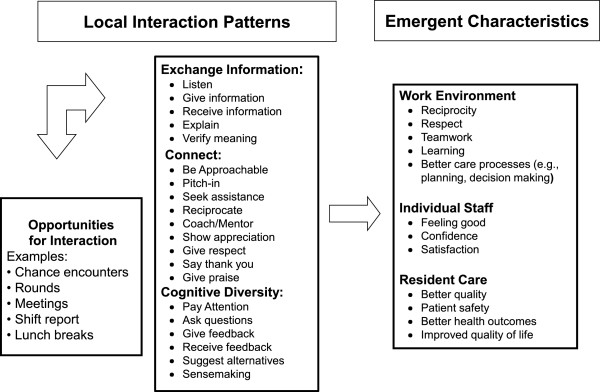
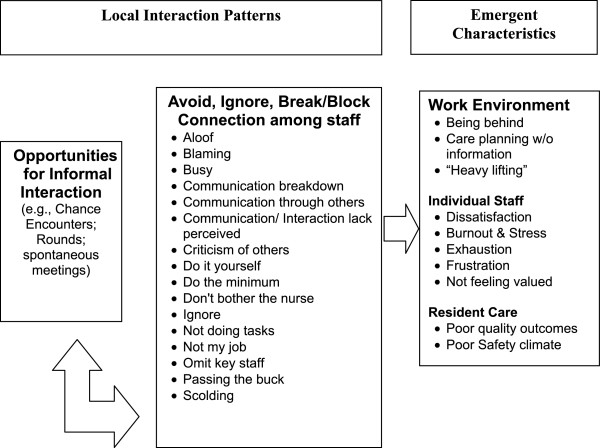
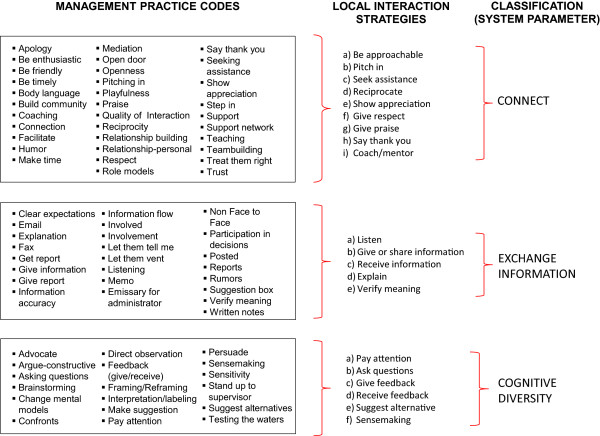
Participants described interaction strategies that they explained could either degrade or enhance their capacity to achieve better outcomes for residents; people in all job categories used these 'local interaction strategies'. We categorized these two sets of local interaction strategies as the 'common pattern' and the 'positive pattern' and summarize the results in two models of local interaction.
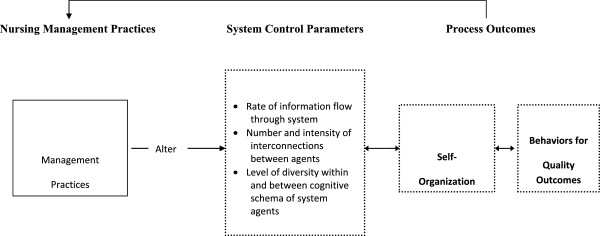
The findings suggest the hypothesis that when staff members in NHs use the set of positive local interaction strategies, they promote inter-connections, information exchange, and diversity of cognitive schema in problem solving that, in turn, create the capacity for delivering better resident care. We propose that these positive local interaction strategies are a critical driver of care quality in NHs. Our hypothesis implies that, while staffing levels and skill mix are important factors for care quality, improvement would be difficult to achieve if staff members are not engaged with each other in these ways.
描述养老院中有助于或阻碍为居民和工作人员取得更好结果的关系模式及管理做法。
我们在选定的养老院(N = 4)中开展了比较性多案例研究。通过直接观察、访谈和文件审查,在六个月的时间里收集了管理人员和工作人员(N = 406)的数据。采用显性内容分析法来识别和探究案例内部及案例之间的模式。
参与者描述了他们认为可能会降低或增强为居民取得更好结果能力的互动策略;所有工作类别的人都使用了这些“局部互动策略”。我们将这两组局部互动策略归类为“常见模式”和“积极模式”,并在两个局部互动模型中总结了结果。
研究结果提出了一个假设,即当养老院工作人员使用积极的局部互动策略时,他们会促进人际关系、信息交流以及问题解决中认知模式的多样性,进而提升为居民提供更好护理的能力。我们认为这些积极的局部互动策略是养老院护理质量的关键驱动因素。我们的假设意味着,虽然人员配备水平和技能组合是护理质量的重要因素,但如果工作人员不以这些方式相互协作,就很难实现改善。