Department of Anesthesiology, Faculty of Medicine, Chiang Mai University, Chiang Mai, Thailand.
Department of Psychiatry, Faculty of Medicine, Chiang Mai University, Chiang Mai, Thailand.
Clin Interv Aging. 2014 May 29;9:879-85. doi: 10.2147/CIA.S62660. eCollection 2014.
The purpose of this study was to determine the validity and reliability of the Thai version of the Confusion Assessment Method for the Intensive Care Unit (CAM-ICU), when compared to the diagnoses made by delirium experts.
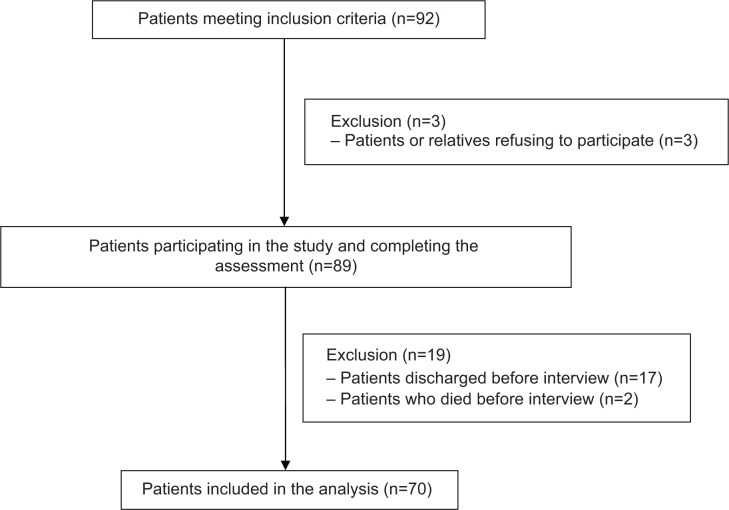
This was a cross-sectional study conducted in both surgical intensive care and subintensive care units in Thailand between February-June 2011. Seventy patients aged 60 years or older who had been admitted to the units were enrolled into the study within the first 48 hours of admission. Each patient was randomly assessed as to whether they had delirium by a nurse using the Thai version of the CAM-ICU algorithm (Thai CAM-ICU) or by a delirium expert using the Diagnostic and Statistical Manual of Mental Disorders, Fourth Edition, Text Revision.
The prevalence of delirium was found to be 18.6% (n=13) by the delirium experts. The sensitivity of the Thai CAM-ICU's algorithms was found to be 92.3% (95% confidence interval [CI] =64.0%-99.8%), while the specificity was 94.7% (95% CI =85.4%-98.9%). The instrument displayed good interrater reliability (Cohen's κ =0.81; 95% CI =0.64-0.99). The time taken to complete the Thai CAM-ICU was 1 minute (interquatile range, 1-2 minutes).
The Thai CAM-ICU demonstrated good validity, reliability, and ease of use when diagnosing delirium in a surgical intensive care unit setting. The use of this diagnostic tool should be encouraged for daily, routine use, so as to promote the early detection of delirium and its rapid treatment.
本研究旨在确定泰国版重症监护病房意识模糊评估法(CAM-ICU)的有效性和可靠性,同时将其与由谵妄专家做出的诊断进行对比。
这是一项在 2011 年 2 月至 6 月间于泰国的外科重症监护病房和亚重症监护病房中进行的横断面研究。研究共纳入了 70 名年龄在 60 岁及以上、入住上述科室 48 小时内的患者。每位患者都将通过护士使用泰国版 CAM-ICU 算法(泰国版 CAM-ICU)或通过谵妄专家使用《精神障碍诊断与统计手册》第四版修订版进行评估,以确定其是否患有谵妄。
由专家评估的谵妄发生率为 18.6%(n=13)。泰国版 CAM-ICU 算法的敏感度为 92.3%(95%置信区间 [CI] =64.0%-99.8%),特异度为 94.7%(95% CI =85.4%-98.9%)。该仪器的组内一致性较好(Cohen's κ =0.81;95% CI =0.64-0.99)。完成泰国版 CAM-ICU 的时间为 1 分钟(四分位距,1-2 分钟)。
泰国版 CAM-ICU 用于诊断外科重症监护病房中的谵妄时,具有良好的有效性、可靠性和易用性。应鼓励将此诊断工具用于日常常规使用,以促进对谵妄的早期发现和快速治疗。