Navarrete Marta, Araque Alfonso
Functional and Systems Neurobiology, Instituto Cajal, CSIC Madrid, Spain.
Functional and Systems Neurobiology, Instituto Cajal, CSIC Madrid, Spain ; Department of Neuroscience, University of Minnesota Minneapolis, MN, USA.
Front Neuroanat. 2014 May 19;8:33. doi: 10.3389/fnana.2014.00033. eCollection 2014.
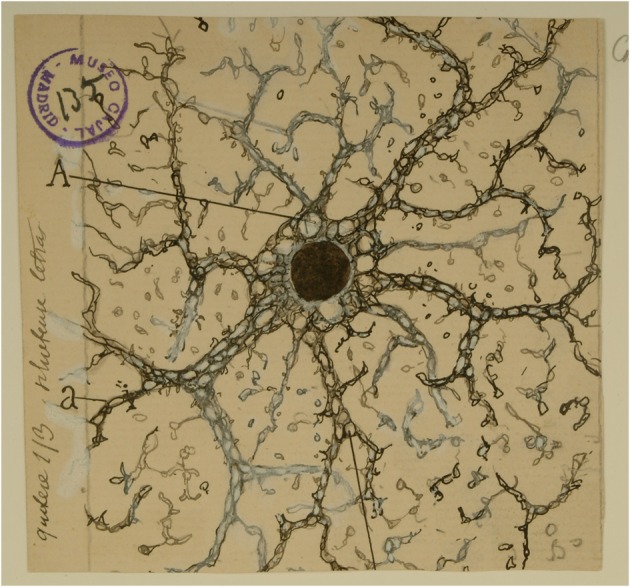
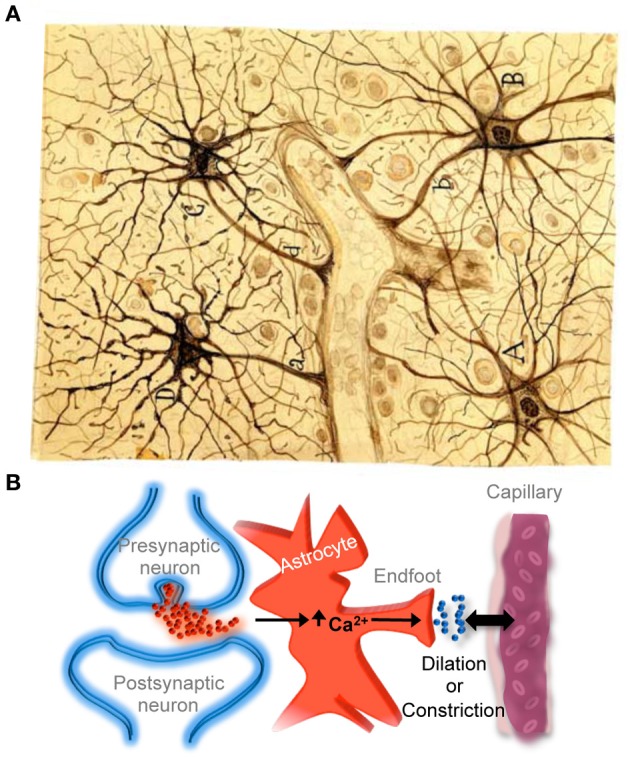
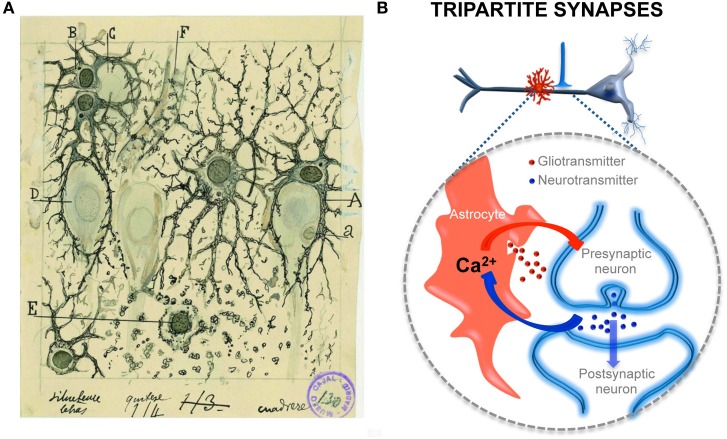
Cajal is widely recognized by the scientific community for his important contributions to our knowledge of the neuronal organization of the nervous system. His studies on neuroglial cells are less recognized, yet they are no less relevant to our current understanding of the cellular bases of brain structure. Two pioneering studies published a century ago -"Something about the physiological significance of neuroglia" (Ramón y Cajal, 1897) and "A contribution to the understanding of neuroglia in the human brain" (Ramón y Cajal, 1913)-focused on glial cells and their role in brain physiology. Novel findings obtained using state-of-the-art and sophisticated technologies largely confirm many of the groundbreaking hypotheses proposed by Cajal related to the structural-functional properties of neuroglia. Here we propose to the reader a journey guided by the ideas of Cajal through the recent findings on the functional significance of astrocytes, the most abundant neuroglial cell type in the nervous system. Astrocyte-neuron interaction, which represents an emerging field in current neuroscience with important implications for our understanding of the cellular processes underlying brain function, has its roots in many of the original concepts proposed by Cajal.
卡哈尔因其对我们关于神经系统神经元组织的认识所做出的重要贡献而被科学界广泛认可。他对神经胶质细胞的研究较少受到关注,然而这些研究对于我们当前对脑结构细胞基础的理解同样重要。一个世纪前发表的两项开创性研究——《关于神经胶质生理意义的一些探讨》(拉蒙·伊·卡哈尔,1897年)和《对理解人类大脑神经胶质的贡献》(拉蒙·伊·卡哈尔,1913年)——聚焦于胶质细胞及其在脑生理学中的作用。利用先进复杂技术获得的新发现很大程度上证实了卡哈尔提出的许多关于神经胶质结构-功能特性的开创性假说。在此,我们向读者提议一次由卡哈尔的观点引领的旅程,去了解关于星形胶质细胞功能意义的最新发现,星形胶质细胞是神经系统中最丰富的神经胶质细胞类型。星形胶质细胞与神经元的相互作用是当前神经科学中一个新兴领域,对我们理解脑功能背后的细胞过程具有重要意义,它源于卡哈尔提出的许多原始概念。