Brown Center for the Study of Children at Risk, Women and Infants Hospital Providence, RI, USA.
Department of Cognitive, Linguistic and Psychological Sciences, Brown University Providence, RI, USA.
Front Psychol. 2014 May 26;5:490. doi: 10.3389/fpsyg.2014.00490. eCollection 2014.
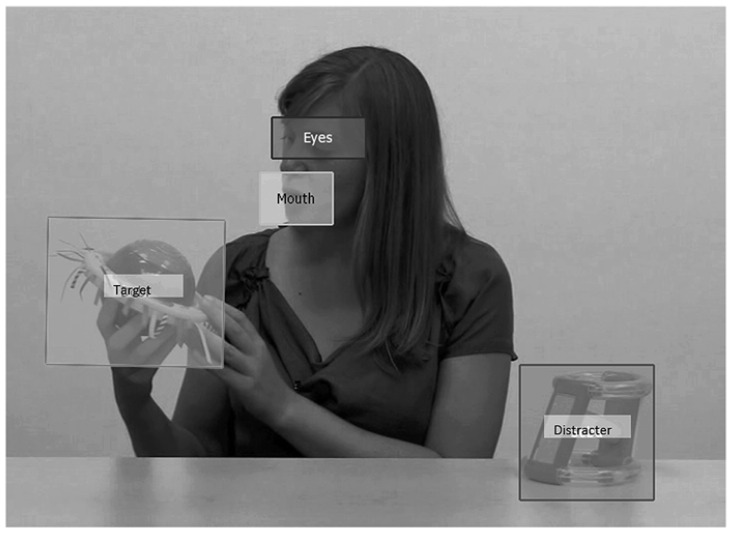
Previous work has demonstrated that patterns of social attention hold predictive value for language development in typically developing infants. The goal of this research was to explore how patterns of attention in autistic, language delayed, and typically developing children relate to early word learning and language abilities. We tracked patterns of eye movements to faces and objects while children watched videos of a woman teaching them a series of new words. Subsequent test trials measured participants' recognition of these novel word-object pairings. Results indicated that greater attention to the speaker's mouth was related to higher scores on standardized measures of language development for autistic and typically developing children (but not for language delayed children). This effect was mediated by age for typically developing, but not autistic children. When effects of age were controlled for, attention to the mouth among language delayed participants was negatively correlated with standardized measures of language learning. Attention to the speaker's mouth and eyes while she was teaching the new words was also predictive of faster recognition of those words among autistic children. These results suggest that language delays among children with autism may be driven in part by aberrant social attention, and that the mechanisms underlying these delays may differ from those in language delayed participants without autism.
先前的研究表明,社会注意力模式对正常发育婴儿的语言发展具有预测价值。本研究旨在探讨自闭症、语言延迟和正常发育儿童的注意力模式如何与早期单词学习和语言能力相关。我们在儿童观看一名女性教他们一系列新单词的视频时,跟踪他们对人脸和物体的眼球运动模式。随后的测试试验测量了参与者对这些新单词-物体配对的识别。结果表明,自闭症和正常发育儿童对说话者嘴巴的注意力与语言发展标准化评估得分呈正相关(但对语言延迟儿童则没有)。这种影响对正常发育儿童是通过年龄来介导的,但对自闭症儿童则不是。当控制年龄的影响时,语言延迟儿童对嘴巴的注意力与语言学习的标准化评估呈负相关。在她教授新单词时对说话者的嘴巴和眼睛的注意力也可以预测自闭症儿童更快地识别这些单词。这些结果表明,自闭症儿童的语言延迟部分可能是由异常的社会注意力引起的,并且这些延迟的机制可能与没有自闭症的语言延迟参与者不同。