Bakulski Kelly M, Park Sung Kyun, Weisskopf Marc G, Tucker Katherine L, Sparrow David, Spiro Avron, Vokonas Pantel S, Nie Linda Huiling, Hu Howard, Weuve Jennifer
Department of Environmental Health Sciences, and.
Environ Health Perspect. 2014 Oct;122(10):1066-74. doi: 10.1289/ehp.1306931. Epub 2014 Jun 6.
Lead (Pb) exposure may influence the plasma concentration of homocysteine, a one-carbon metabolite associated with cardiovascular and neurodegenerative diseases. Little is known about the associations between Pb and homocysteine over time, or the potential influence of dietary factors.
We examined the longitudinal association of recent and cumulative Pb exposure with homocysteine concentrations and the potential modifying effect of dietary nutrients involved in one-carbon metabolism.
In a subcohort of the Veterans Affairs (VA) Normative Aging Study (1,056 men with 2,301 total observations between 1993 and 2011), we used mixed-effects models to estimate differences in repeated measures of total plasma homocysteine across concentrations of Pb in blood and tibia bone, assessing recent and cumulative Pb exposure, respectively. We also assessed effect modification by dietary intake and plasma concentrations of folate, vitamin B6, and vitamin B12.
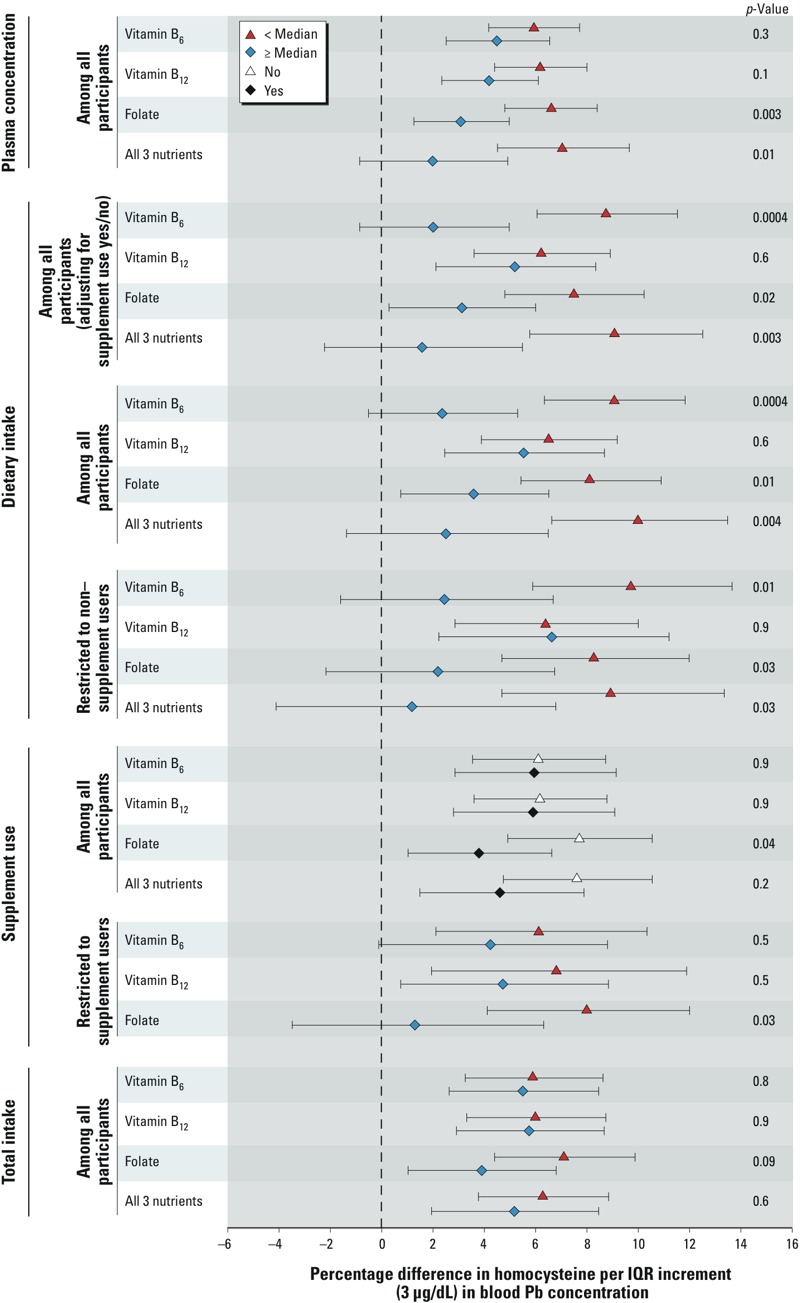
An interquartile range (IQR) increment in blood Pb (3 μg/dL) was associated with a 6.3% higher homocysteine concentration (95% CI: 4.8, 7.8%). An IQR increment in tibia bone Pb (14 μg/g) was associated with a 3.7% higher homocysteine (95% CI: 1.6, 5.6%), which was attenuated to 1.5% (95% CI: -0.5, 3.6%) after adjusting for blood Pb. For comparison, a 5-year increase in time from baseline was associated with a 5.7% increase in homocysteine (95% CI: 4.3, 7.1%). The association between blood Pb and homocysteine was significantly stronger among participants with estimated dietary intakes of vitamin B6 and folate below (vs. above) the study population medians, which were similar to the U.S. recommended dietary allowance intakes.
Pb exposure was positively associated with plasma homocysteine concentration. This association was stronger among men with below-median dietary intakes of vitamins B6 and folate. These findings suggest that increasing intake of folate and B6 might reduce Pb-associated increases in homocysteine, a risk factor for cardiovascular disease and neurodegeneration.
铅(Pb)暴露可能会影响同型半胱氨酸的血浆浓度,同型半胱氨酸是一种与心血管疾病和神经退行性疾病相关的一碳代谢物。关于铅与同型半胱氨酸随时间的关联,或饮食因素的潜在影响,人们了解甚少。
我们研究了近期和累积铅暴露与同型半胱氨酸浓度的纵向关联,以及参与一碳代谢的饮食营养素的潜在调节作用。
在退伍军人事务部(VA)规范老化研究的一个亚队列中(1993年至2011年间有1056名男性,共进行了2301次观察),我们使用混合效应模型来估计全血和胫骨中铅浓度不同时,血浆总同型半胱氨酸重复测量值的差异,分别评估近期和累积铅暴露情况。我们还评估了饮食摄入量以及叶酸、维生素B6和维生素B12的血浆浓度对效应的调节作用。
血铅四分位数间距(IQR)增加(3μg/dL)与同型半胱氨酸浓度升高6.3%相关(95%置信区间:4.8,7.8%)。胫骨骨铅IQR增加(14μg/g)与同型半胱氨酸升高3.7%相关(95%置信区间:1.6,5.6%),在调整血铅后,该值减弱至1.5%(95%置信区间:-0.5,3.6%)。相比之下,从基线起时间增加5年与同型半胱氨酸增加5.7%相关(95%置信区间:4.3,7.1%)。在估计饮食中维生素B6和叶酸摄入量低于(与高于)研究人群中位数(与美国推荐膳食摄入量相似)的参与者中,血铅与同型半胱氨酸之间的关联明显更强。
铅暴露与血浆同型半胱氨酸浓度呈正相关。在维生素B6和叶酸饮食摄入量低于中位数的男性中,这种关联更强。这些发现表明,增加叶酸和B6的摄入量可能会减少铅相关的同型半胱氨酸升高,同型半胱氨酸是心血管疾病和神经退行性变的一个危险因素。