Department of Life Sciences, University of Modena and Reggio Emilia, via Campi 183, 41100 Modena, Italy.
Microb Cell Fact. 2014 Jun 7;13:83. doi: 10.1186/1475-2859-13-83.
Microbial lipids represent a valuable alternative feedstock for biodiesel production when oleaginous microbes are cultured with inexpensive substrates in processes exhibiting high yield and productivity. In this perspective, crude glycerol is among the most promising raw materials for lipid production, because it is the costless residual of biodiesel production. Thus, cultivation of oleaginous yeasts in glycerol-based media is attracting great interest and natural biodiversity is increasingly explored to identify novel oleaginous species recycling this carbon source for growth and lipid production.
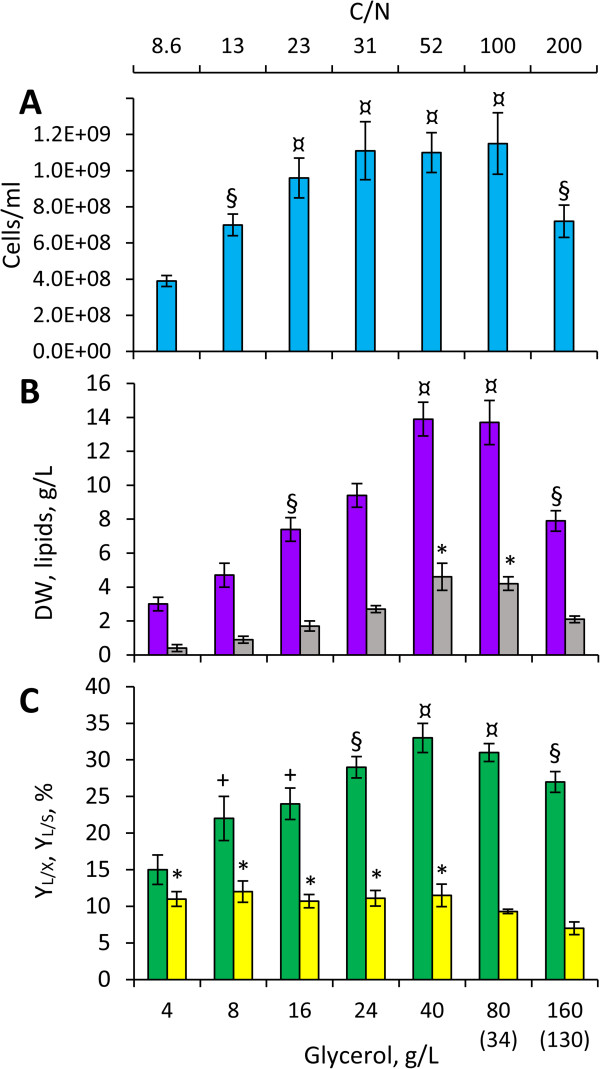
Thirty-three yeasts strains belonging to 19 species were screened for the ability to grow and produce intracellular lipids in a pure glycerol-based medium with high C/N ratio. A minority of them consumed most of the glycerol and generated visible lipid bodies. Among them, Candida freyschussii ATCC 18737 was selected, because it exhibited the highest lipid production and glycerol conversion yield. Lipid production in this strain was positively affected by the increase of C/N ratio, but growth was inhibited by glycerol concentration higher than 40 g/L. In batch cultures, the highest lipid production (4.6 g/L), lipid content of biomass (33% w/w), and lipid volumetric productivity (0.15 g/L/h) were obtained with 40 g/L glycerol, during the course of a 30-h process. Fed-batch cultivation succeeded in preventing substrate inhibition and in achieving a high cell-density culture. The improved lipid production and volumetric productivity reached the remarkable high level of 28 g/L and 0.28 g/L/h, respectively. The lipids accumulated by C. freyschussii ATCC 18737 have similar fatty acid composition of plant oil indicating their potential use as biodiesel feedstock. Calculated physicochemical properties of a biodiesel produced with the lipids from C. freyschussii ATCC 18737 are expected to meet the European and American standards, being equal to those of rapeseed and palm biodiesel.
C. freyschussii ATCC 18737 could be considered an interesting microorganism for utilization in biofuel industry. Cultivation of this yeast in media containing crude glycerol should be investigated deeper in order to evaluate whether it may find application in the valorization of the waste of biodiesel manufacturing.
当使用廉价基质在具有高产率和生产力的过程中培养产油微生物时,微生物油脂是生物柴油生产的有价值的替代原料。在这方面,粗甘油是最有前途的脂质生产原料之一,因为它是生物柴油生产的无成本残余物。因此,在基于甘油的培养基中培养产油酵母引起了极大的兴趣,并且越来越多地探索自然生物多样性,以鉴定用于生长和脂质生产的新型产油物种来回收这种碳源。
筛选了 33 株属于 19 个种的酵母菌株,以研究其在高 C/N 比的纯甘油基培养基中生长和产生细胞内脂质的能力。其中少数消耗了大部分甘油并产生可见的脂滴。在其中,选择了弗氏毕赤酵母 ATCC 18737,因为它表现出最高的脂质生产和甘油转化率。该菌株的脂质生产受 C/N 比增加的正向影响,但生长受到高于 40g/L 甘油浓度的抑制。在分批培养中,在 30 小时的过程中,以 40g/L 甘油获得了最高的脂质产量(4.6g/L)、生物质的脂质含量(33%w/w)和脂质体积生产率(0.15g/L/h)。补料分批培养成功地防止了基质抑制,并实现了高细胞密度培养。改进的脂质生产和体积生产率分别达到了 28g/L 和 0.28g/L/h 的显著高水平。弗氏毕赤酵母 ATCC 18737 积累的脂质具有与植物油相似的脂肪酸组成,表明它们可作为生物柴油原料使用。用弗氏毕赤酵母 ATCC 18737 的脂质生产的生物柴油的计算物理化学性质预计将符合欧洲和美国标准,与油菜籽和棕榈生物柴油相当。
弗氏毕赤酵母 ATCC 18737 可被认为是生物燃料工业中利用的一种有趣的微生物。应更深入地研究在含有粗甘油的培养基中培养该酵母,以评估其是否可用于生物柴油制造废物的增值。