Prakash Varuna, Koczmara Christine, Savage Pamela, Trip Katherine, Stewart Janice, McCurdie Tara, Cafazzo Joseph A, Trbovich Patricia
Faculty of Medicine, Institute for Biomaterials and Biomedical Engineering, University of Toronto, Toronto, Ontario, Canada Healthcare Human Factors, Techna Institute, University Health Network, Toronto, Ontario, Canada.
Institute for Safe Medication Practices Canada, Toronto, Ontario, Canada.
BMJ Qual Saf. 2014 Nov;23(11):884-92. doi: 10.1136/bmjqs-2013-002484. Epub 2014 Jun 6.
Nurses are frequently interrupted during medication verification and administration; however, few interventions exist to mitigate resulting errors, and the impact of these interventions on medication safety is poorly understood.
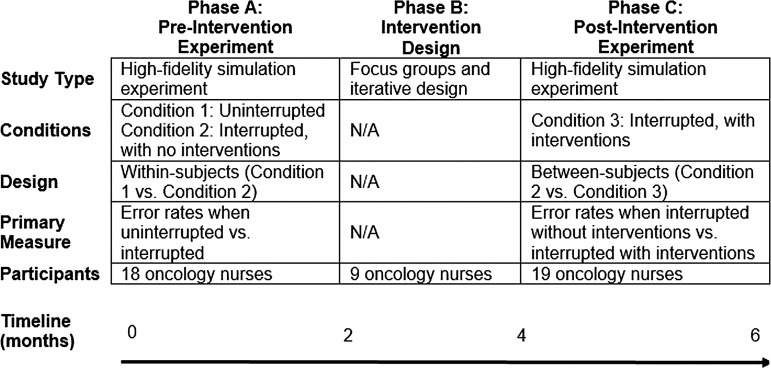
The study objectives were to (A) assess the effects of interruptions on medication verification and administration errors, and (B) design and test the effectiveness of targeted interventions at reducing these errors.
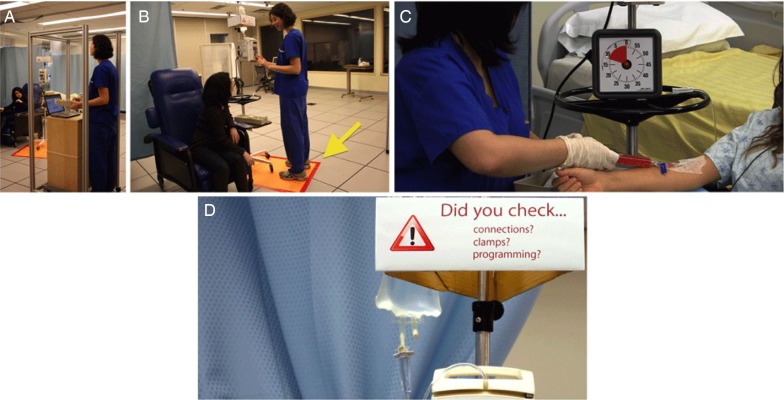
The study focused on medication verification and administration in an ambulatory chemotherapy setting. A simulation laboratory experiment was conducted to determine interruption-related error rates during specific medication verification and administration tasks. Interventions to reduce these errors were developed through a participatory design process, and their error reduction effectiveness was assessed through a postintervention experiment.
Significantly more nurses committed medication errors when interrupted than when uninterrupted. With use of interventions when interrupted, significantly fewer nurses made errors in verifying medication volumes contained in syringes (16/18; 89% preintervention error rate vs 11/19; 58% postintervention error rate; p=0.038; Fisher's exact test) and programmed in ambulatory pumps (17/18; 94% preintervention vs 11/19; 58% postintervention; p=0.012). The rate of error commission significantly decreased with use of interventions when interrupted during intravenous push (16/18; 89% preintervention vs 6/19; 32% postintervention; p=0.017) and pump programming (7/18; 39% preintervention vs 1/19; 5% postintervention; p=0.017). No statistically significant differences were observed for other medication verification tasks.
Interruptions can lead to medication verification and administration errors. Interventions were highly effective at reducing unanticipated errors of commission in medication administration tasks, but showed mixed effectiveness at reducing predictable errors of detection in medication verification tasks. These findings can be generalised and adapted to mitigate interruption-related errors in other settings where medication verification and administration are required.
护士在药品核对与给药过程中经常被打断;然而,几乎没有干预措施来减少由此导致的错误,而且这些干预措施对用药安全的影响也知之甚少。
本研究的目的是:(A)评估打断对药品核对与给药错误的影响,以及(B)设计并测试针对性干预措施在减少这些错误方面的有效性。
本研究聚焦于门诊化疗环境中的药品核对与给药。进行了一项模拟实验室实验,以确定特定药品核对与给药任务期间与打断相关的错误率。通过参与式设计过程制定了减少这些错误的干预措施,并通过干预后实验评估了其减少错误的有效性。
与未被打断时相比,护士在被打断时出现用药错误的情况明显更多。在被打断时使用干预措施后,在核对注射器中药物剂量(干预前错误率为16/18;89%,干预后为11/19;58%;p=0.038;Fisher精确检验)以及在门诊输液泵中编程(干预前为17/18;94%,干预后为11/19;58%;p=0.012)时出错的护士明显减少。在静脉推注(干预前为16/18;89%,干预后为6/19;32%;p=0.017)和输液泵编程(干预前为7/18;39%,干预后为1/19;5%;p=0.017)过程中被打断时使用干预措施,错误发生率显著降低。在其他药品核对任务中未观察到统计学上的显著差异。
打断会导致药品核对与给药错误。干预措施在减少给药任务中意外的执行错误方面非常有效,但在减少药品核对任务中可预测的发现错误方面效果不一。这些发现可加以推广并应用于其他需要进行药品核对与给药的环境中,以减轻与打断相关的错误。