Kindler Eveline, Thiel Volker
Institute of Virology and Immunology IVI, Bern, and Vetsuisse Faculty, University of Bern, Länggassstrasse 122, 3012 Bern, Switzerland.
Institute of Virology and Immunology IVI, Bern, and Vetsuisse Faculty, University of Bern, Länggassstrasse 122, 3012 Bern, Switzerland.
Curr Opin Microbiol. 2014 Aug;20:69-75. doi: 10.1016/j.mib.2014.05.005. Epub 2014 Jun 5.
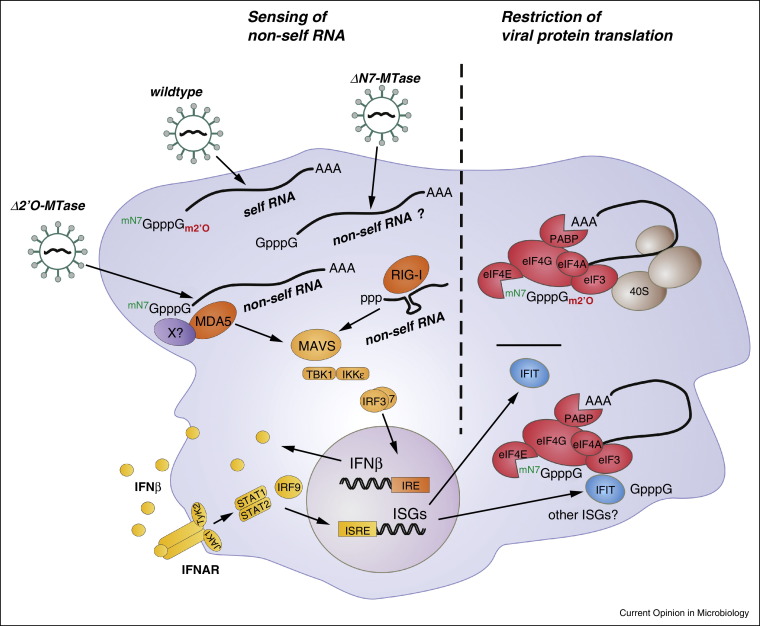
An essential function of innate immunity is to distinguish self from non-self and receptors have evolved to specifically recognize viral components and initiate the expression of antiviral proteins to restrict viral replication. Coronaviruses are RNA viruses that replicate in the host cytoplasm and evade innate immune sensing in most cell types, either passively by hiding their viral signatures and limiting exposure to sensors or actively, by encoding viral antagonists to counteract the effects of interferons. Since many cytoplasmic viruses exploit similar mechanisms of innate immune evasion, mechanistic insight into the direct interplay between viral RNA, viral RNA-processing enzymes, cellular sensors and antiviral proteins will be highly relevant to develop novel antiviral targets and to restrict important animal and human infections.
固有免疫的一项基本功能是区分自我与非自我,并且已经进化出了能够特异性识别病毒成分并启动抗病毒蛋白表达以限制病毒复制的受体。冠状病毒是在宿主细胞质中复制的RNA病毒,在大多数细胞类型中可逃避固有免疫感应,要么通过隐藏其病毒特征并限制与传感器的接触来被动逃避,要么通过编码病毒拮抗剂来对抗干扰素的作用来主动逃避。由于许多细胞质病毒利用类似的固有免疫逃避机制,因此深入了解病毒RNA、病毒RNA加工酶、细胞传感器和抗病毒蛋白之间的直接相互作用机制,对于开发新的抗病毒靶点以及限制重要的动物和人类感染将具有高度相关性。