Department of Biochemical Engineering, Faculty of Science and Technology, University of Debrecen, Egyetem tér 1, H-4032 Debrecen, Hungary.
BMC Genomics. 2014 Jun 9;15(1):447. doi: 10.1186/1471-2164-15-447.
The putative methyltransferase LaeA is a global regulator that affects the expression of multiple secondary metabolite gene clusters in several fungi. In Trichoderma reesei, its ortholog LAE1 appears to predominantly regulate genes involved in increasing competitive fitness in its environment, including expression of cellulases and polysaccharide hydrolases. A drawback in all studies related to LaeA/LAE1 function so far, however, is that the respective loss-of-function and overexpressing mutants display different growth rates. Thus some of the properties attributed to LaeA/LAE1 could be simply due to changes of the growth rate.
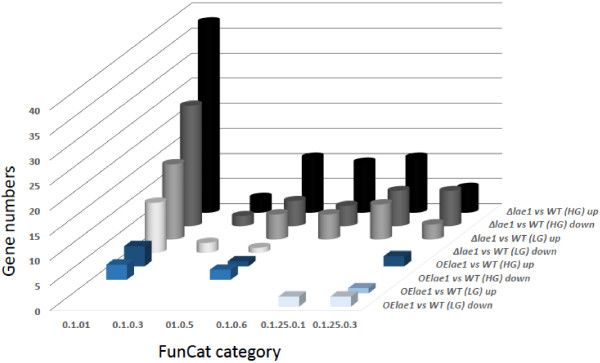
We cultivated T. reesei, a Δlae1 mutant and a lae1-overexpressing strain in chemostats on glucose at two different growth rates (0.075 and 0.020 h-1) which resemble growth rates at repressing and derepressing conditions, respectively. Under these conditions, the effect of modulating LAE1 expression was mainly visible in the Δlae1 mutant, whereas the overexpressing strain showed little differences to the parent strain. The effect on the expression of some gene categories identified earlier (polyketide synthases, heterokaryon incompatibility proteins, PTH11-receptors) was confirmed, but in addition GCN5-N-acetyltransferases, amino acid permeases and flavin monooxygenases were identified as so far unknown major targets of LAE1 action. LAE1 was also shown to interfere with the regulation of expression of several genes by the growth rate. About a tenth of the genes differentially expressed in the Δlae1 mutant under either growth condition were found to be clustered in the genome, but no specific gene group was associated with this phenomenon.
Our data show that - using T. reesei LAE1 as a model - the investigation of transcriptome in regulatory mutants at constant growth rates leads to new insights into the physiological roles of the respective regulator.
假定的甲基转移酶 LaeA 是一种全局调节剂,它影响几种真菌中多个次级代谢物基因簇的表达。在里氏木霉中,其同源物 LAE1 似乎主要调节与提高其环境中竞争适应性相关的基因表达,包括纤维素酶和多糖水解酶的表达。然而,迄今为止,与 LaeA/LAE1 功能相关的所有研究的一个缺点是,相应的功能丧失和过表达突变体显示出不同的生长速率。因此,归因于 LaeA/LAE1 的一些特性可能仅仅是由于生长速率的变化。
我们在葡萄糖恒化器中以两种不同的生长速率(0.075 和 0.020 h-1)培养里氏木霉、Δlae1 突变体和 lae1 过表达菌株,这两种生长速率分别类似于抑制和去抑制条件下的生长速率。在这些条件下,调节 LAE1 表达的影响主要在 Δlae1 突变体中可见,而过表达菌株与亲本菌株几乎没有差异。对之前确定的一些基因类别(聚酮合酶、异核体不亲和蛋白、PTH11 受体)的表达的影响得到了证实,但此外,GCN5-N-乙酰转移酶、氨基酸渗透酶和黄素单加氧酶也被确定为 LAE1 作用的未知主要靶标。LAE1 还被证明会干扰几个基因的表达调控,这些基因在两种生长条件下的Δlae1 突变体中差异表达。在两种生长条件下,在 Δlae1 突变体中差异表达的约十分之一的基因被发现聚类在基因组中,但没有特定的基因群与这种现象相关。
我们的数据表明,- 使用里氏木霉 LAE1 作为模型 - 在恒定生长速率下研究调节突变体的转录组会导致对各自调节剂的生理作用的新认识。