Ghiretti Amy E, Paradis Suzanne
Department of Biology, National Center for Behavioral Genomics, and Volen Center for Complex Systems, Brandeis University, Waltham, MA 02454, USA.
Department of Biology, National Center for Behavioral Genomics, and Volen Center for Complex Systems, Brandeis University, Waltham, MA 02454, USA.
Trends Neurosci. 2014 Jul;37(7):399-407. doi: 10.1016/j.tins.2014.05.003. Epub 2014 Jun 5.
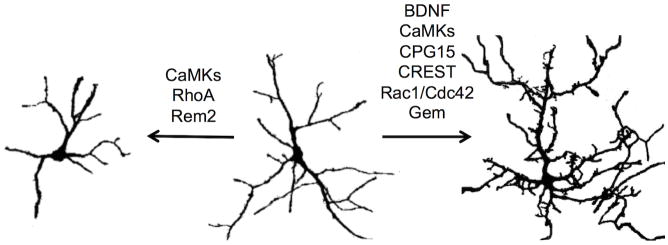
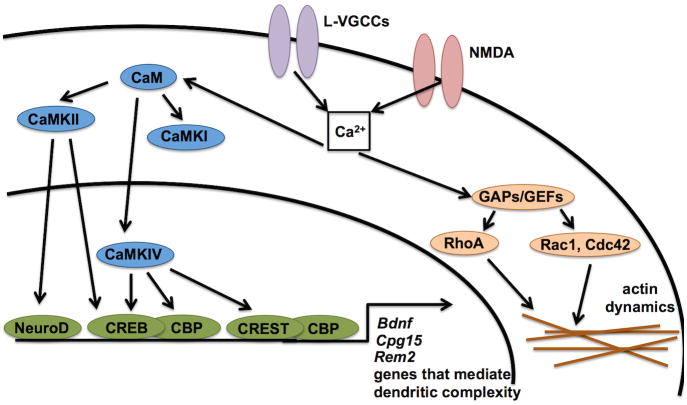
The nervous system has the amazing capacity to transform sensory experience from the environment into changes in neuronal activity that, in turn, cause long-lasting alterations in neuronal morphology. Recent findings indicate that, surprisingly, sensory experience concurrently activates molecular signaling pathways that both promote and inhibit dendritic complexity. Historically, a number of positive regulators of activity-dependent dendritic complexity have been described, whereas the list of identified negative regulators of this process is much shorter. In recent years, there has been an emerging appreciation of the importance of the Rad/Rem/Rem2/Gem/Kir (RGK) GTPases as mediators of activity-dependent structural plasticity. In the following review, we discuss the traditional view of RGK proteins, as well as our evolving understanding of the role of these proteins in instructing structural plasticity.
神经系统具有惊人的能力,能将来自环境的感官体验转化为神经元活动的变化,进而导致神经元形态的持久改变。最近的研究结果表明,令人惊讶的是,感官体验同时激活了促进和抑制树突复杂性的分子信号通路。从历史上看,已经描述了许多与活动依赖性树突复杂性相关的正向调节因子,而该过程中已确定的负向调节因子的清单则要短得多。近年来,人们越来越认识到Rad/Rem/Rem2/Gem/Kir(RGK)GTP酶作为活动依赖性结构可塑性介质的重要性。在以下综述中,我们讨论了RGK蛋白的传统观点,以及我们对这些蛋白在指导结构可塑性方面作用的不断演变的理解。