Lee Yen-Chieh, Lin Chin-Hsien, Wu Ruey-Meei, Lin Jou-Wei, Chang Chia-Hsuin, Lai Mei-Shu
Department of Family Medicine, Cathay General Hospital, Taipei, Taiwan.
Department of Neurology, National Taiwan University Hospital, Taipei, Taiwan.
PLoS One. 2014 Jun 9;9(6):e98961. doi: 10.1371/journal.pone.0098961. eCollection 2014.
Hypertension has been associated with Parkinson's disease (PD), but data on antihypertensive drugs and PD are inconclusive. We aim to evaluate antihypertensive drugs for an association with PD in hypertensive patients.
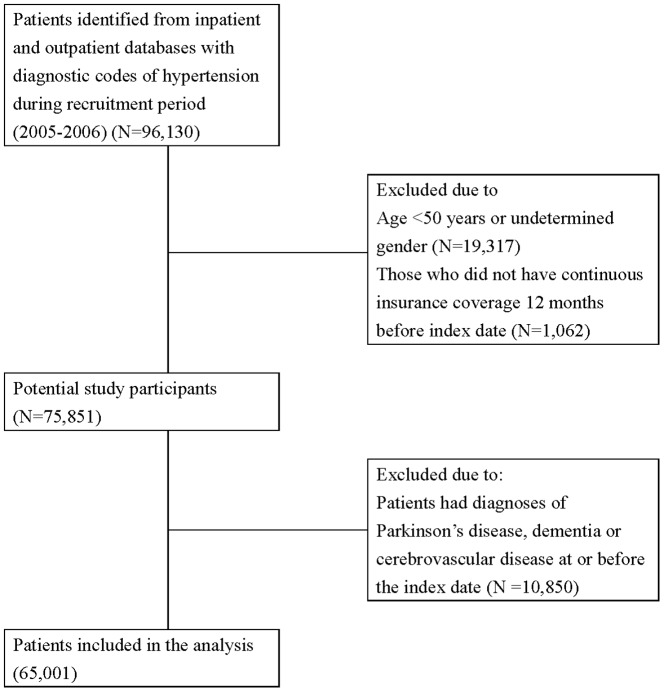
Hypertensive patients who were free of PD, dementia and stroke were recruited from 2005-2006 using Taiwan National Health Insurance Database. We examined the association between the use of calcium channel blockers (CCBs), angiotensin converting enzyme inhibitors (ACEIs), angiotensin receptor blockers (ARBs) and the incidence of PD using beta-blockers as the reference. Cox regression model with time-varying medication use was applied.
Among 65,001 hypertensive patients with a mean follow-up period of 4.6 years, use of dihydropyridine CCBs, but not non-dihydropyridine CCBs, was associated with a reduced risk of PD (adjusted hazard ratio [aHR] = 0.71; 95% CI, 0.57-0.90). Additionally, use of central-acting CCBs, rather than peripheral-acting ones, was associated with a decreased risk of PD (aHR = .69 [55-0.87]. Further decreased association was observed for higher cumulative doses of felodipine (aHR = 0.54 [0.36-0.80]) and amlodipine (aHR = 0.60 [0.45-0.79]). There was no association between the use of ACEIs (aHR = 0.80 [0.64-1.00]) or ARBs (aHR = 0.86 [0.69-1.08]) with PD. A potentially decreased association was only found for higher cumulative use of ACEIs (HR = 0.52 [0.34-0.80]) and ARBs (HR = 0.52 [0.33-0.80]).
Our study suggests centrally-acting dihydropyridine CCB use and high cumulative doses of ACEIs and ARBs may associate with a decreased incidence of PD in hypertensive patients. Further long-term follow-up studies are needed to confirm the potential beneficial effects of antihypertensive agents in PD.
高血压与帕金森病(PD)相关,但关于抗高血压药物与PD的数据尚无定论。我们旨在评估高血压患者中抗高血压药物与PD的关联。
利用台湾国民健康保险数据库,招募了2005年至2006年间无PD、痴呆和中风的高血压患者。我们以β受体阻滞剂作为对照,研究钙通道阻滞剂(CCB)、血管紧张素转换酶抑制剂(ACEI)、血管紧张素受体阻滞剂(ARB)的使用与PD发病率之间的关联。应用了随时间变化用药情况的Cox回归模型。
在65,001名平均随访期为4.6年的高血压患者中,使用二氢吡啶类CCB而非非二氢吡啶类CCB与PD风险降低相关(调整后风险比[aHR]=0.71;95%可信区间[CI],0.57 - 0.90)。此外,使用中枢作用CCB而非外周作用CCB与PD风险降低相关(aHR = 0.69[0.55 - 0.87])。对于更高累积剂量的非洛地平(aHR = 0.54[0.36 - 0.80])和氨氯地平(aHR = 0.60[0.45 - 0.79]),观察到关联进一步降低。ACEI(aHR = 0.80[0.64 - 1.00])或ARB(aHR = 0.86[0.69 - 1.08])的使用与PD之间无关联。仅在ACEI和ARB更高累积使用量时发现潜在的关联降低(风险比[HR]=0.52[0.34 - 0.80]和HR = 0.52[0.33 - 0.80])。
我们的研究表明,中枢作用的二氢吡啶类CCB的使用以及ACEI和ARB的高累积剂量可能与高血压患者中PD发病率降低相关。需要进一步的长期随访研究来证实抗高血压药物对PD的潜在有益作用。