1] Healthy Active Living and Obesity Research Group, Children's Hospital of Eastern Ontario Research Institute, Ottawa, Ontario, Canada [2] Department of Pediatrics, Faculty of Medicine, University of Ottawa, Ottawa, Ontario, Canada.
Healthy Active Living and Obesity Research Group, Children's Hospital of Eastern Ontario Research Institute, Ottawa, Ontario, Canada.
Nutr Diabetes. 2014 Jun 9;4(6):e117. doi: 10.1038/nutd.2014.14.
To examine independent and combined associations among objectively measured movement/non-movement behaviors (moderate-to-vigorous-intensity physical activity (MVPA), total sedentary time and sleep duration) and adiposity indicators in a sample of Canadian children.
A cross-sectional study was conducted on 507 children aged 9-11 years from Ottawa, Canada. Movement/non-movement behaviors were assessed using an Actigraph GT3X+ accelerometer over 7 days (24-h protocol). Outcomes included percentage body fat (bioelectrical impedance) and waist-to-height ratio.
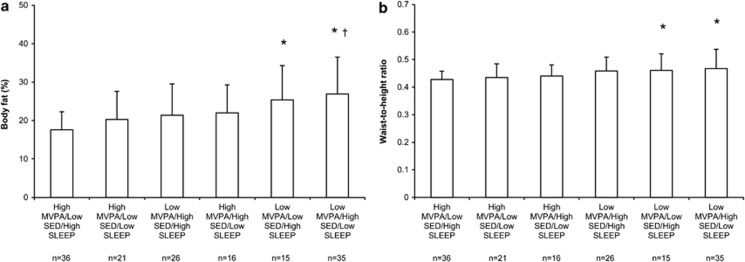
After adjustment for age, sex, ethnicity, maturity offset, fast food consumption, annual household income and highest level of parental education, MVPA was inversely and sedentary time positively associated with adiposity indicators, whereas sleep duration was not. However, only MVPA remained significantly associated with adiposity indicators after additional adjustment for the other movement/non-movement behaviors. Combined associations using tertiles of the three movement/non-movement behaviors showed that higher levels of MVPA were associated with lower adiposity indicators, irrespective of total sedentary time and sleep duration.
Higher levels of MVPA were associated with lower adiposity in this sample of children regardless of sedentary time and sleep duration. Although correlational in nature, these findings suggest that future efforts of obesity reduction should focus more on increasing MVPA than on reducing sedentary time or increasing sleep duration to maximize the effectiveness of interventions.
在加拿大儿童样本中,研究客观测量的运动/非运动行为(中等到剧烈强度的身体活动(MVPA)、总久坐时间和睡眠时间)与肥胖指标之间的独立和联合关联。
对来自加拿大渥太华的 507 名 9-11 岁儿童进行了一项横断面研究。使用 Actigraph GT3X+加速度计在 7 天内(24 小时方案)评估运动/非运动行为。结果包括体脂肪百分比(生物电阻抗)和腰高比。
在校正年龄、性别、种族、成熟度偏移、快餐消费、家庭年收入和父母最高教育水平后,MVPA 与肥胖指标呈负相关,而久坐时间与肥胖指标呈正相关,而睡眠时间则无相关性。然而,仅 MVPA 在进一步调整其他运动/非运动行为后仍与肥胖指标显著相关。使用三种运动/非运动行为的三分位数进行联合关联分析显示,较高水平的 MVPA 与较低的肥胖指标相关,无论总久坐时间和睡眠时间如何。
在这个儿童样本中,较高水平的 MVPA 与较低的肥胖有关,无论久坐时间和睡眠时间如何。尽管这些发现具有相关性,但它们表明,未来减少肥胖的努力应更侧重于增加 MVPA,而不是减少久坐时间或增加睡眠时间,以最大限度地提高干预措施的效果。