Yang Huan, Gu Qinying, Gao Tingting, Wang Xubo, Chue Phenwei, Wu Qinan, Jia Xiaobin
Department of Chinese Materia Medica, School of Pharmacy, Jiangsu University, China.
Department of Pharmaceutical Technology and Biological Engineering, Changzhou Institute of Engineering Technology, China.
Pharmacogn Mag. 2014 Apr;10(38):185-90. doi: 10.4103/0973-1296.131034.
Toona sinensis (A. Juss.) Roemer is an endemic species of Toona genus native to Asia. Its crude extract exhibits an effective anti-oxidant capacity against oxidative models, but the intrinsic substances responsible for this capacity in the extract remains unclear and is yet to be studied comprehensively.
To investigate the chemical constituents of the young leaves of Toona sinensis and its anti-oxidant capacity.
Silica gel column chromatography, preparative high-performance liquid chromatography (HPLC), nuclear magnetic resonance (NMR), and mass spectrometry (MS) were used to isolate and characterize the chemical constituents. Four chemical-induced oxidative models including DPPH free-radical scavenging assay, phenazine methosulphate (PMS) nicotinamide adenine dinucleotide (NADH) PMS-NADH-NBT superoxide anion scavenging assay, FeCl3-K3Fe (CN)6 reducing power assay, and FeCl2-FerroZine metal chelation assay were applied in the present study for evaluating anti-oxidant capacity.
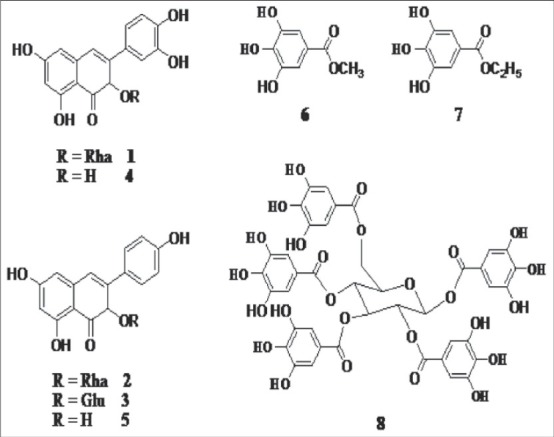
Five flavonols and three derivatives of gallic acid, including quercetrin, kaempferol-3-O-α-L-rhamopyranoside, astragalin, quercetin, kaempferol, methyl gallate, ethyl gallate, and 1, 2, 3, 4, 6-penta-O-galloyl-β-D-glucopyranose were isolated from the leaves. Results showed that these compounds exhibited various antioxidant properties, markedly either as the strong scavengers for superoxide and free radicals or as molecules that were reducing or metal chelating in nature.
The findings suggested that the 8 compounds in the young leaves of T. sinensis that were isolated in our study were the active compounds responsible for its antioxidant activity. These compounds can be utilized as a potential health supplement, as an available source of natural antioxidants, and as an effective material in pharmaceutical applications.
香椿是楝属的一种亚洲特有物种。其粗提物对氧化模型具有有效的抗氧化能力,但其提取物中负责此能力的内在物质尚不清楚,有待全面研究。
研究香椿幼叶的化学成分及其抗氧化能力。
采用硅胶柱色谱、制备型高效液相色谱(HPLC)、核磁共振(NMR)和质谱(MS)分离并鉴定化学成分。本研究应用了四种化学诱导氧化模型,包括二苯基苦味酰基自由基清除试验、硫酸甲酯吩嗪(PMS)-烟酰胺腺嘌呤二核苷酸(NADH)-PMS-NADH-NBT超氧阴离子清除试验、FeCl3-K3Fe(CN)6还原力试验和FeCl2-亚铁嗪金属螯合试验来评估抗氧化能力。
从叶片中分离出五种黄酮醇和三种没食子酸衍生物,包括槲皮苷、山奈酚-3-O-α-L-鼠李糖苷、紫云英苷、槲皮素、山奈酚、没食子酸甲酯、没食子酸乙酯和1,2,3,4,6-五-O-没食子酰基-β-D-吡喃葡萄糖。结果表明,这些化合物表现出各种抗氧化特性,显著地要么作为超氧化物和自由基的强清除剂,要么作为具有还原或金属螯合性质的分子。
我们的研究结果表明,从香椿幼叶中分离出的8种化合物是其抗氧化活性的活性化合物。这些化合物可作为潜在的健康补充剂、天然抗氧化剂的可用来源以及药物应用中的有效材料。