Liu Jianfeng, Wang Haibin, Wang Yan, Yin Yujing, Wang Liman, Liu Zhiqiang, Yang Junjie, Chen Yundai, Wang Changyong
Department of Advanced Interdisciplinary Studies, Institute of Basic Medical Sciences; Tissue Engineering Research Center, Academy of Military Medical Sciences, Beijing, P.R. China; Department of Cardiology, Medical school of Chinese PLA, Chinese PLA General Hospital, Beijing, P.R. China; Department of Geriatric Cardiology, Chinese PLA General Hospital, Beijing, China.
Department of Advanced Interdisciplinary Studies, Institute of Basic Medical Sciences; Tissue Engineering Research Center, Academy of Military Medical Sciences, Beijing, P.R. China.
PLoS One. 2014 Jun 10;9(6):e99756. doi: 10.1371/journal.pone.0099756. eCollection 2014.
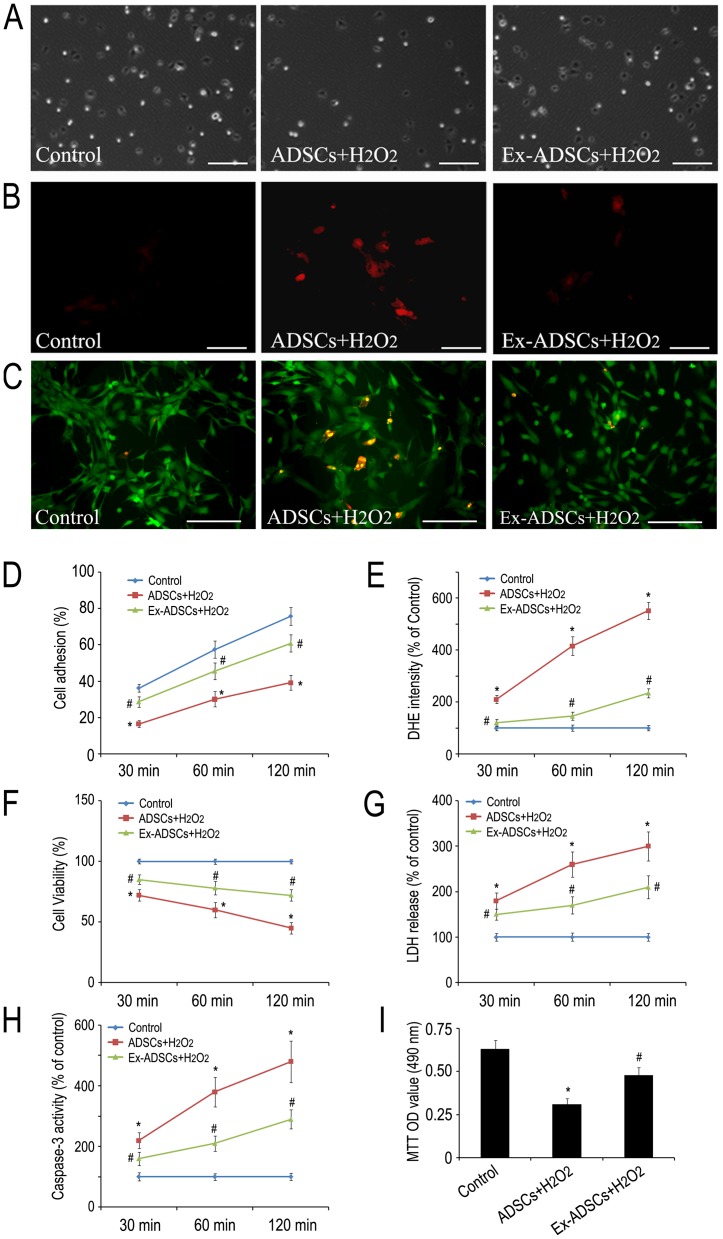
Reactive oxygen species (ROS), which were largely generated after myocardial ischemia, severely impaired the adhesion and survival of transplanted stem cells. In this study, we aimed to determine whether Exendin-4 pretreatment could improve the adhesion and therapeutic efficacy of transplanted adipose derived stem cells (ADSCs) in ischemic myocardium. In vitro, H2O2 was used to provide ROS environments, in which ADSCs pretreated with Exendin-4 were incubated. ADSCs without pretreatment were used as control. Then, cell adhesion and viability were analyzed with time. Compared with control ADSCs, Exendin-4 treatment significantly increased the adhesion of ADSCs in ROS environment, while reduced intracellular ROS and cell injury as determined by dihydroethidium (DHE) staining live/Dead staining, lactate dehydrogenase-release assay and MTT assay. Western Blotting demonstrated that ROS significantly decreased the expression of adhesion-related integrins and integrin-related focal adhesion proteins, which were significantly reversed by Exendin-4 pretreatment and followed by decreases in caspase-3, indicating that Exendin-4 may facilitate cell survival through enhanced adhesion. In vivo, myocardial infarction (MI) was induced by the left anterior descending artery ligation in SD rats. Autologous ADSCs with or without Exendin-4 pretreatment were injected into the border area of infarcted hearts, respectively. Multi-techniques were used to assess the beneficial effects after transplantation. Longitudinal bioluminescence imaging and histological staining revealed that Exendin-4 pretreatment enhanced the survival and differentiation of engrafted ADSCs in ischemic myocardium, accompanied with significant benefits in cardiac function, matrix remodeling, and angiogenesis compared with non-pretreated ADSCs 4 weeks post-transplantation. In conclusion, transplantation of Exendin-4 pretreated ADSCs significantly improved cardiac performance and can be an innovative approach in the clinical perspective.
活性氧(ROS)在心肌缺血后大量产生,严重损害移植干细胞的黏附及存活。在本研究中,我们旨在确定艾塞那肽-4预处理是否能改善移植的脂肪来源干细胞(ADSCs)在缺血心肌中的黏附及治疗效果。在体外,使用过氧化氢(H₂O₂)营造ROS环境,将经艾塞那肽-4预处理的ADSCs置于其中孵育。未经预处理的ADSCs用作对照。然后,随时间分析细胞黏附及活力。与对照ADSCs相比,艾塞那肽-4处理显著增加了ADSCs在ROS环境中的黏附,同时通过二氢乙锭(DHE)染色、活/死染色、乳酸脱氢酶释放测定及MTT测定发现细胞内ROS减少且细胞损伤减轻。蛋白质免疫印迹表明,ROS显著降低黏附相关整合素及整合素相关黏着斑蛋白的表达,而艾塞那肽-4预处理可显著逆转这种降低,随后半胱天冬酶-3表达降低,这表明艾塞那肽-4可能通过增强黏附促进细胞存活。在体内,通过结扎SD大鼠左前降支诱导心肌梗死(MI)。分别将经或未经艾塞那肽-4预处理的自体ADSCs注入梗死心脏的边缘区域。采用多种技术评估移植后的有益效果。纵向生物发光成像及组织学染色显示,与移植后4周未预处理的ADSCs相比,艾塞那肽-4预处理增强了植入的ADSCs在缺血心肌中的存活及分化,并在心脏功能、基质重塑及血管生成方面带来显著益处。总之,移植经艾塞那肽-4预处理的ADSCs显著改善心脏功能,从临床角度来看可能是一种创新方法。