Cantais Aymeric, Mory Olivier, Pillet Sylvie, Verhoeven Paul O, Bonneau Julie, Patural Hugues, Pozzetto Bruno
Department of Pediatric Emergency, University-Hospital of Saint-Etienne, CHU de Saint-Etienne, 42055 Saint-Etienne Cedex 02, France.
Groupe Immunité des Muqueuses et Agents Pathogènes, EA3064, Faculty of Medicine of Saint-Etienne, University of Lyon, 42023 Saint-Etienne Cedex 02, France.
J Clin Virol. 2014 Aug;60(4):402-7. doi: 10.1016/j.jcv.2014.05.006. Epub 2014 May 22.
The management of children with community-acquired pneumonia (CAP) is largely influenced by the development of new molecular diagnostic tests that allow the simultaneous detection of a wide range of pathogens.
Evaluation of a diagnostic approach including multiplex PCR assays for revisiting the epidemiology and etiology of CAP in children at hospital.
Children of all ages consulting at the Emergency Department of the University hospital of Saint-Etienne, France, during the 2012-2013 winter period were included. In addition to bacterial cultures, the following pathogens were detected using biplex commercially-available rt-PCR tests: adenovirus, respiratory syncytial virus, human metapneumovirus, bocavirus, rhinovirus/enterovirus, coronavirus, influenza viruses A and B, parainfluenza viruses, Mycoplasma pneumoniae and Chlamydophila pneumonia.
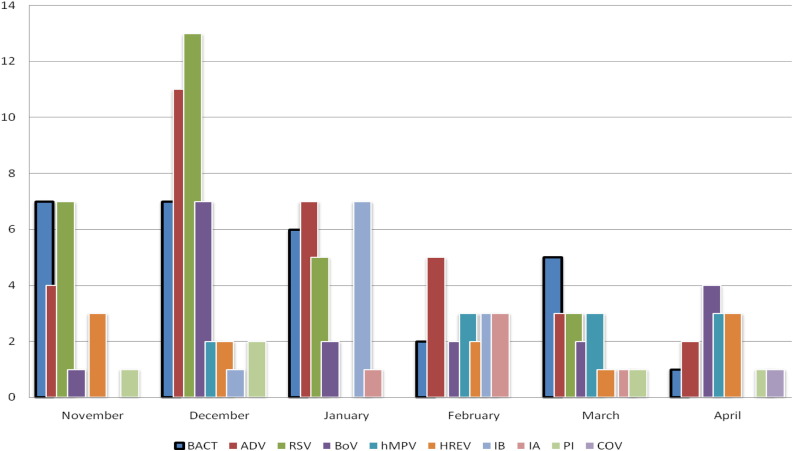
From 85 patients with CAP, at least one pathogen was identified in 81 cases (95.3%), including 4 bacterial exclusive infections (4.7%), 53 viral exclusive infections (62.4%) and 24 mixed infections (28.2%). Coinfection by at least two viruses was observed in 37 cases (43.5%). Mean age was higher in the case of documented bacterial infection (P<0.05). In the subgroup of viral exclusive infection, the mean age of severe cases was 2.0 years vs 3.8 years in mild and moderate cases (P<0.05).
These findings highlight the huge proportion of CAP of viral origin, the high number of co-infection by multiple viruses and the low number of bacterial CAP, notably in children under 5 years, and address the need to re-evaluate the indications of empiric antimicrobial treatment in this age group.
社区获得性肺炎(CAP)患儿的管理很大程度上受到新型分子诊断检测技术发展的影响,这些技术能够同时检测多种病原体。
评估一种诊断方法,包括多重聚合酶链反应(PCR)检测,以重新审视医院中儿童CAP的流行病学和病因。
纳入2012 - 2013年冬季在法国圣艾蒂安大学医院急诊科就诊的各年龄段儿童。除细菌培养外,使用商用双靶点逆转录PCR检测法检测以下病原体:腺病毒、呼吸道合胞病毒、人偏肺病毒、博卡病毒、鼻病毒/肠道病毒、冠状病毒、甲型和乙型流感病毒、副流感病毒、肺炎支原体和肺炎衣原体。
85例CAP患儿中,81例(95.3%)至少鉴定出一种病原体,包括4例单纯细菌感染(4.7%)、53例单纯病毒感染(62.4%)和24例混合感染(28.2%)。37例(43.5%)观察到至少两种病毒合并感染。确诊细菌感染患儿的平均年龄较高(P<0.05)。在单纯病毒感染亚组中,重症病例的平均年龄为2.0岁,而轻症和中症病例为3.8岁(P<0.05)。
这些发现突出了病毒源性CAP的巨大比例、多种病毒合并感染的高发生率以及细菌所致CAP的低发生率,尤其是在5岁以下儿童中,并表明需要重新评估该年龄组经验性抗菌治疗的指征。