Magalhaes Isabelle, Eriksson Mikael, Linde Charlotte, Muhammad Rashid, Rane Lalit, Ambati Aditya, Axelsson-Robertson Rebecca, Khalaj Bahareh, Alvarez-Corrales Nancy, Lapini Giulia, Montomoli Emanuele, Linde Annika, Pedersen Nancy L, Maeurer Markus
Center for allogeneic stem cell transplantation, Karolinska University Hospital, Stockholm, Sweden.
BMC Infect Dis. 2014 Jun 11;14:319. doi: 10.1186/1471-2334-14-319.
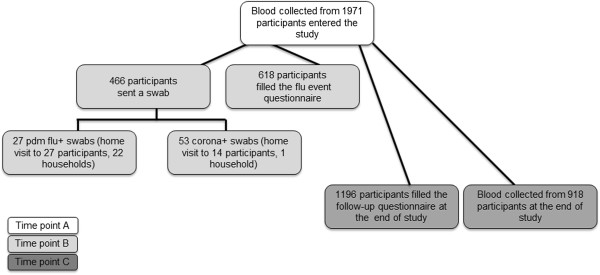
Previous exposures to flu and subsequent immune responses may impact on 2009/2010 pandemic flu vaccine responses and clinical symptoms upon infection with the 2009 pandemic H1N1 influenza strain. Qualitative and quantitative differences in humoral and cellular immune responses associated with the flu vaccination in 2009/2010 (pandemic H1N1 vaccine) and natural infection have not yet been described in detail. We designed a longitudinal study to examine influenza- (flu-) specific immune responses and the association between pre-existing flu responses, symptoms of influenza-like illness (ILI), impact of pandemic flu infection, and pandemic flu vaccination in a cohort of 2,040 individuals in Sweden in 2009-2010.
Cellular flu-specific immune responses were assessed by whole-blood antigen stimulation assay, and humoral responses by a single radial hemolysis test.
Previous seasonal flu vaccination was associated with significantly lower flu-specific IFN-γ responses (using a whole-blood assay) at study entry. Pandemic flu vaccination induced long-lived T-cell responses (measured by IFN-γ production) to influenza A strains, influenza B strains, and the matrix (M1) antigen. In contrast, individuals with pandemic flu infection (PCR positive) exhibited increased flu-specific T-cell responses shortly after onset of ILI symptoms but the immune response decreased after the flu season (spring 2010). We identified non-pandemic-flu vaccinated participants without ILI symptoms who showed an IFN-γ production profile similar to pandemic-flu infected participants, suggesting exposure without experiencing clinical symptoms.
Strong and long-lived flu-M1 specific immune responses, defined by IFN-γ production, in individuals after vaccination suggest that M1-responses may contribute to protective cellular immune responses. Silent flu infections appeared to be frequent in 2009/2010. The pandemic flu vaccine induced qualitatively and quantitatively different humoral and cellular immune responses as compared to infection with the 2009 H1N1 pandemic H1N1 influenza strain.
既往接触流感及后续免疫反应可能会影响2009/2010年大流行性流感疫苗的反应以及感染2009年大流行性H1N1流感毒株后的临床症状。2009/2010年(大流行性H1N1疫苗)流感疫苗接种与自然感染相关的体液和细胞免疫反应在质和量上的差异尚未得到详细描述。我们设计了一项纵向研究,以检查瑞典2009 - 2010年一组2040名个体中流感特异性免疫反应以及既往流感反应、流感样疾病(ILI)症状、大流行性流感感染影响与大流行性流感疫苗接种之间的关联。
通过全血抗原刺激试验评估细胞流感特异性免疫反应,通过单向辐射溶血试验评估体液反应。
既往季节性流感疫苗接种与研究开始时显著较低的流感特异性IFN-γ反应(使用全血检测)相关。大流行性流感疫苗接种诱导了对甲型流感毒株、乙型流感毒株和基质(M1)抗原的长期T细胞反应(通过IFN-γ产生来衡量)。相比之下,大流行性流感感染(PCR阳性)个体在ILI症状出现后不久表现出流感特异性T细胞反应增加,但在流感季节(2010年春季)后免疫反应下降。我们确定了未接种非大流行性流感疫苗且无ILI症状的参与者,其IFN-γ产生情况与大流行性流感感染参与者相似,表明存在无症状接触。
接种疫苗后个体中由IFN-γ产生所定义的强烈且持久的流感-M1特异性免疫反应表明,M1反应可能有助于保护性细胞免疫反应。2009/2010年无症状流感感染似乎很常见。与感染2009年H1N1大流行性H1N1流感毒株相比,大流行性流感疫苗诱导的体液和细胞免疫反应在质和量上均有所不同。