Biodefence Centre, Ministry of Defence, Singapore, Singapore.
PLoS One. 2011;6(10):e26572. doi: 10.1371/journal.pone.0026572. Epub 2011 Oct 28.
Limited information is available about pandemic H1N1-2009 influenza vaccine effectiveness in tropical communities. We studied the effectiveness of a pandemic H1N1 vaccination program in reducing influenza cases in Singapore.
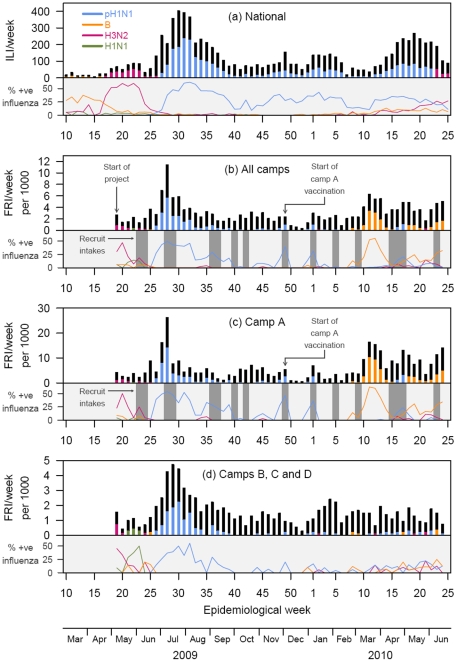
A surveillance study was conducted among military personnel presenting with febrile respiratory illness from mid-2009 to mid-2010. Consenting individuals underwent nasal washes, which were tested with RT-PCR and subtyped. A vaccination program (inactivated monovalent Panvax H1N1-2009 vaccine) was carried out among recruits. A Bayesian hierarchical model was used to quantify relative risks in the pre- and post-vaccination periods. An autoregressive generalised linear model (GLM) was developed to minimise confounding.
Of 2858 participants, 437 (15.3%), 60 (2.1%), and 273 (9.6%) had pandemic H1N1, H3N2, and influenza B. The ratio of relative risks for pandemic H1N1 infection before and after vaccination for the recruit camp relative to other camps was 0.14 (0.016,0.49); for H3N2, 0.44 (0.035,1.8); and for influenza B, 18 (0.77,89). Using the GLM for the recruit camp, post-vaccination weekly cases decreased by 54% (37%,67%, p<0.001) from that expected without vaccination; influenza B increased by 66 times (9-479 times, p<0.001); with no statistical difference for H3N2 (p = 0.54).
Pandemic vaccination reduced H1N1-2009 disease burden among military recruits. Routine seasonal influenza vaccination should be considered.
关于大流行 H1N1-2009 流感疫苗在热带社区的效果,信息有限。我们研究了大流行 H1N1 疫苗接种计划在减少新加坡流感病例中的效果。
对 2009 年中至 2010 年中出现发热性呼吸道疾病的军人进行监测研究。同意参与的个体进行鼻冲洗,并用 RT-PCR 进行检测和亚型分析。对新兵开展疫苗接种计划(灭活单价 Panvax H1N1-2009 疫苗)。采用贝叶斯分层模型来量化接种前后的相对风险。采用自回归广义线性模型(GLM)来最小化混杂因素。
在 2858 名参与者中,437(15.3%)、60(2.1%)和 273(9.6%)人感染了大流行 H1N1、H3N2 和 B 型流感。相对于其他营地,新兵营接种前后大流行 H1N1 感染的相对风险比为 0.14(0.016,0.49);H3N2 为 0.44(0.035,1.8);B 型流感为 18(0.77,89)。使用新兵营的 GLM,接种疫苗后每周的病例数减少了 54%(37%,67%,p<0.001),比未接种疫苗时预期的减少了 54%;B 型流感增加了 66 倍(9-479 倍,p<0.001);H3N2 没有统计学差异(p=0.54)。
大流行疫苗接种降低了新兵中 H1N1-2009 疾病负担。应考虑常规季节性流感疫苗接种。