Feng Jie, Hong Lichuan, Wu Yonggang, Li Chuzhong, Wan Hong, Li Guilin, Sun Yilin, Yu Shenyuan, Chittiboina Prashant, Montgomery Blake, Zhuang Zhengping, Zhang Yazhuo
Beijing Neurosurgical Institute, Capital Medical University, Beijing, 100050, China,
J Neurooncol. 2014 Sep;119(2):307-15. doi: 10.1007/s11060-014-1479-1. Epub 2014 Jun 11.
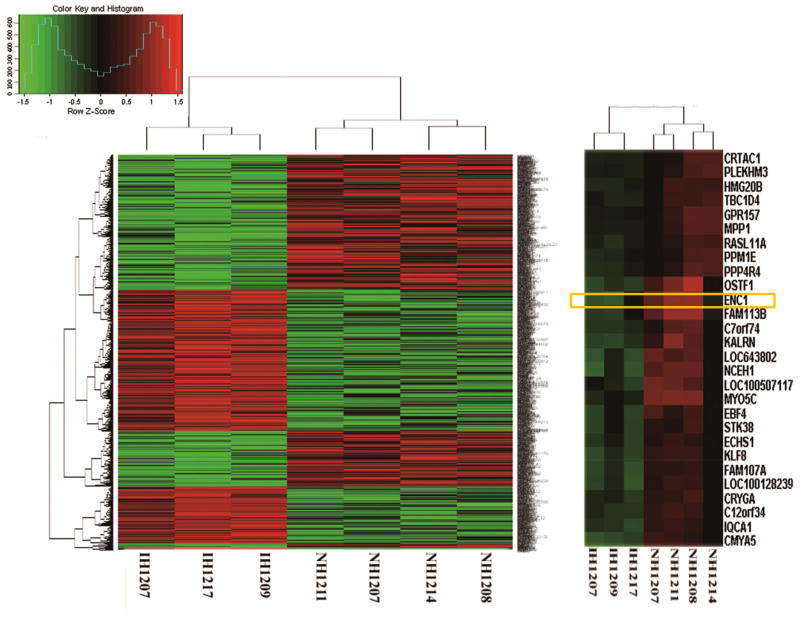
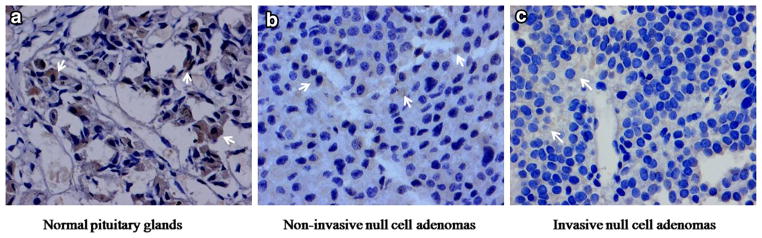
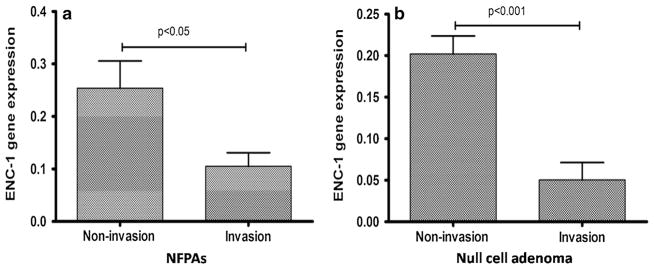
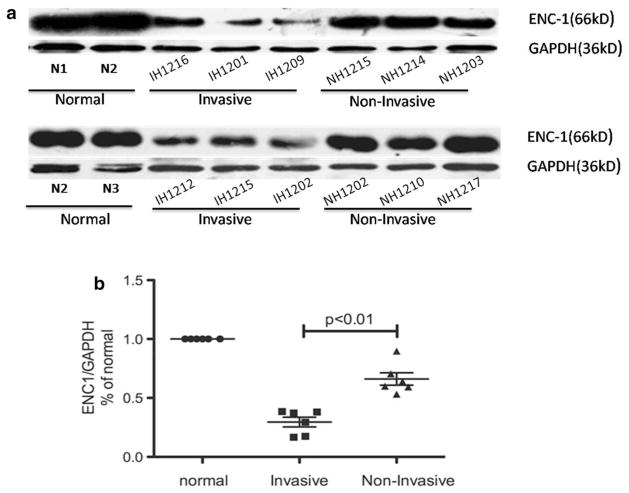
Non-functioning pituitary adenomas (NFPAs) may be locally invasive. Surgery is a treatment option, but unlike the case for functional pituitary adenomas, there are almost no drug treatments available for NFPAs. Markers of invasiveness are needed to guide therapeutic decision-making and identify potential adjuvant drugs. Owing to the highly heterogeneous nature of NFPAs, little is known regarding the subtype-specific gene expression profiles associated with invasiveness. To identify important biomarkers of invasiveness, we selected 23 null cell adenomas and 20 oncocytomas. These tumors were classified as invasive or non-invasive adenomas based on magnetic resonance imaging, pathology slides and surgical findings. Firstly, we observed that there were significant differences in expression between invasive (n = 3) and non-invasive (n = 4) adenomas by gene expression microarray. A total of 1,188 genes were differentially expressed in the invasive and non-invasive adenomas. Among these 1,188 genes, 578 were upregulated and 610 were downregulated in invasive adenomas. Secondly, the expression of ENC1, which displayed the significant alterations, was further confirmed by qRT-PCR and Western blot analysis in all 43 tumor samples and three normal pituitary glands. Low levels of ENC1 were found in tumor samples, while high levels were detected in normal pituitary glands. Interestingly, the ENC1 expression level was low in invasive null cell adenomas compared with non-invasive adenomas, but this relationship was not observed in invasive oncocytomas. Immunohistochemistry also demonstrated that the staining of ENC1 was different between invasive and non-invasive null cell adenomas. In addition, bioinformatics studies, including gene ontology and protein interaction analyses, were also performed to better understand the critical role of ENC1 in the development and progression of null cell adenomas and oncocytomas. Consequently, ENC1 may be an important biomarker for null cell adenomas and oncocytomas, and it is specific to invasive null cell adenomas.
无功能垂体腺瘤(NFPAs)可能具有局部侵袭性。手术是一种治疗选择,但与功能性垂体腺瘤不同,NFPAs几乎没有可用的药物治疗方法。需要侵袭性标志物来指导治疗决策并识别潜在的辅助药物。由于NFPAs具有高度异质性,关于与侵袭性相关的亚型特异性基因表达谱知之甚少。为了确定侵袭性的重要生物标志物,我们选取了23例无功能细胞腺瘤和20例嗜酸细胞瘤。根据磁共振成像、病理切片和手术结果,将这些肿瘤分为侵袭性或非侵袭性腺瘤。首先,通过基因表达微阵列观察到侵袭性(n = 3)和非侵袭性(n = 4)腺瘤之间的表达存在显著差异。在侵袭性和非侵袭性腺瘤中共有1188个基因差异表达。在这1188个基因中,侵袭性腺瘤中有578个上调,610个下调。其次,通过qRT-PCR和蛋白质印迹分析在所有43个肿瘤样本和三个正常垂体中进一步证实了显示出显著变化的ENC1的表达。在肿瘤样本中发现ENC1水平较低,而在正常垂体中检测到高水平。有趣的是,与非侵袭性腺瘤相比,侵袭性无功能细胞腺瘤中ENC1表达水平较低,但在侵袭性嗜酸细胞瘤中未观察到这种关系。免疫组织化学也表明,侵袭性和非侵袭性无功能细胞腺瘤之间ENC1的染色不同。此外,还进行了包括基因本体论和蛋白质相互作用分析在内的生物信息学研究,以更好地了解ENC1在无功能细胞腺瘤和嗜酸细胞瘤的发生和发展中的关键作用。因此,ENC1可能是无功能细胞腺瘤和嗜酸细胞瘤的重要生物标志物,并且它对侵袭性无功能细胞腺瘤具有特异性。