Lacombe Otto Kischlat, Zuma Aline Araujo, da Silva Camila Cristina, de Souza Wanderley, Motta Maria Cristina M
Laboratório de Ultraestrutura Celular Hertha Meyer, Instituto de Biofísica Carlos Chagas Filho, Universidade Federal do Rio de Janeiro, 21491-590 Rio de Janeiro, RJ, Brazil.
J Negat Results Biomed. 2014 Jun 10;13(1):11. doi: 10.1186/1477-5751-13-11.
Trypanosoma cruzi is the etiological agent of Chagas' disease that is an endemic disease in Latin America and affects about 8 million people. This parasite belongs to the Trypanosomatidae family which contains a single mitochondrion with an enlarged region, named kinetoplast that harbors the mitochondrial DNA (kDNA). The kinetoplast and the nucleus present a great variety of essential enzymes involved in DNA replication and topology, including DNA topoisomerases. Such enzymes are considered to be promising molecular targets for cancer treatment and for antiparasitic chemotherapy. In this work, the proliferation and ultrastructure of T. cruzi epimastigotes were evaluated after treatment with eukaryotic topoisomerase I inhibitors, such as topotecan and irinotecan, as well as with dual inhibitors (compounds that block eukaryotic topoisomerase I and topoisomerase II activities), such as baicalein, luteolin and evodiamine. Previous studies have shown that such inhibitors were able to block the growth of tumor cells, however most of them have never been tested on trypanosomatids.
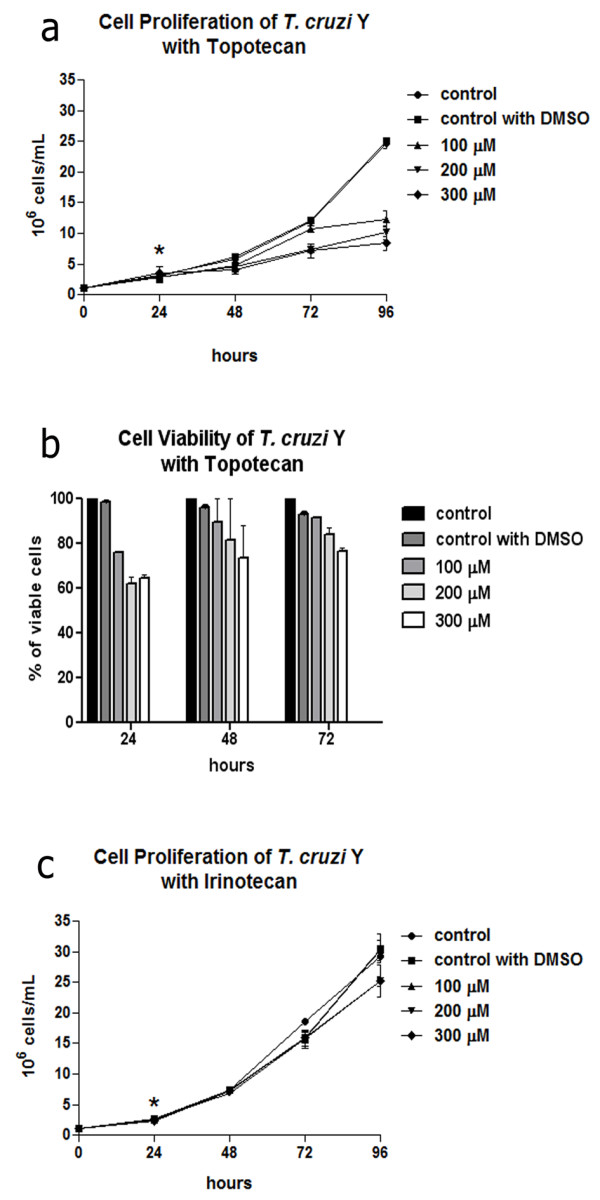
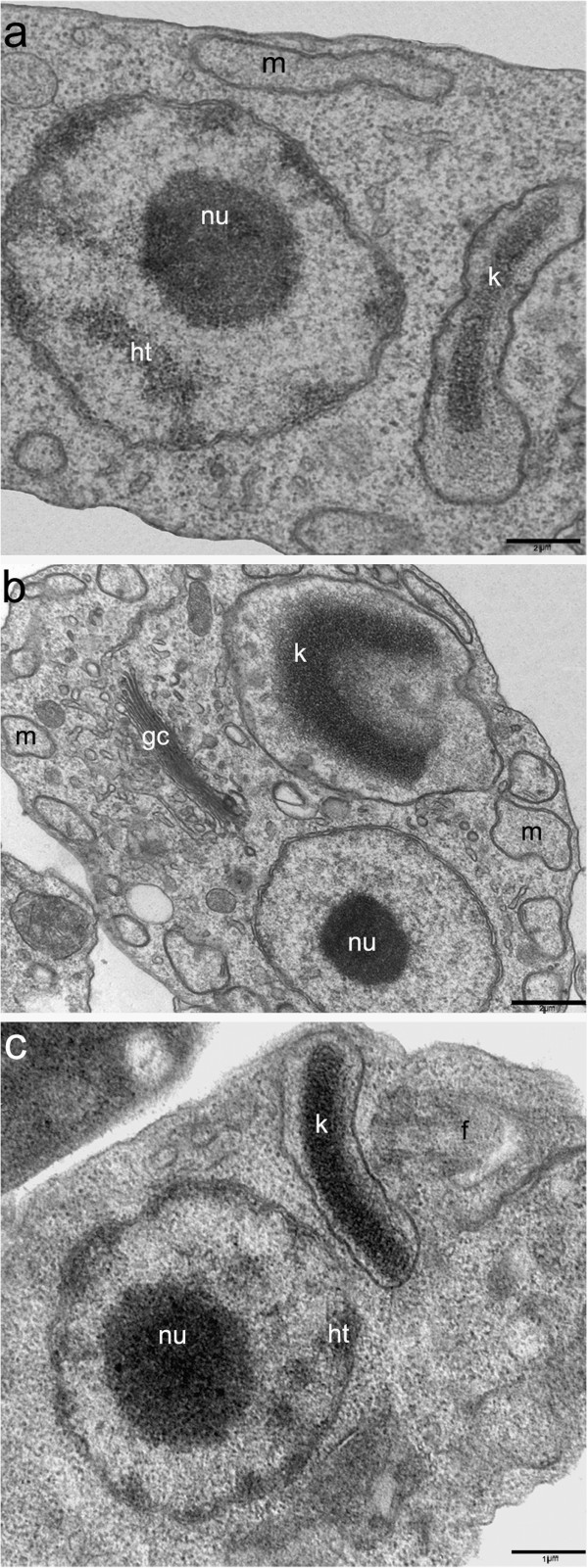
Considering the effects of topoisomerase I inhibitors, our results showed that topotecan decreased cell proliferation and caused unpacking of nuclear heterochromatin, however none of these alterations were observed after treatment with irinotecan. The dual inhibitors baicalein and evodiamine decreased cell growth; however the nuclear and kinetoplast ultrastructures were not affected.
Taken together, our data showed that camptothecin is more efficient than its derivatives in decreasing T. cruzi proliferation. Furthermore, we conclude that drugs pertaining to a certain class of topoisomerase inhibitors may present different efficiencies as chemotherapeutical agents.
克氏锥虫是恰加斯病的病原体,恰加斯病是拉丁美洲的一种地方病,影响约800万人。这种寄生虫属于锥虫科,该科包含一个单一的线粒体,其有一个扩大的区域,称为动质体,其中含有线粒体DNA(kDNA)。动质体和细胞核存在多种参与DNA复制和拓扑结构的必需酶,包括DNA拓扑异构酶。这些酶被认为是癌症治疗和抗寄生虫化疗的有前景的分子靶点。在这项工作中,在用真核拓扑异构酶I抑制剂(如拓扑替康和伊立替康)以及双重抑制剂(阻断真核拓扑异构酶I和拓扑异构酶II活性的化合物)(如黄芩素、木犀草素和吴茱萸碱)处理后,评估了克氏锥虫前鞭毛体的增殖和超微结构。先前的研究表明,这些抑制剂能够阻断肿瘤细胞的生长,然而其中大多数从未在锥虫类上进行过测试。
考虑到拓扑异构酶I抑制剂的作用,我们的结果表明,拓扑替康降低了细胞增殖并导致核异染色质解聚,然而在用伊立替康处理后未观察到这些改变。双重抑制剂黄芩素和吴茱萸碱降低了细胞生长;然而核和动质体超微结构未受影响。
综上所述,我们的数据表明喜树碱在降低克氏锥虫增殖方面比其衍生物更有效。此外,我们得出结论,属于某一类拓扑异构酶抑制剂的药物作为化疗药物可能具有不同的效率。