Kim Christopher, Gao Yu-Tang, Xiang Yong-Bing, Barone-Adesi Francesco, Zhang Yawei, Hosgood H Dean, Ma Shuangge, Shu Xiao-ou, Ji Bu-Tian, Chow Wong-Ho, Seow Wei Jie, Bassig Bryan, Cai Qiuyin, Zheng Wei, Rothman Nathaniel, Lan Qing
Division of Cancer Epidemiology and Genetics, National Cancer Institute, National Institutes of Health, Bethesda, MD; School of Public Health, Yale University, New Haven, CT.
Int J Cancer. 2015 Feb 1;136(3):632-8. doi: 10.1002/ijc.29020. Epub 2014 Jun 28.
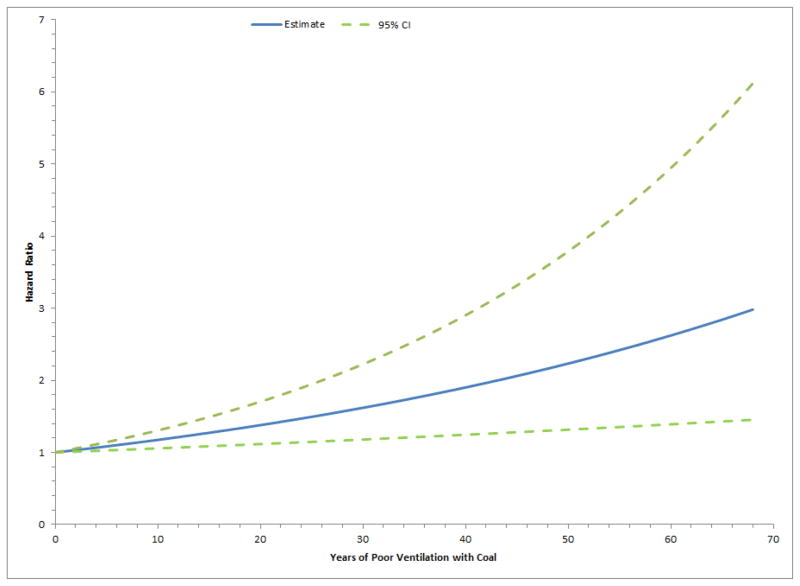
Indoor air pollution (IAP) caused by cooking has been associated with lung cancer risk in retrospective case-control studies in developing and rural countries. We report the association of cooking conditions, fuel use, oil use, and risk of lung cancer in a developed urban population in a prospective cohort of women in Shanghai. A total of 71,320 never smoking women were followed from 1996 through 2009 and 429 incident lung cancer cases were identified. Questionnaires collected information on household living and cooking practices for the three most recent residences and utilization of cooking fuel and oil, and ventilation conditions. Cox proportional hazards regression estimated the association for kitchen ventilation conditions, cooking fuels, and use of cooking oils for the risk of lung cancer by hazard ratios (HR) with 95% confidence intervals (95% CI). Ever poor kitchen ventilation was associated with a 49% increase in lung cancer risk (HR: 1.49; 95% CI: 1.15-1.95) compared to never poor ventilation. Ever use of coal was not significantly associated. However, ever coal use with poor ventilation (HR: 1.69; 95% CI: 1.22-2.35) and 20 or more years of using coal with poor ventilation (HR: 2.03; 95% CI: 1.35-3.05) was significantly associated compared to no exposure to coal or poor ventilation. Cooking oil use was not significantly associated. These results demonstrate that IAP from poor ventilation of coal combustion increases the risk of lung cancer and is an important public health issue in cities across China where people may have lived in homes with inadequate kitchen ventilation.
在发展中国家和农村地区开展的回顾性病例对照研究中,烹饪导致的室内空气污染(IAP)与肺癌风险相关。我们报告了在上海一项针对女性的前瞻性队列研究中,发达城市人群的烹饪条件、燃料使用、食用油使用与肺癌风险之间的关联。从1996年至2009年,对总共71320名从不吸烟的女性进行了随访,共确定了429例肺癌新发病例。通过问卷调查收集了她们最近三处住所的家庭生活和烹饪习惯、烹饪燃料和食用油的使用情况以及通风条件等信息。Cox比例风险回归分析通过风险比(HR)及95%置信区间(95%CI)估计了厨房通风条件、烹饪燃料和食用油使用与肺癌风险之间的关联。与通风状况良好的情况相比,厨房通风状况曾经较差的女性患肺癌的风险增加了49%(HR:1.49;95%CI:1.15 - 1.95)。曾经使用煤炭与肺癌风险无显著关联。然而,与未接触煤炭或通风状况良好的情况相比,曾经使用煤炭且通风状况较差(HR:1.69;95%CI:1.22 - 2.35)以及使用煤炭且通风状况较差达20年或更长时间(HR:2.03;95%CI:1.35 - 3.05)与肺癌风险显著相关。食用油的使用与肺癌风险无显著关联。这些结果表明,煤炭燃烧通风不良导致的室内空气污染会增加肺癌风险,在中国各地城市,这是一个重要的公共卫生问题,因为人们居住的房屋厨房通风可能不足。